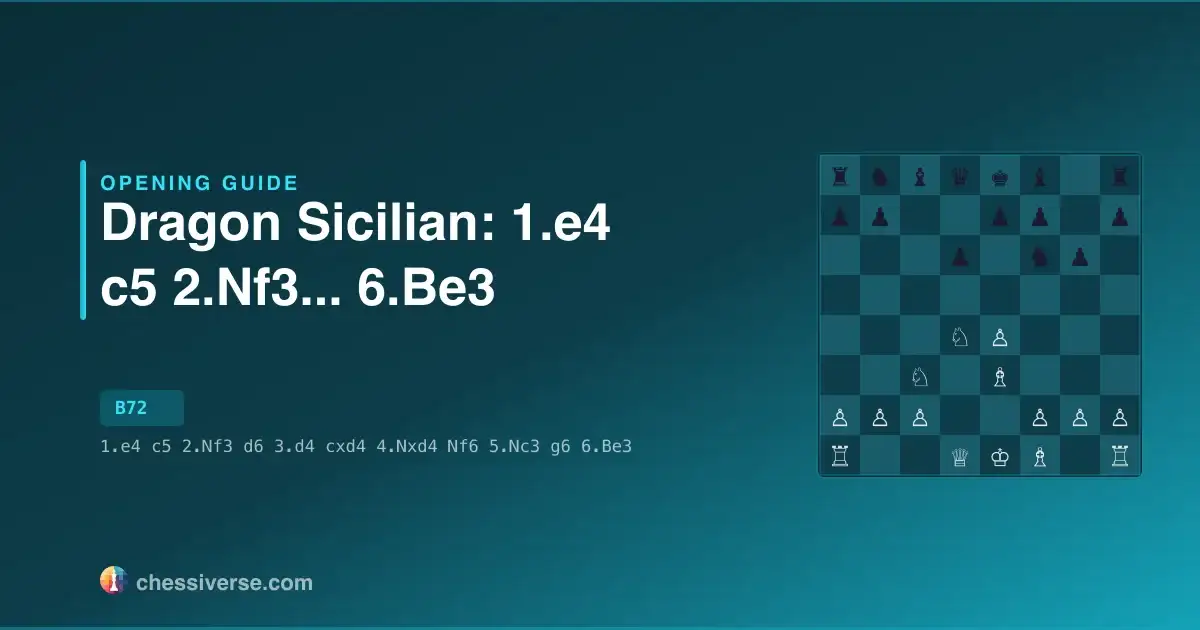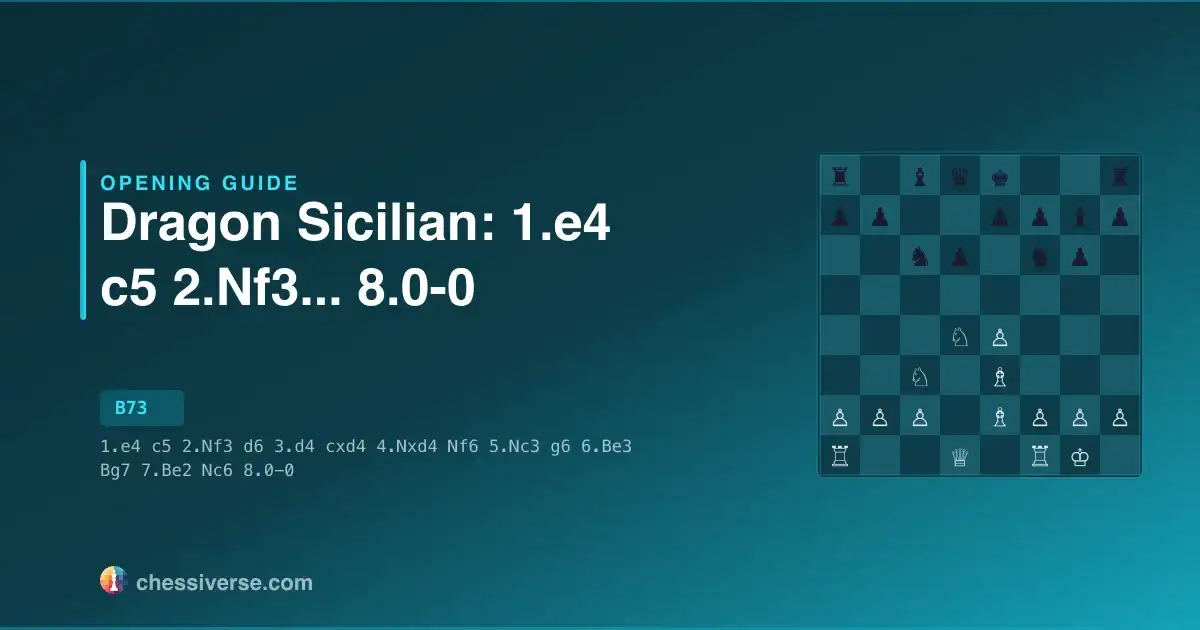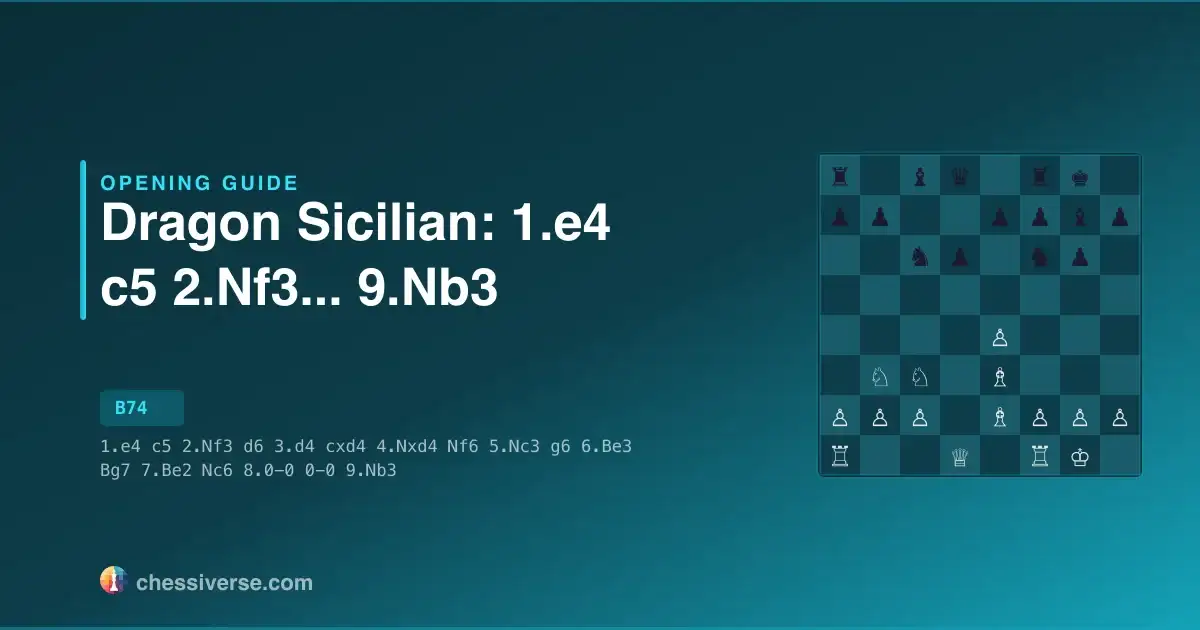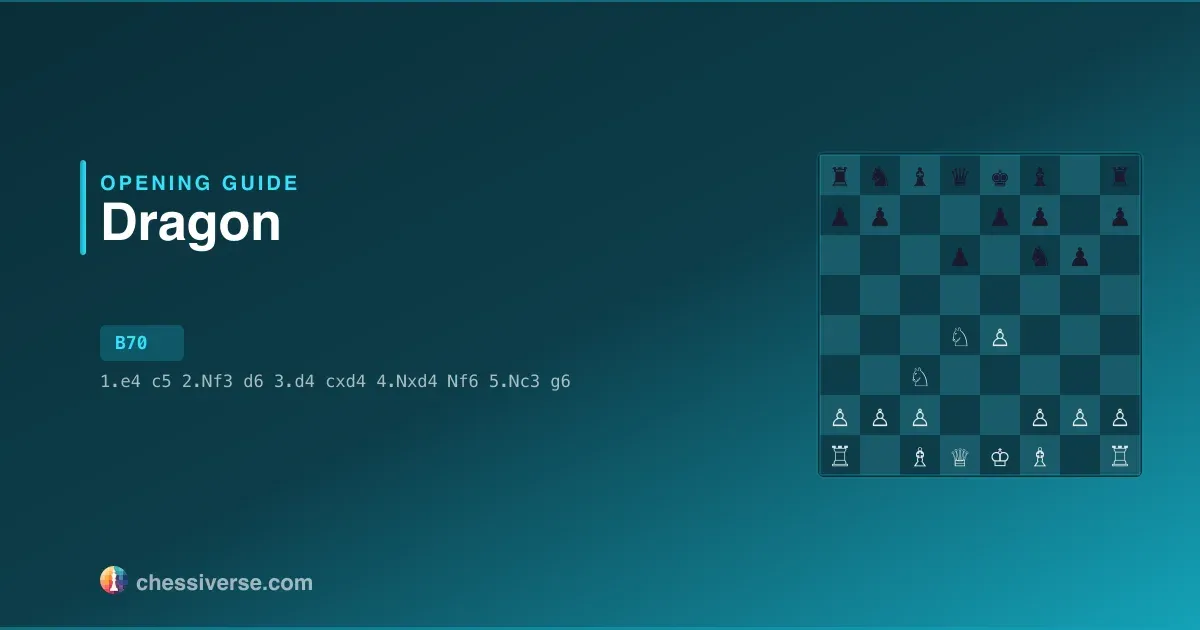
The Sicilian Defense: Dragon Variation arises after 1.e4 c5 2.Nf3 d6 3.d4 cxd4 4.Nxd4 Nf6 5.Nc3 g6 and falls under ECO code B70. The move 5...g6 launches one of the most celebrated and theoretically dense variations in all of chess. Though the Dragon's strategic themes are straightforward in outline, the sheer depth of established theory means that a single inaccuracy against a well-prepared opponent can prove decisive. Black's plan is to fianchetto the dark-squared bishop on g7, from where it exerts powerful pressure on the center and supports queenside counterplay. The trade-off is that 5...g6 compromises Black's kingside pawn cover, inviting White to mount a kingside offensive. In the most common scenarios, White castles queenside and advances kingside pawns to tear open Black's king position, while Black castles short and directs counterattacking resources at the center and the queenside. This mutual assault on opposite flanks leaves no room for slow maneuvering — sharp tactics dominate throughout. As in all mainline Sicilian structures, Black has exchanged the c-pawn for White's d-pawn, undermining White's center and opening the c-file, while White compensates with faster development and attacking momentum. With 6.8 million Lichess games across all rating levels, it is a well-established opening choice.
- In the Yugoslav Attack both sides castle on opposite wings and race pawn storms at each other's kings.
- Black's whole game flows through the fianchettoed g7-bishop on the long diagonal plus counterplay down the half-open c-file.
- A signature resource is the exchange sacrifice on c3, wrecking White's queenside pawns.
History and Notable Players
It arises from the Sicilian Defense (2.Nf3). Among the most prolific practitioners on the White side are Vlastimil Jansa (57 games), Oleg Korneev (45 games), Petar Popovic (41 games). On the Black side, notable exponents include Evarth Kahn (105 games), Miso Cebalo (102 games), Chris G Ward (96 games).
Louis Paulsen worked out the modern Dragon around 1880, Henry Bird played it often that decade, and it won broad acceptance around 1900 through Harry Nelson Pillsbury. It later starred in the 1974 Karpov-Korchnoi Candidates final, and Kasparov scored two wins and a draw with it against Anand in their 1995 world title match.
Named after: Named for the constellation Draco: Fyodor Dus-Chotimirsky, a master and amateur astronomer, said Black's kingside pawn chain reminded him of its stars.
Notable players: Garry Kasparov, Veselin Topalov, Tony Miles, Eduard Gufeld
Dus-Chotimirsky claimed he coined the name back in 1901, yet the earliest printed reference historians have traced is a 1914 issue of the Wiener Schachzeitung.
Statistics
Based on 6.8 million Lichess games across all rating levels:
- White wins: 46.2%
- Black wins: 48.8%
- Draws: 5%
Interestingly, Black scores well in this opening, suggesting it offers strong counterplay.
Main Lines and Variations
After 1.e4 c5 2.Nf3 d6 3.d4 cxd4 4.Nxd4 Nf6 5.Nc3 g6, the main continuations include:
Each of these lines leads to distinct types of positions and requires its own understanding of the resulting pawn structures and piece placements.
Common Mistakes to Avoid
- Ignoring the opponent's kingside attack: In many Sicilian lines, White will castle queenside and push pawns toward your king. If you don't create counterplay on the queenside or in the center, White's attack will arrive first.
Practice on Chessiverse
The best way to learn the Sicilian Defense: Dragon Variation is through practice. On Chessiverse, you can play chess against computer opponents that specialize in this opening. Our AI bots range from beginner to grandmaster level, each with unique playing styles — from aggressive attackers to solid defenders. Choose a bot that matches your rating and work your way up as you master the opening's key ideas.
Performance Across Rating Levels
How well the Sicilian Defense: Dragon Variation works depends on what level you're playing at. The 1200 bracket has 257,743 games (0.04% of all games at that level); White wins 46.9%, Black 49.2%, 3.9% are drawn. At 1800 the opening surfaces in 0.22% of games; White wins 46%, Black 49.3%, draws 4.7%. Among 2500-rated players the line appears in 0.58% of games and draws spike to 8.9%, indicating tight preparation.
Time Control Patterns
Look at the same opening across time controls and blitz stands out. In bullet, it appears in 0.11% of games (2,947,938); White wins 46.5%. Blitz shows 0.16% adoption across 5,685,263 games, White scoring 46.2%. In rapid, the share rises to 0.10% — 1,158,393 games, White 45.8%.
Move Diversity and Theory Depth
What players actually play after the opening moves depends heavily on rating. At 1200 Elo (257,743 games), the top reply is Bg5, played 24.3% of the time. Four other moves each take at least 5% of games, and the top three moves account for 60% of games. Entropy: 2.99. By 2500 (79,740 games), Be3 takes over as the top reply at 64.2%; only three other moves still reach 5% and the top three moves account for 79.7% of games. Entropy drops to 1.97. The narrowing is significant — strong players consolidate around a small set of best moves, while amateurs scatter across many plausible-looking options.
Historical Trends
Long-term, the trajectory of this opening is informative. Adoption peaked in 2020 at 0.20% (1,154,152 games). By 2025 it sits at 0.11%, 46% below the peak but still 19% above its 2013 level, so the line is up over the full period despite easing from the high.