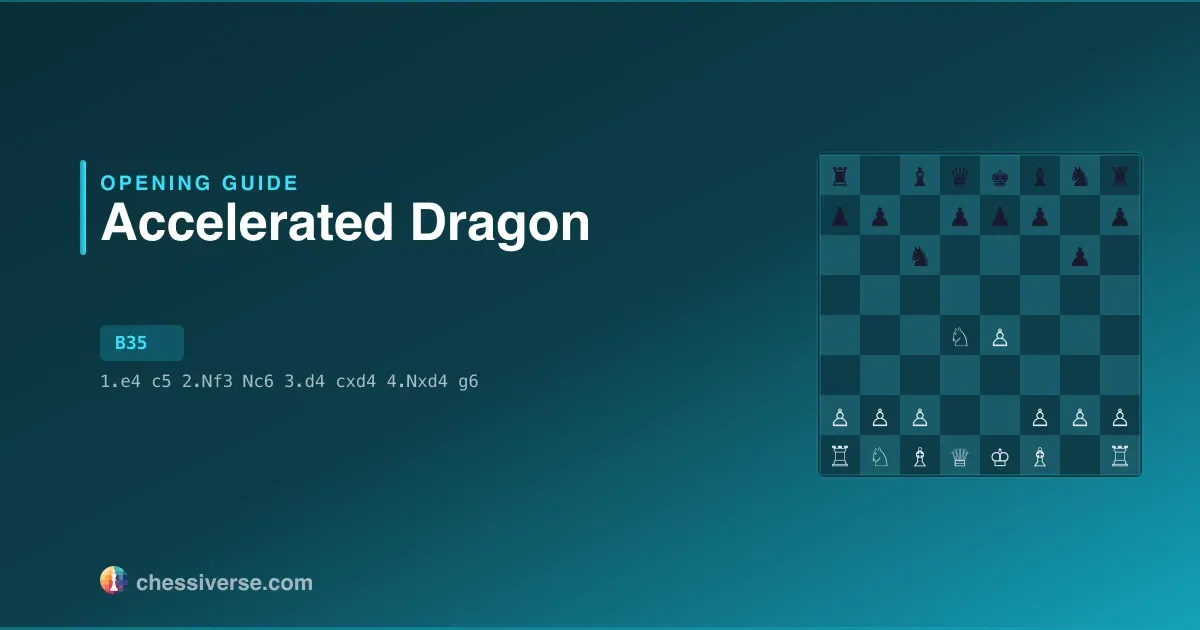
The Sicilian Defense: Accelerated Dragon arises after 1.e4 c5 2.Nf3 Nc6 3.d4 cxd4 4.Nxd4 g6 and falls under ECO code B34. Black aims for a Dragon Sicilian setup with ...Bg7, ...Nf6, and ...O-O, but skips the usual ...d6, hence the name "Accelerated." By omitting ...d6, Black saves a tempo and preserves the option of advancing ...d5 in a single move. This is particularly significant because it neutralizes the Yugoslav Attack, the most dangerous weapon against the standard Dragon: Black can achieve ...d5 a move sooner, opening the position before White has time to castle long and set up a battery on the d-file. The downside is that White gains access to 5. c4, a continuation the regular Dragon move order prevents. The Modern Variation, 5. Nc3, is a popular choice; because the Yugoslav-style attack (5...Bg7 6. Be3 Nf6 7. f3!?) carries less sting when Black can respond with 7...O-O 8. Qd2 d5! equalizing, the modern approach instead features 7. Bc4. The most challenging line for Black is 5. c4, the Maroczy Bind, where White's two pawns lock down the d5 square, making the ...d5 break extremely difficult and steering the game toward a slower, positional struggle. With 10.5 million Lichess games across all rating levels, it is a specialized opening choice.
- Black skips ...d6 so the freeing ...d5 break can come in one move; if White allows it, Black usually equalizes on the spot.
- Play is generally more positional than in most Sicilians, and Black sidesteps the fearsome Yugoslav Attack of the regular Dragon.
- The price is that White can play 5.c4, the Maroczy Bind, clamping down on d5 with extra space; Black responds with piece trades and breaks like ...b5.
History and Notable Players
It arises from the Sicilian Defense (2.Nf3). Among the most prolific practitioners on the White side are Jonny Hector (37 games), Janis Klovans (26 games), Manuel Apicella (23 games). On the Black side, notable exponents include Boris Savchenko (34 games), Gadir Guseinov (31 games), Gyozo V Forintos (31 games).
Named after: Called 'accelerated' because Black reaches the Dragon fianchetto without spending a move on ...d6, hoping to play ...d5 in a single step later.
After 7.Bc4 Qa5, the natural-looking 8.Qd2 already loses material to 8...Nxe4, leaving Black a healthy pawn up.
Statistics
Based on 10.5 million Lichess games across all rating levels:
- White wins: 46.6%
- Black wins: 48.3%
- Draws: 5.1%
The statistics show a roughly balanced opening where both sides have equal chances.
Main Lines and Variations
After 1.e4 c5 2.Nf3 Nc6 3.d4 cxd4 4.Nxd4 g6, the main continuations include:
- Sicilian Defense: Accelerated Dragon, Maróczy Bind
- Sicilian Defense: Accelerated Dragon, Modern Bc4 Variation
Each of these lines leads to distinct types of positions and requires its own understanding of the resulting pawn structures and piece placements.
Common Mistakes to Avoid
- Ignoring the opponent's kingside attack: In many Sicilian lines, White will castle queenside and push pawns toward your king. If you don't create counterplay on the queenside or in the center, White's attack will arrive first.
Practice on Chessiverse
The best way to learn the Sicilian Defense: Accelerated Dragon is through practice. On Chessiverse, you can play chess against computer opponents that specialize in this opening. Our AI bots range from beginner to grandmaster level, each with unique playing styles — from aggressive attackers to solid defenders. Choose a bot that matches your rating and work your way up as you master the opening's key ideas.
Performance Across Rating Levels
How well the Sicilian Defense: Accelerated Dragon works depends on what level you're playing at. Among 1200-rated players, it appears in 0.07% of games — 470,904 of them on record — with White winning 46.2% and Black 50.4%. By 1800, popularity is 0.37% and White's score is 47% to Black's 48%. Among 2500-rated players the line appears in 0.37% of games and draws spike to 11.3%, indicating tight preparation.
Time Control Patterns
Look at the same opening across time controls and blitz stands out. In bullet, it appears in 0.19% of games (5,077,153); White wins 47.1%. Blitz shows 0.24% adoption across 8,775,658 games, White scoring 46.7%. In rapid, the share rises to 0.15% — 1,704,694 games, White 46.1%.
Move Diversity and Theory Depth
Looking at move selection shows how forcing — or not — the position really is. At 1200 Elo (470,904 games), the top reply is Nxc6, played 40.1% of the time. Two other moves each take at least 5% of games, and the top three moves account for 82% of games. Entropy: 2.28. By 2500 (50,824 games), c4 takes over as the top reply at 46.4%; only one other move still reaches 5% and the top three moves account for 93.5% of games. Entropy drops to 1.60. The narrowing is significant — strong players consolidate around a small set of best moves, while amateurs scatter across many plausible-looking options.
Historical Trends
Year-over-year data tells you whether this opening is a contemporary fixture or a fading one. Adoption peaked in 2020 at 0.26% (1,512,649 games). By 2025 it sits at 0.21%, 22% below the peak but still 40% above its 2013 level, so the line is up over the full period despite easing from the high.