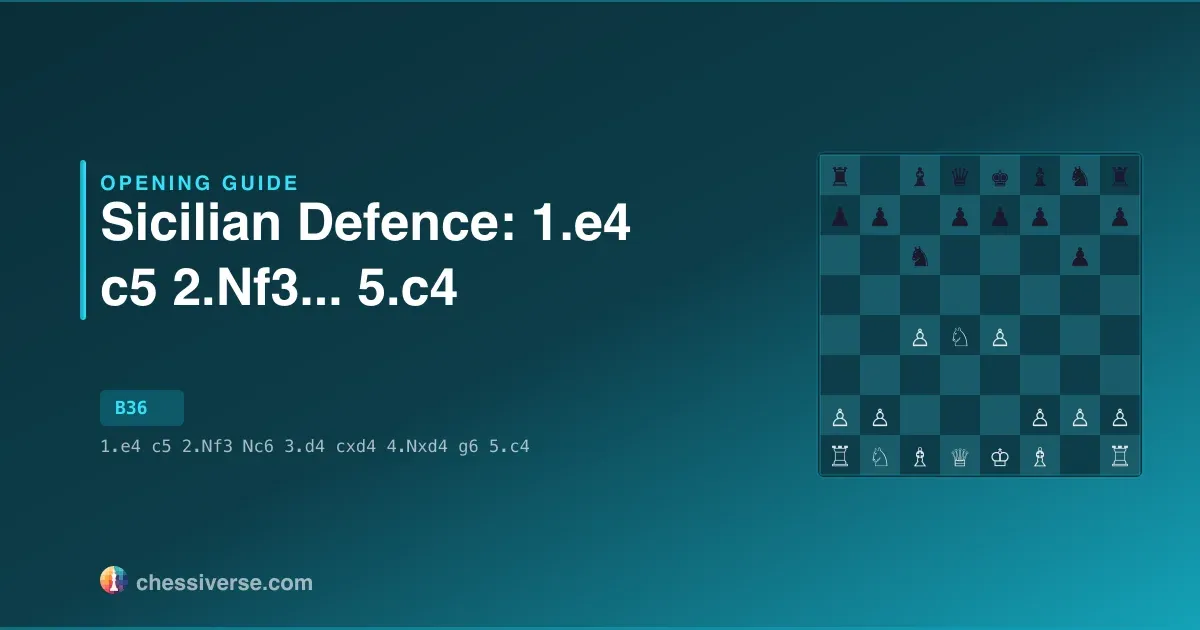
Starting from 1.e4 c5 2.Nf3 Nc6 3.d4 cxd4 4.Nxd4 g6 5.c4, players enter the Sicilian Defense: Accelerated Dragon, Maróczy Bind — ECO B36. White slams down 5.c4 and Black's central freedom evaporates. The Maroczy Bind is one of the most theory-defining positional weapons in chess.
Strategic Overview
The Maroczy Bind is the reason the Accelerated Dragon doesn't get played at master level the way the standard Dragon does. By planting pawns on c4 and e4, White takes a near-permanent grip on d5 and makes it extremely hard for Black to achieve the freeing ...d5 break — which is the standard Sicilian goal. Without that break, Black is stuck in a cramped position where piece coordination becomes a constant battle, especially on the central and queenside squares. White's plan from here is straightforward: develop normally with Nc3, Be2, Be3, 0-0, queen to d2, and then start probing for weak squares while Black tries to find any kind of pawn break to release the pressure. Black's main resources are dynamic counterplay through ...b5 or ...f5, but both require careful preparation and concede other squares in the process. Modern theory has shown Black can equalize with precise play — moves like ...Nxd4 to ease the cramp, the ...Bg7-Re8-...Nf6-d5 maneuver, or carefully timed pawn breaks — but the burden of accuracy is entirely on Black, and any inaccuracy hands White a long-term positional advantage. The Maroczy Bind is one of the most studied positions in chess for exactly this reason: small concessions accumulate.
Key Ideas
A few ideas come up again and again in this opening:
- The Maroczy Bind kills the ...d5 break — With pawns on c4 and e4, White locks down d5 and prevents Black's standard Sicilian freeing move. Without ...d5, Black's pieces stay cramped and the position is structurally uphill.
- Spatial advantage forces precision — White has more room and easier piece coordination. Black has to play accurately for many moves to find counterplay; any inaccuracy and the position drifts into a slow positional squeeze with no easy escape.
- ...b5 and ...f5 are the breaks — Black's only realistic pawn breaks are on the wings — ...b5 to challenge c4, or ...f5 to attack e4. Both require careful preparation and create new weaknesses in the process.
- Black can equalize, but barely — Modern analysis shows Black can hold with precise play, but the line is one-sided in terms of who has to think harder. Most Accelerated Dragon players prefer to avoid the Maroczy through move-order tricks if they can.
History and Notable Players
It arises from the Sicilian Defense: Accelerated Dragon. On the White side, Oleg Korneev (37 games), Friso Nijboer (27 games), Vlastimil Jansa (24 games) top the database. Notable Black exponents: Sergei Tiviakov (67 games), Dragoljub Velimirovic (56 games), Margeir Petursson (56 games).
Performance Across Rating Levels
The picture changes a lot as you climb the rating ladder. The 1200 bracket has 21,131 games (0.00% of all games at that level); White wins 46.7%, Black 50%, 3.3% are drawn. By 1800, popularity is 0.04% and White's score is 50.7% to Black's 43.6%. Among 2500-rated players the line appears in 0.22% of games and draws spike to 12.5%, indicating tight preparation. Positions also become less sharp as level rises (sharpness 0.97 → 0.88).
Time Control Patterns
Time control matters here: blitz players reach for this opening more than others. In bullet, it appears in 0.02% of games (510,976); White wins 48.4%. Blitz shows 0.03% adoption across 1,216,524 games, White scoring 48.5%. In rapid, the share rises to 0.02% — 188,616 games, White 49.7%.
Move Diversity and Theory Depth
Move choice is far from uniform in the Sicilian Defense: Accelerated Dragon, Maróczy Bind. At 1200 Elo (21,131 games), the top reply is Bg7, played 88.7% of the time. No other move reaches 5% of games, and the top three moves account for 96.1% of games. Entropy: 0.79. By 2500 (30,559 games), Nf6 takes over as the top reply at 50.5%; one other move reaches 5% and the top three moves account for 99.4% of games. Entropy rises to 1.11.
Historical Trends
Long-term, the trajectory of this opening is informative. Adoption peaked in 2020 at 0.04% (209,033 games). By 2025 it sits at 0.03%, 18% below the peak but still 51% above its 2013 level, so the line is up over the full period despite easing from the high.
Main Lines and Variations
The main branches off 1.e4 c5 2.Nf3 Nc6 3.d4 cxd4 4.Nxd4 g6 5.c4 include:
Each branch leads to a different middlegame character — the resulting pawn structure decides what kind of game you get.
Common Mistakes
- Drifting away from main theory — At 400 Elo, the three most-played moves cover 93.5% of games, against 99.2% at 2000. The most popular deviation is Nxd4 (played 17.1% of the time at 400, much less so up top). It looks fine but quietly hands the better-prepared side an edge.
- Neglecting development — Extra pawn moves in the opening are tempting, especially when you "know the moves". Developing a piece each turn is the simple correction.
- Ignoring the kingside attack — In sharp Sicilian lines, White typically castles long and pushes the h-pawn. Without your own counterplay on the queenside or in the centre, White's attack lands first.
Practice on Chessiverse
Ready to try the Sicilian Defense: Accelerated Dragon, Maróczy Bind against a bot? Pick an opponent at your level and play a game.