



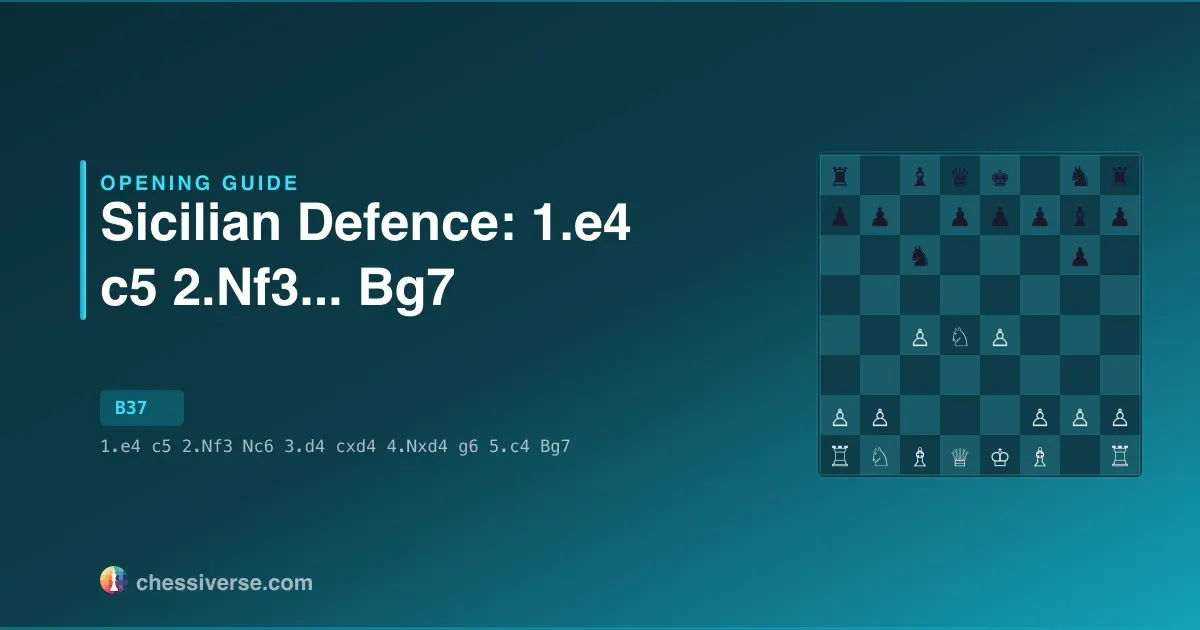
The Sicilian Defense: Accelerated Dragon, Maróczy Bind (5...Bg7) begins with 1.e4 c5 2.Nf3 Nc6 3.d4 cxd4 4.Nxd4 g6 5.c4 Bg7 (ECO B37). Black completes the fianchetto and the d4-knight is suddenly hanging. White's response shapes the whole middlegame.
Strategic Overview
Once the bishop comes to g7, the g7-bishop's pressure on d4 forces White to make a decision about the knight. The standard reply is 6.Be3, supporting the knight and continuing development. With the Maroczy Bind on the board (pawns on c4 and e4), this is the classic spatial squeeze: White has more room, easier piece coordination, and a stable center; Black has the bishop pair pointing down the long diagonal and is hunting for the right moment to break with ...d5 or wing breaks. The strategic battle is concrete. Black's typical setup involves ...Nf6, ...0-0, ...d6, ...Nxd4 to trade off a piece and ease the cramp, and then ...Bd7-c6 to fight for the diagonal and the d5-square. The g7-bishop is Black's most important piece in this whole structure — keeping it active and pointed at the center and queenside is essentially Black's strategic mission for the rest of the game. White's plan is calm: complete development, double on the c- or d-file, and slowly build toward exploiting Black's space disadvantage. This is positional chess at its most demanding, and the side that handles the maneuvering more precisely tends to win.
Key Ideas
When players succeed in this line, they usually do so by leaning on the following themes:
- The d4-knight needs defending — Once Black fianchettoes, the g7-bishop hits d4 and White has to decide how to support it. 6.Be3 is the standard answer, locking the bishop into the defense and completing development.
- The g7-bishop is the heart of Black's position — It points down the long diagonal at White's queenside and pressures d4 indirectly. Keeping it active and unblocked is the central strategic task for Black throughout the middlegame.
- Trade off pieces to ease the cramp — With less space, Black benefits from exchanges. ...Nxd4 to swap a piece is a common idea, as is the bishop maneuver to c6 to challenge White's pieces along the long diagonal.
- Maroczy Bind structure persists — The pawns on c4 and e4 still dominate d5 and Black still has to find his ...d5 break against the bind. The whole strategic context of the previous move carries forward into this position.
History and Notable Players
It arises from the Sicilian Defense: Accelerated Dragon, Maróczy Bind. Among the most prolific White practitioners are Oleg Korneev (22 games), Aleksander Wojtkiewicz (16 games), Jan Banas (15 games). Black-side regulars include Bent Larsen (45 games), Dragoljub Velimirovic (43 games), Yochanan Afek (33 games).
Performance Across Rating Levels
How well the Sicilian Defense: Accelerated Dragon, Maróczy Bind (5...Bg7) works depends on what level you're playing at. Among 1200-rated players, it appears in 0.00% of games — 23,115 of them on record — with White winning 46.3% and Black 50.5%. By 1800, popularity is 0.05% and White's score is 51.3% to Black's 43%. Among 2500-rated players the line appears in 0.20% of games and draws spike to 12.1%, indicating tight preparation. Positions also become less sharp as level rises (sharpness 0.97 → 0.88).
Time Control Patterns
The Sicilian Defense: Accelerated Dragon, Maróczy Bind (5...Bg7) skews toward blitz chess. In bullet, it appears in 0.02% of games (599,932); White wins 49.3%. Blitz shows 0.04% adoption across 1,351,131 games, White scoring 50%. In rapid, the share rises to 0.02% — 211,756 games, White 50.8%.
Move Diversity and Theory Depth
Move choice is far from uniform in the Sicilian Defense: Accelerated Dragon, Maróczy Bind (5...Bg7). At 1200 Elo (23,115 games), the top reply is Be3, played 53.7% of the time. One other move takes at least 5% of games, and the top three moves account for 94.4% of games. Entropy: 1.52. By 2500 (27,552 games), Be3 dominates at 91.5% of replies; one other move reaches 5% and the top three moves account for 99.5% of games. Entropy drops to 0.48. That entropy collapse is the signature of a line where preparation pays off: at the top, players know the best move and play it.
Historical Trends
Long-term, the trajectory of this opening is informative. Adoption peaked in 2020 at 0.04% (240,098 games). By 2025 it sits at 0.03%, 25% below the peak but still 47% above its 2013 level, so the line is up over the full period despite easing from the high.
Main Lines and Variations
From the position after 1.e4 c5 2.Nf3 Nc6 3.d4 cxd4 4.Nxd4 g6 5.c4 Bg7, the recognised continuations are:
Each branch leads to a different middlegame character — the resulting pawn structure decides what kind of game you get.
Common Mistakes
- Playing outside main lines — At 400 Elo, only 92.2% of games stay with the three most-played moves; at 2000 that climbs to 97.3%. Most of the gap is players who pick a reasonable-looking move over the best one, and the position quietly drifts.
- Neglecting development — It can feel productive to make extra pawn moves early, but falling behind in piece development is what loses most amateur games — especially in open positions where active pieces find squares fast.
- Ignoring the kingside attack — In sharp Sicilian lines, White typically castles long and pushes the h-pawn. Without your own counterplay on the queenside or in the centre, White's attack lands first.
Practice on Chessiverse
Ready to try the Sicilian Defense: Accelerated Dragon, Maróczy Bind (5...Bg7) against a bot? Pick an opponent at your level and play a game.