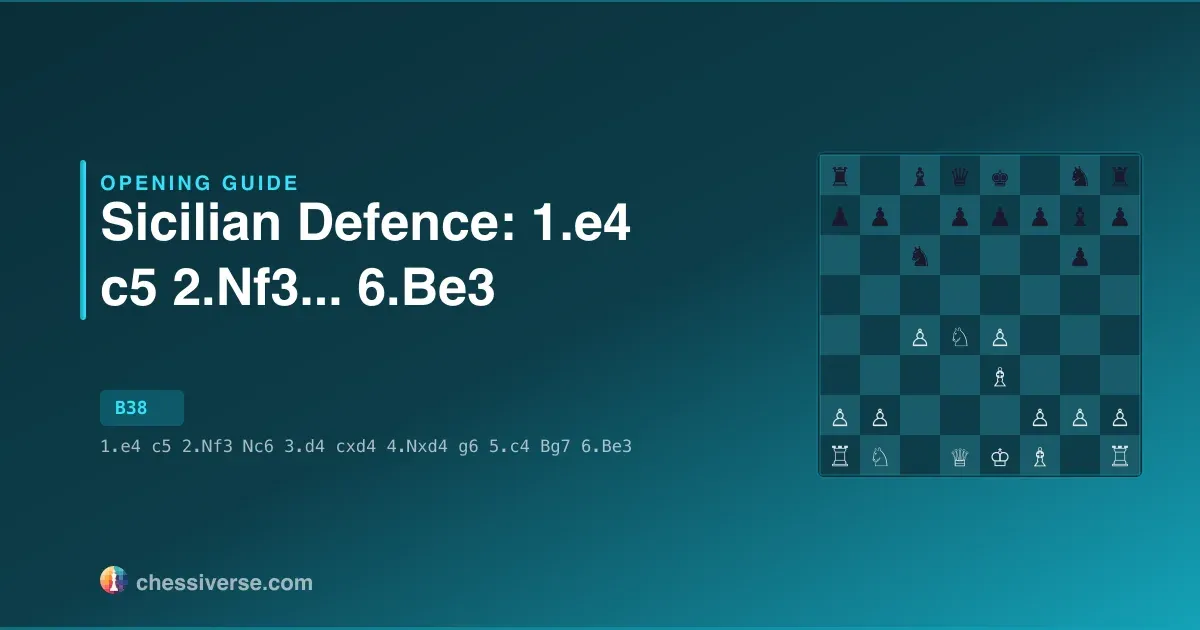
The Sicilian Defense: Accelerated Dragon, Maróczy Bind (5...Bg7 6.Be3) begins with 1.e4 c5 2.Nf3 Nc6 3.d4 cxd4 4.Nxd4 g6 5.c4 Bg7 6.Be3 (ECO B38). White supports the d4-knight and quietly continues development. The Maroczy Bind is now fully in place and the strategic battle settles in for the long haul.
History and Notable Players
It arises from the Sicilian Defense: Accelerated Dragon, Maróczy Bind (5...Bg7). Among the most prolific White practitioners are Oleg Korneev (22 games), Aleksander Wojtkiewicz (16 games), Jan Banas (15 games). Black-side regulars include Bent Larsen (44 games), Dragoljub Velimirovic (41 games), Yochanan Afek (32 games).
Performance Across Rating Levels
The picture changes a lot as you climb the rating ladder. At 1200 Elo, the opening shows up in 0.00% of games (13,359 samples). White scores 50.5%, Black 46.6%, draws 2.8%. By 1800, popularity is 0.05% and White's score is 51.9% to Black's 42.2%. At 2500, 0.19% of games go into this opening; draws sit at 12.4% — the line is well-mapped at this level. White's edge erodes by 3.5pp from 1200 to 2500 Elo, suggesting Black's counterplay is easier to find with experience.
Time Control Patterns
Time control matters here: blitz players reach for this opening more than others. In bullet, it appears in 0.02% of games (544,379); White wins 50%. Blitz shows 0.03% adoption across 1,252,677 games, White scoring 50.5%. In rapid, the share rises to 0.02% — 187,699 games, White 52.5%. White's score swings 2.5pp across formats, so time control isn't just a stylistic choice here — it shifts the actual results.
Move Diversity and Theory Depth
Looking at move selection shows how forcing — or not — the position really is. At 1200 Elo (13,359 games), the top reply is Nf6, played 38.7% of the time. Five other moves each take at least 5% of games, and the top three moves account for 72.6% of games. Entropy: 2.58. By 2500 (25,762 games), Nf6 dominates at 72.8% of replies; only two other moves still reach 5% and the top three moves account for 97.7% of games. Entropy drops to 1.26. That entropy collapse is the signature of a line where preparation pays off: at the top, players know the best move and play it.
Historical Trends
Tracking the Sicilian Defense: Accelerated Dragon, Maróczy Bind (5...Bg7 6.Be3) year over year shows a clear story. Adoption peaked in 2020 at 0.04% (222,213 games). By 2025 it sits at 0.03%, 24% below the peak but still 69% above its 2013 level, so the line is up over the full period despite easing from the high.
Main Lines and Variations
After 1.e4 c5 2.Nf3 Nc6 3.d4 cxd4 4.Nxd4 g6 5.c4 Bg7 6.Be3, the established follow-ups are:
Each branch leads to a different middlegame character — the resulting pawn structure decides what kind of game you get.
Common Mistakes
- Drifting away from main theory — At 400 Elo, the three most-played moves cover 74.2% of games, against 90.4% at 2000. The most popular deviation is e5 (played 17.9% of the time at 400, much less so up top). It looks fine but quietly hands the better-prepared side an edge.
- Neglecting development — It can feel productive to make extra pawn moves early, but falling behind in piece development is what loses most amateur games — especially in open positions where active pieces find squares fast.
- Ignoring the kingside attack — In sharp Sicilian lines, White typically castles long and pushes the h-pawn. Without your own counterplay on the queenside or in the centre, White's attack lands first.
Practice on Chessiverse
Ready to try the Sicilian Defense: Accelerated Dragon, Maróczy Bind (5...Bg7 6.Be3) against a bot? Pick an opponent at your level and play a game.