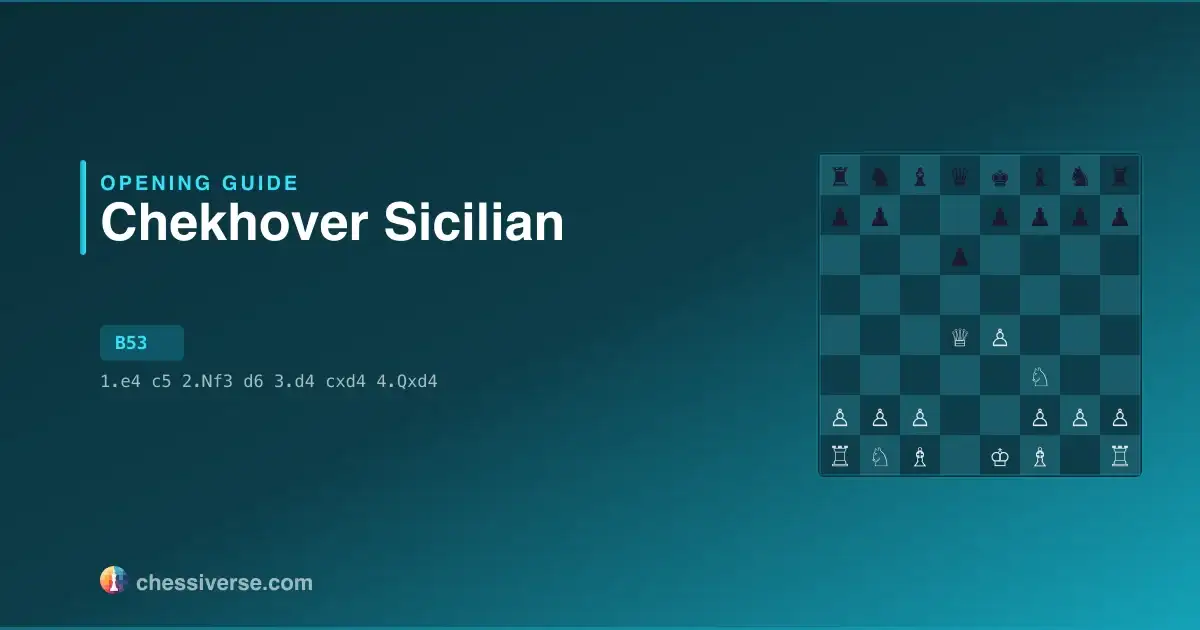


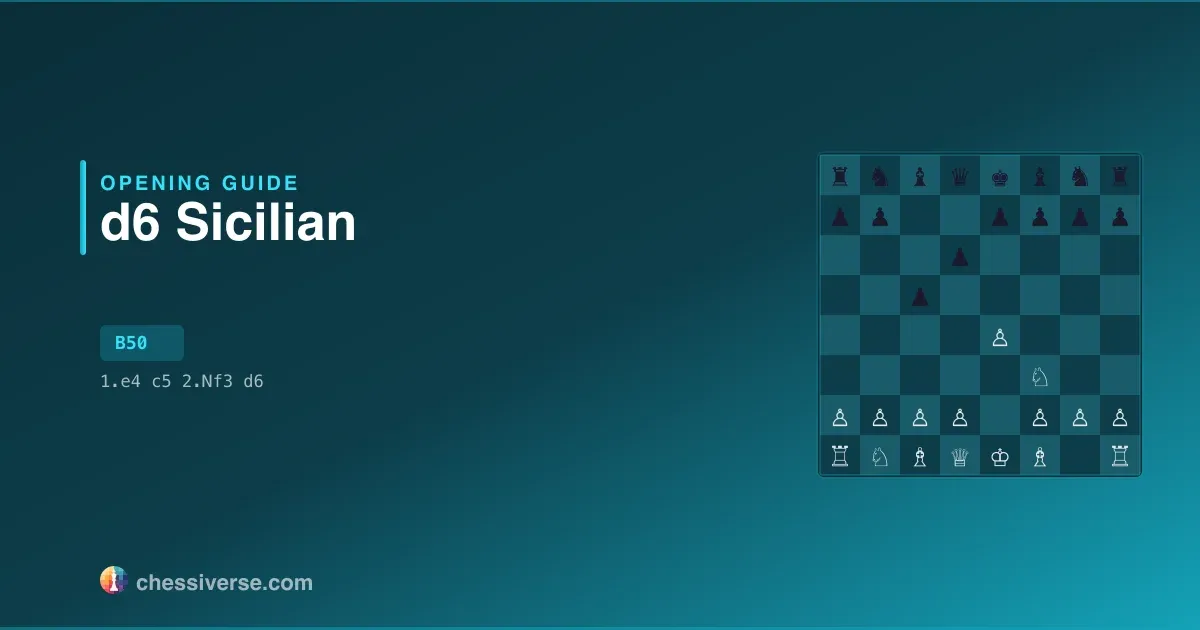
The Sicilian Defense: d6 Systems arises after 1.e4 c5 2.Nf3 d6 and falls under ECO code B50. The Sicilian is a counter-attacking, asymmetric defence in which Black uses a flank pawn to contest d4, aiming to exchange it for White's central d-pawn and emerge with a two-to-one central pawn majority. With 2...d6, Black chooses the most flexible continuation of the Open Sicilian, preserving the ability to enter a range of deeply theoretical systems: the Najdorf (via ...a6), the Dragon (via ...g6), the Classical (via ...Nc6 and ...e5), or the Scheveningen (via ...e6). Unlike 2...Nc6 or 2...e6, this move avoids early piece or structural commitments, letting Black tailor the setup to White's response. A key characteristic of 1...c5 is that it does not aid development or open bishop diagonals the way 1...e5 does, meaning Black must invest at least one more pawn move before a bishop can emerge, and White can exploit this development lead by opening the position. After the standard sequence 3. d4 cxd4 4. Nxd4, White obtains central space and active piece placement, while Black relies on the queenside pawn majority and the half-open c-file for counterplay. White also has 3. Bb5+, the Moscow Variation, as an alternative to the Open Sicilian. With 516.3 million Lichess games across all rating levels, it is one of the most popular openings.
- 2...d6 prepares ...Nf6 to hit the e4-pawn without letting White chase the knight away with e5.
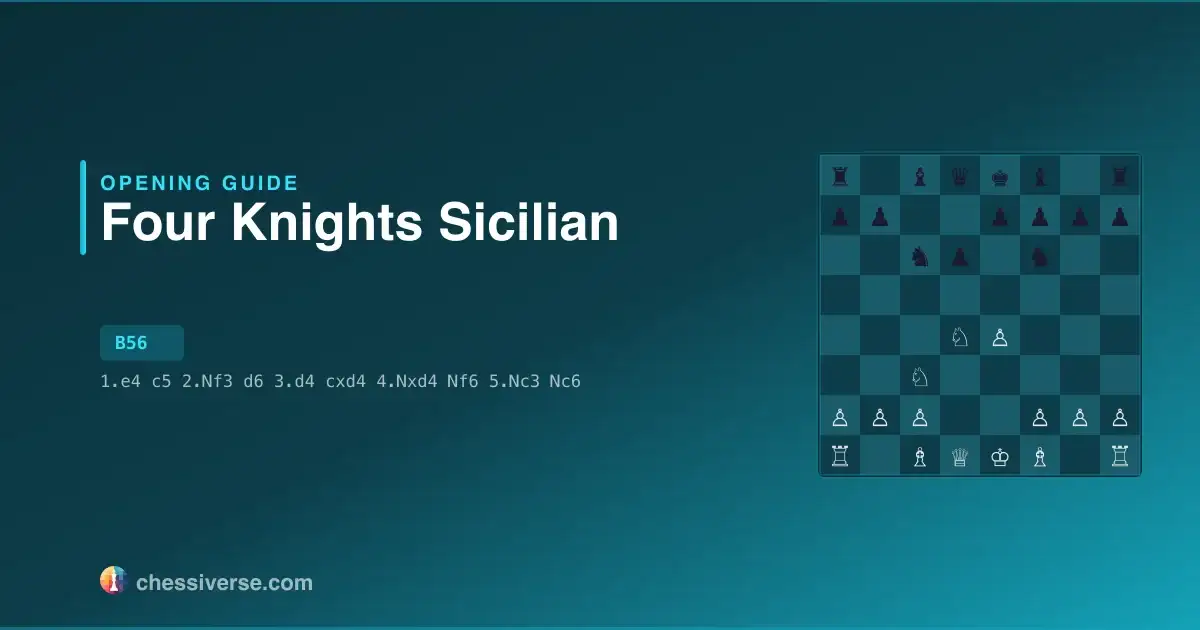
- After 3.d4 cxd4 4.Nxd4 Nf6 5.Nc3, Black chooses a flagship system: Najdorf (5...a6), Dragon (5...g6), Classical (5...Nc6) or Scheveningen (5...e6).
- Instead of the main line 3.d4, White can give check with 3.Bb5+, known as the Moscow Variation.
History and Notable Players
Among the most prolific practitioners on the White side are Vlastimil Jansa (661 games), Heikki MJ Westerinen (641 games), Oleg Korneev (608 games). On the Black side, notable exponents include Loek Van Wely (738 games), Miso Cebalo (592 games), Zdenko Kozul (590 games).
The Sicilian was analysed as far back as 1594 by Giulio Polerio, but only became a top-level mainstay after Botvinnik, Boleslavsky and others revived it in the 1940s and 1950s. The 2...d6 move order became the doorway to several of its most famous systems, including the Najdorf and the Dragon.
Named after: The parent Sicilian Defence is named for the island of Sicily; Jacob Henry Sarratt standardised the English name in 1813.
Notable players: Bobby Fischer, Garry Kasparov
One modest pawn move is the gateway to four legendary Sicilians at once - and Fischer and Kasparov leaned on the Sicilian almost exclusively, cementing its fearsome reputation.
Statistics
Based on 90.9 million Lichess games across all rating levels:
- White wins: 47.9%
- Black wins: 47.4%
- Draws: 4.7%
The statistics show a roughly balanced opening where both sides have equal chances.
Main Lines and Variations
After 1.e4 c5 2.Nf3 d6, the main continuations include:
Each of these lines leads to distinct types of positions and requires its own understanding of the resulting pawn structures and piece placements.
Common Mistakes to Avoid
- Ignoring the opponent's kingside attack: In many Sicilian lines, White will castle queenside and push pawns toward your king. If you don't create counterplay on the queenside or in the center, White's attack will arrive first.
Practice on Chessiverse
The best way to learn the Sicilian Defense: d6 Systems is through practice. On Chessiverse, you can play chess against computer opponents that specialize in this opening. Our AI bots range from beginner to grandmaster level, each with unique playing styles — from aggressive attackers to solid defenders. Choose a bot that matches your rating and work your way up as you master the opening's key ideas.
Performance Across Rating Levels
How well the Sicilian Defense: d6 Systems works depends on what level you're playing at. Among 1200-rated players, it appears in 1.04% of games — 7,040,463 of them on record — with White winning 48% and Black 48.3%. By 1800, popularity is 2.69% and White's score is 47.8% to Black's 47.4%. At 2500, 5.32% of games go into this opening; draws sit at 9% — the line is well-mapped at this level.
Time Control Patterns
Look at the same opening across time controls and blitz stands out. In bullet, it appears in 9.23% of games (245,326,791); White wins 48.6%. Blitz shows 11.42% adoption across 410,500,344 games, White scoring 47.9%. In rapid, the share rises to 9.56% — 105,776,922 games, White 46.8%.
Move Diversity and Theory Depth
Looking at move selection shows how forcing — or not — the position really is. At 1200 Elo (49,471,054 games), the top reply is Nf3, played 47% of the time. Three other moves each take at least 5% of games, and the top three moves account for 74.7% of games. Entropy: 2.51. By 2500 (2,316,411 games), Nf3 dominates at 72.4% of replies; only two other moves still reach 5% and the top three moves account for 90.7% of games. Entropy drops to 1.52. That entropy collapse is the signature of a line where preparation pays off: at the top, players know the best move and play it.