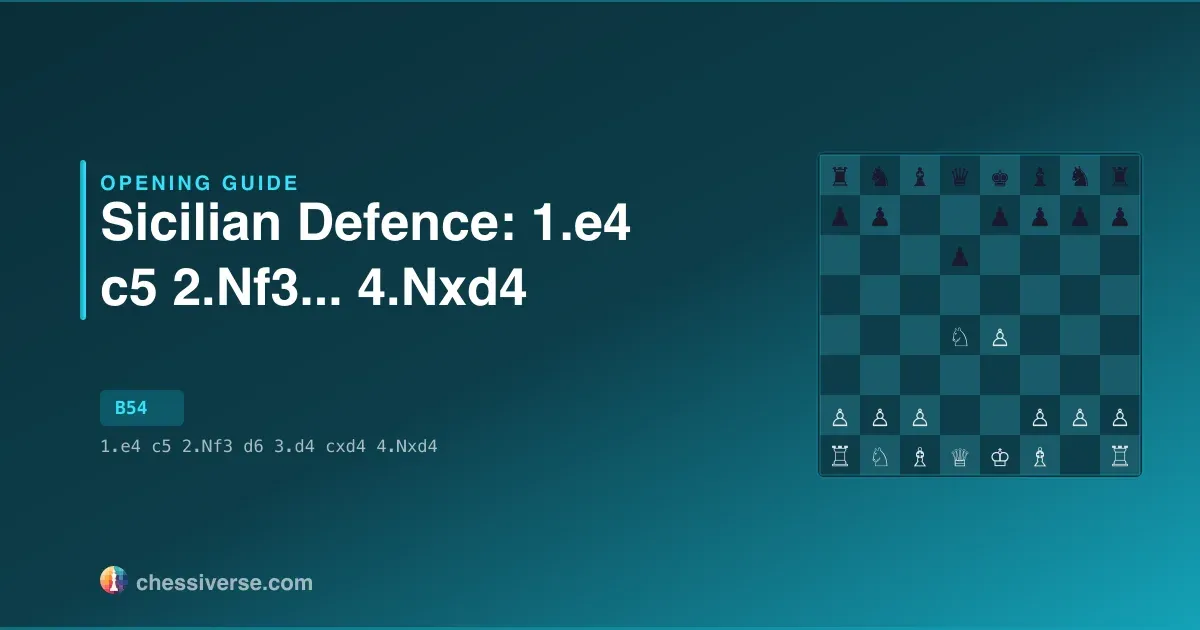
The Sicilian Defense: Modern Variations (4.Nxd4) arises after 1.e4 c5 2.Nf3 d6 3.d4 cxd4 4.Nxd4 and falls under ECO code B54. White recaptures with the knight, placing it on a strong central square. In the resulting position, White enjoys a modest spatial edge in the center along with open lines for both bishops, while Black compensates with a central pawn majority. Given the chance, White would ideally play 5. c4 to establish the classic Maroczy Bind formation with pawns on c4 and e4, which would also keep the c-file open for a future Nc3 without blocking the c-pawn. The c4 advance would also severely limit Black's queenside counterplay by making ...b5 very hard to achieve. To prevent this, Black almost universally responds with 4...Nf6, which attacks the e4 pawn and forces White to decide how to defend it. The standard answer is 5. Nc3, which protects e4 but blocks the c-pawn and rules out the Maroczy Bind. If White still wants to pursue that formation, 5. f3, known as the Prins Variation, is an alternative. With 41.3 million Lichess games across all rating levels, it is one of the most popular openings.
History and Notable Players
It arises from the Sicilian Defense: d6 Systems. Among the most prolific practitioners on the White side are Viswanathan Anand (249 games), Vlastimil Jansa (226 games), Oleg Korneev (222 games). On the Black side, notable exponents include Lubomir Ftacnik (274 games), Loek Van Wely (274 games), Boris Gelfand (260 games).
Statistics
Based on 41.3 million Lichess games across all rating levels:
- White wins: 48%
- Black wins: 47.3%
- Draws: 4.7%
The statistics show a roughly balanced opening where both sides have equal chances.
Main Lines and Variations
After 1.e4 c5 2.Nf3 d6 3.d4 cxd4 4.Nxd4, the main continuations include:
Each of these lines leads to distinct types of positions and requires its own understanding of the resulting pawn structures and piece placements.
Common Mistakes to Avoid
- Ignoring the opponent's kingside attack: In many Sicilian lines, White will castle queenside and push pawns toward your king. If you don't create counterplay on the queenside or in the center, White's attack will arrive first.
Practice on Chessiverse
The best way to learn the Sicilian Defense: Modern Variations (4.Nxd4) is through practice. On Chessiverse, you can play chess against computer opponents that specialize in this opening. Our AI bots range from beginner to grandmaster level, each with unique playing styles — from aggressive attackers to solid defenders. Choose a bot that matches your rating and work your way up as you master the opening's key ideas.
Performance Across Rating Levels
How well the Sicilian Defense: Modern Variations (4.Nxd4) works depends on what level you're playing at. At 1200 Elo, the opening shows up in 0.28% of games (1,920,205 samples). White scores 48%, Black 48.3%, draws 3.7%. At 1800 the opening surfaces in 1.36% of games; White wins 47.9%, Black 47.5%, draws 4.6%. At the top end (2500+ Elo), popularity is 3.30% with 8.5% draws — a clear sign of how much theory rules the line at master level.
Time Control Patterns
Time control matters here: blitz players reach for this opening more than others. In bullet, it appears in 0.64% of games (16,952,574); White wins 47.3%. Blitz shows 0.95% adoption across 34,032,573 games, White scoring 48%. In rapid, the share rises to 0.66% — 7,254,748 games, White 47.9%.
Move Diversity and Theory Depth
What players actually play after the opening moves depends heavily on rating. At 1200 Elo (1,920,205 games), the top reply is Nf6, played 55% of the time. Three other moves each take at least 5% of games, and the top three moves account for 86.4% of games. Entropy: 1.94. By 2500 (450,563 games), Nf6 dominates at 97.1% of replies; no other move reaches 5% and the top three moves account for 98.9% of games. Entropy drops to 0.25. That entropy collapse is the signature of a line where preparation pays off: at the top, players know the best move and play it.