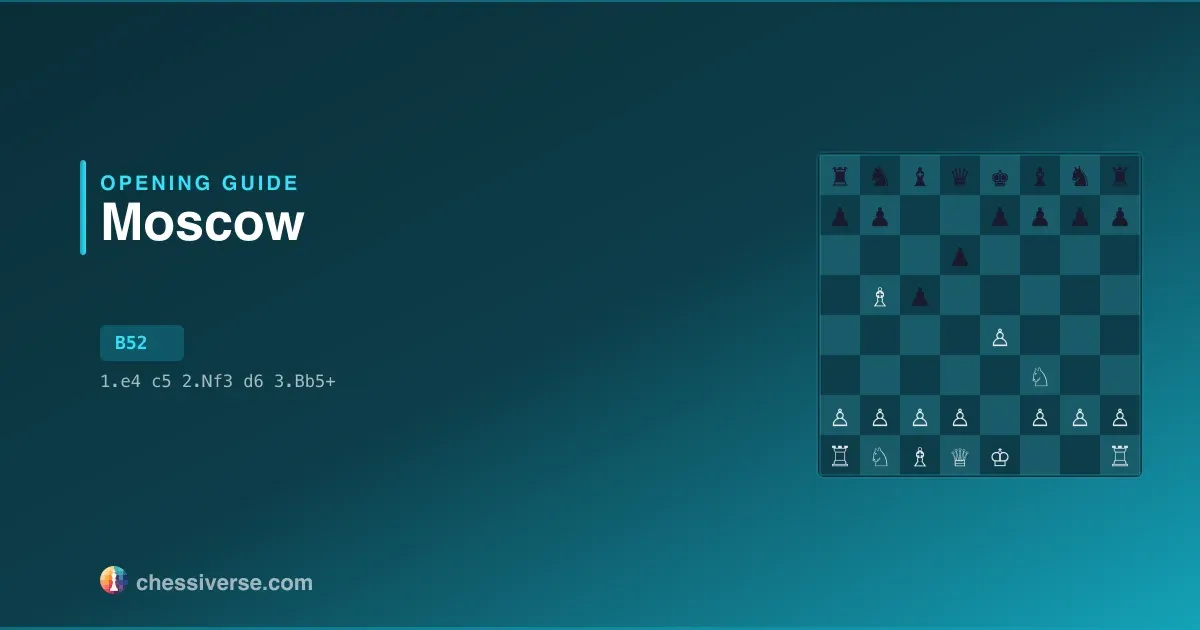
The Sicilian Defense: Moscow Variation arises after 1.e4 c5 2.Nf3 d6 3.Bb5+ and falls under ECO code B51. With 6.3 million Lichess games across all rating levels, it is a well-established opening choice.
- The check develops the bishop with tempo and readies quick castling, all while dodging the heavy theory of the Open Sicilians.
- A standard plan is to trade off the light-squared bishop and then clamp down on d5 with a Maroczy bind - pawns on e4 and c4.
- 3...Bd7 is the main line, compelling the bishop trade; separately, White may play for the centre with c3 and d4, Ruy Lopez-style.
History and Notable Players
It arises from the Sicilian Defense (2.Nf3). Among the most prolific practitioners on the White side are Sergei Rublevsky (51 games), Igor Glek (43 games), Eduardas Rozentalis (39 games). On the Black side, notable exponents include Krum Georgiev (35 games), Kiril Georgiev (30 games), Georg Danner (27 games).
Esteban Canal and Alexey Sokolsky began playing 3.Bb5+ in the 1940s, and the Moscow name is tied to events in that city such as the 1947 Chigorin Memorial. It reached a huge audience in 1999 when Kasparov chose it in Kasparov versus the World, beating over 50,000 voting opponents in 62 moves over four months.
Named after: Likely named for Moscow events where the line appeared, like the 1947 Chigorin Memorial; also the Canal-Sokolsky Attack after Esteban Canal and Alexey Sokolsky.
Notable players: Esteban Canal, Alexey Sokolsky, Nicolas Rossolimo, Garry Kasparov
In Kasparov versus the World (1999), Kasparov used 3.Bb5+ against more than 50,000 opponents voting on moves online, and won after 62 moves stretched over four months - a game described as the hardest-fought of his career.
Statistics
Based on 6.3 million Lichess games across all rating levels:
- White wins: 48.3%
- Black wins: 45.8%
- Draws: 6%
The statistics show a roughly balanced opening where both sides have equal chances.
Main Lines and Variations
After 1.e4 c5 2.Nf3 d6 3.Bb5+, the main continuations include:
Each of these lines leads to distinct types of positions and requires its own understanding of the resulting pawn structures and piece placements.
Practice on Chessiverse
The best way to learn the Sicilian Defense: Moscow Variation is through practice. On Chessiverse, you can play chess against computer opponents that specialize in this opening. Our AI bots range from beginner to grandmaster level, each with unique playing styles — from aggressive attackers to solid defenders. Choose a bot that matches your rating and work your way up as you master the opening's key ideas.
Performance Across Rating Levels
How well the Sicilian Defense: Moscow Variation works depends on what level you're playing at. The 1200 bracket has 449,176 games (0.07% of all games at that level); White wins 47.3%, Black 48.4%, 4.3% are drawn. At 1800 the opening surfaces in 0.16% of games; White wins 48.4%, Black 45.7%, draws 5.9%. At 2500, 0.91% of games go into this opening; draws sit at 10.5% — the line is well-mapped at this level.
Time Control Patterns
The Sicilian Defense: Moscow Variation skews toward blitz chess. In bullet, it appears in 0.09% of games (2,343,439); White wins 49.6%. Blitz shows 0.14% adoption across 5,124,984 games, White scoring 48.5%. In rapid, the share rises to 0.11% — 1,210,064 games, White 47.2%. White's score swings 2.4pp across formats, so time control isn't just a stylistic choice here — it shifts the actual results.
Move Diversity and Theory Depth
What players actually play after the opening moves depends heavily on rating. At 1200 Elo (449,176 games), the top reply is Bd7, played 62.9% of the time. Two other moves each take at least 5% of games, and the top three moves account for 99.9% of games. Entropy: 1.31. By 2500 (124,051 games), Bd7 is still the top reply, at 46.9%; two other moves reach 5% and the top three moves account for 99.9% of games. Entropy drops to 1.29.