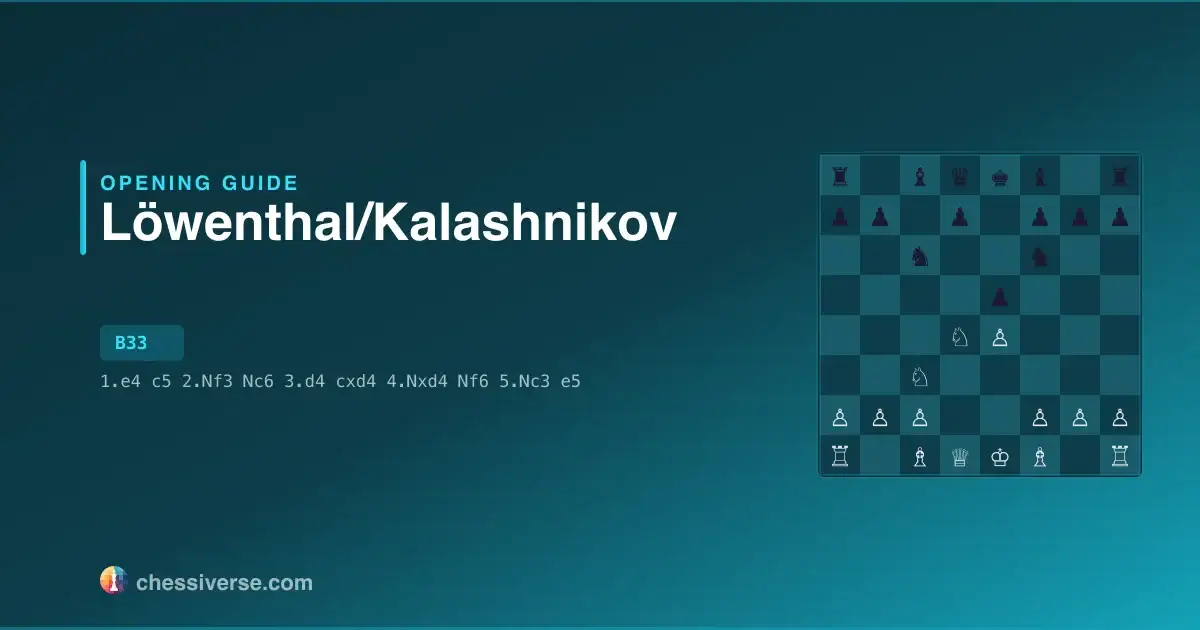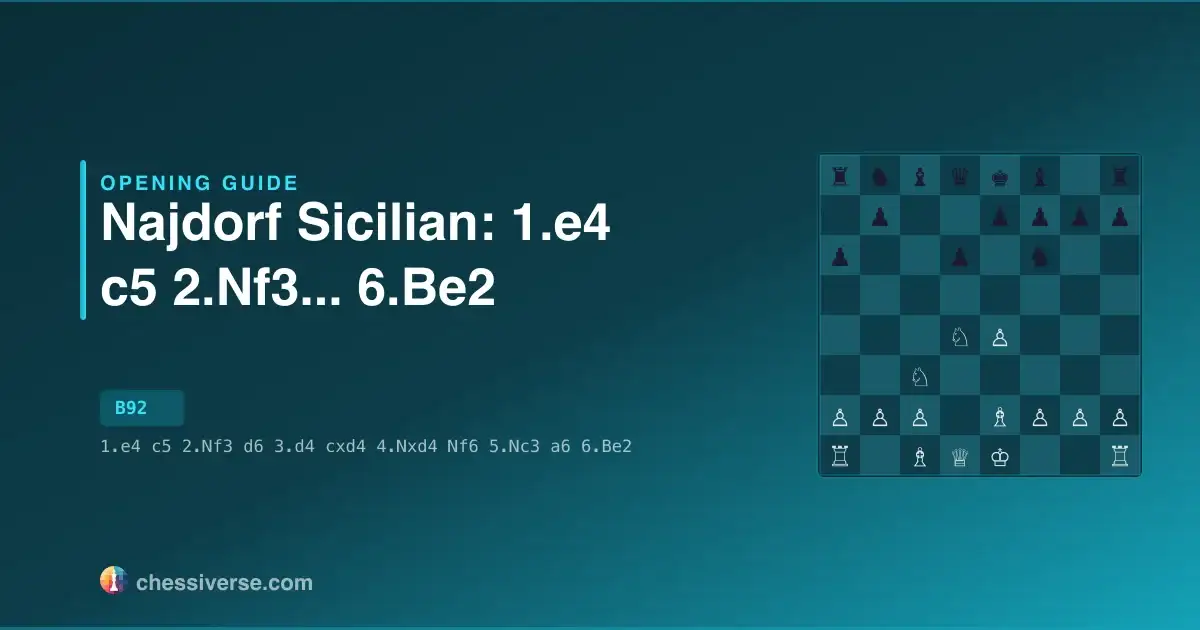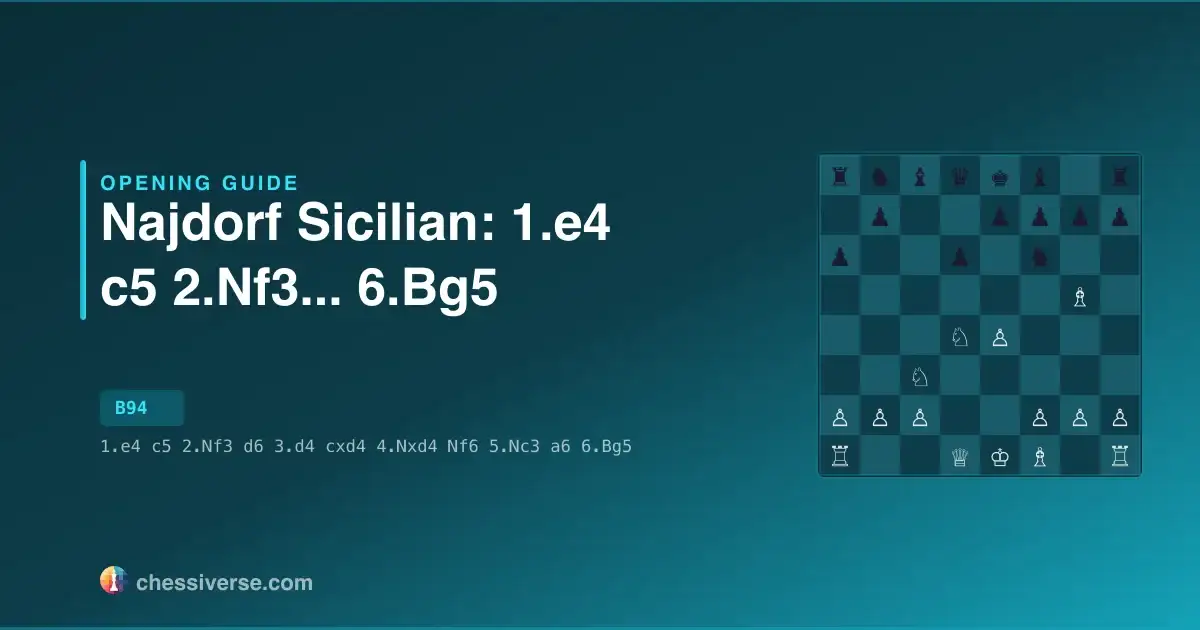





The Sicilian Defense (2.Nf3) arises after 1.e4 c5 2.Nf3 and falls under ECO code B27. White reinforces control of d4 with the knight, setting up the standard plan of 3. d4 cxd4 4. Nxd4 to open the position. Black must now focus on development, particularly finding a way to activate the bishops, which requires at least one more pawn move. Across all rating levels on Lichess, 2...Nc6 is the most common reply (42.5% of games), followed by 2...d6 (32.3%) and 2...e6 (16.0%). 2...Nc6 leads in every rating bracket up to 2000; from 2200 up, 2...d6 takes over, with 37.8% at 2200 and 43.1% at 2500 and above. After 2...d6, the queenside bishop gains access to the c8-h3 diagonal, while the kingside bishop usually goes to e7, or to g7 in the Dragon. This move also covers e5, ensuring Black can develop with ...Nf6. Following 3. d4 cxd4 4. Nxd4, the game usually enters one of the major Sicilian systems: the Najdorf, Dragon, Classical, or Scheveningen. White also has the sideline 3. Bb5+, the Moscow variation. With 279.6 million Lichess games across all rating levels, it is one of the most popular openings.
- White gets a lead in development and extra kingside space, often the fuel for a direct attack on Black's king.
- Black counts on a central pawn majority and pressure down the open c-file for queenside counterplay.
- After 3.d4 cxd4 4.Nxd4, Black chooses a system on move five: Najdorf (...a6), Dragon (...g6), Classical (...Nc6) or Scheveningen (...e6).
History and Notable Players
It arises from the Sicilian Defense. Among the most prolific practitioners on the White side are Vlastimil Jansa (193 games), Oleg Korneev (191 games), Alexei Shirov (158 games). On the Black side, notable exponents include Alexander Moiseenko (301 games), Evgeny Sveshnikov (289 games), Vyacheslav Ikonnikov (214 games).
The Sicilian was analysed as early as Giulio Polerio's 1594 manuscript, and Jacob Sarratt standardised the English name in 1813. Botvinnik and Najdorf helped bring it back into fashion across the 1940s and 1950s, and it became the main battleground for Fischer and Kasparov; about 80% of master games with 1.e4 c5 now continue 2.Nf3.
Named after: 'Sicilian' comes from an old Italian manuscript phrase, il gioco siciliano. 2.Nf3 prepares 3.d4, the move that opens the game into the Open Sicilian.
Notable players: Bobby Fischer, Garry Kasparov, Miguel Najdorf, Mikhail Botvinnik
Paul Morphy and Wilhelm Steinitz both rejected the Sicilian in favour of 1...e5, yet a century later world champions Fischer and Kasparov relied on it almost exclusively.
Statistics
Based on 279.6 million Lichess games across all rating levels:
- White wins: 48%
- Black wins: 47.4%
- Draws: 4.6%
The statistics show a roughly balanced opening where both sides have equal chances.
Main Lines and Variations
After 1.e4 c5 2.Nf3, the main continuations include:
- d6 Sicilian
- Hyper-Accelerated Dragon
- O'Kelly
- Nc6 Sicilian
- Sicilian Defense: Nimzowitsch Variation
- Sicilian Defense: French Variation
Each of these lines leads to distinct types of positions and requires its own understanding of the resulting pawn structures and piece placements.
Common Mistakes to Avoid
- Ignoring the opponent's kingside attack: In many Sicilian lines, White will castle queenside and push pawns toward your king. If you don't create counterplay on the queenside or in the center, White's attack will arrive first.
Practice on Chessiverse
The best way to learn the Sicilian Defense (2.Nf3) is through practice. On Chessiverse, you can play chess against computer opponents that specialize in this opening. Our AI bots range from beginner to grandmaster level, each with unique playing styles — from aggressive attackers to solid defenders. Choose a bot that matches your rating and work your way up as you master the opening's key ideas.
Performance Across Rating Levels
Popularity and results vary sharply by rating level. Among 1200-rated players, it appears in 3.39% of games — 22,884,500 of them on record — with White winning 48.6% and Black 47.8%. At 1800 the opening surfaces in 8.35% of games; White wins 47.8%, Black 47.4%, draws 4.7%. At the top end (2500+ Elo), popularity is 12.33% with 9.3% draws — a clear sign of how much theory rules the line at master level.
Time Control Patterns
Time control matters here: blitz players reach for this opening more than others. In bullet, it appears in 4.68% of games (124,509,243); White wins 48%. Blitz shows 6.29% adoption across 225,968,831 games, White scoring 48.1%. In rapid, the share rises to 4.85% — 53,646,612 games, White 47.8%.
Move Diversity and Theory Depth
What players actually play after the opening moves depends heavily on rating. At 1200 Elo (22,884,500 games), the top reply is Nc6, played 45.6% of the time. Two other moves each take at least 5% of games, and the top three moves account for 89.1% of games. Entropy: 2.04. By 2500 (1,680,784 games), d6 takes over as the top reply at 43.1%; two other moves reach 5% and the top three moves account for 91.7% of games. Entropy drops to 1.95. Move diversity stays high even at master level, suggesting the opening doesn't force one specific response.