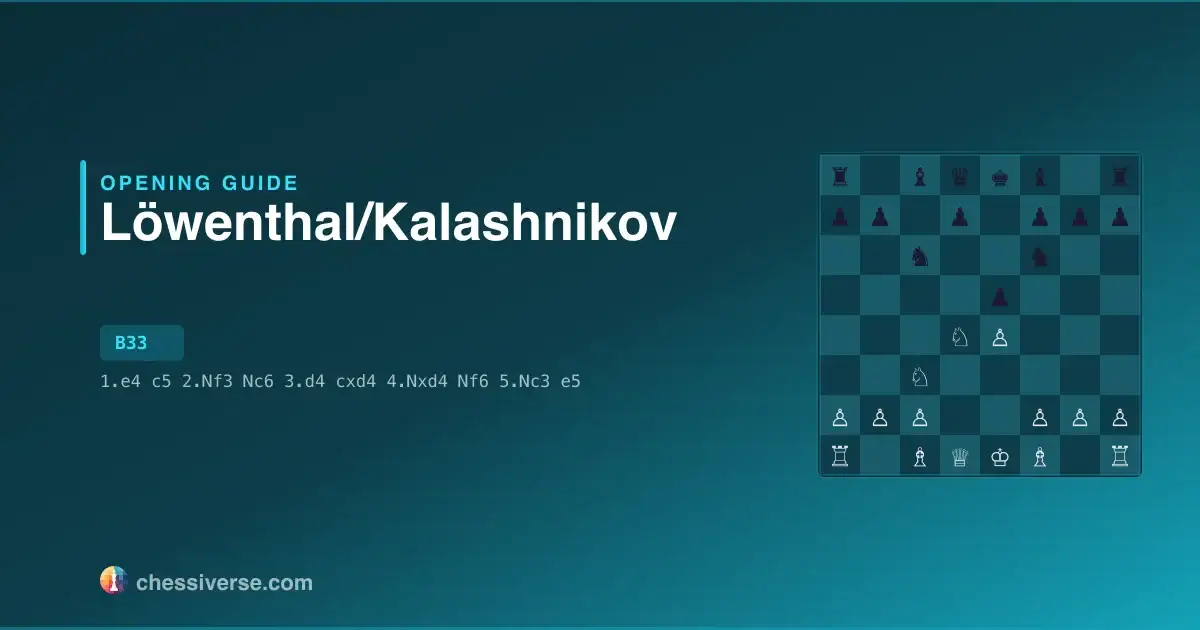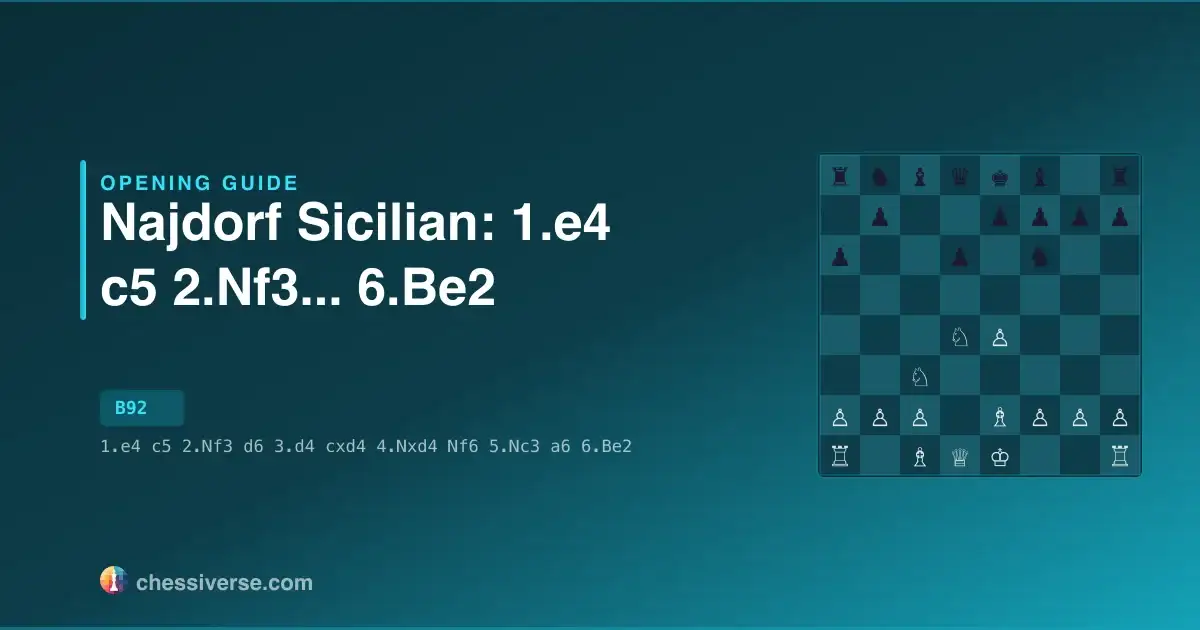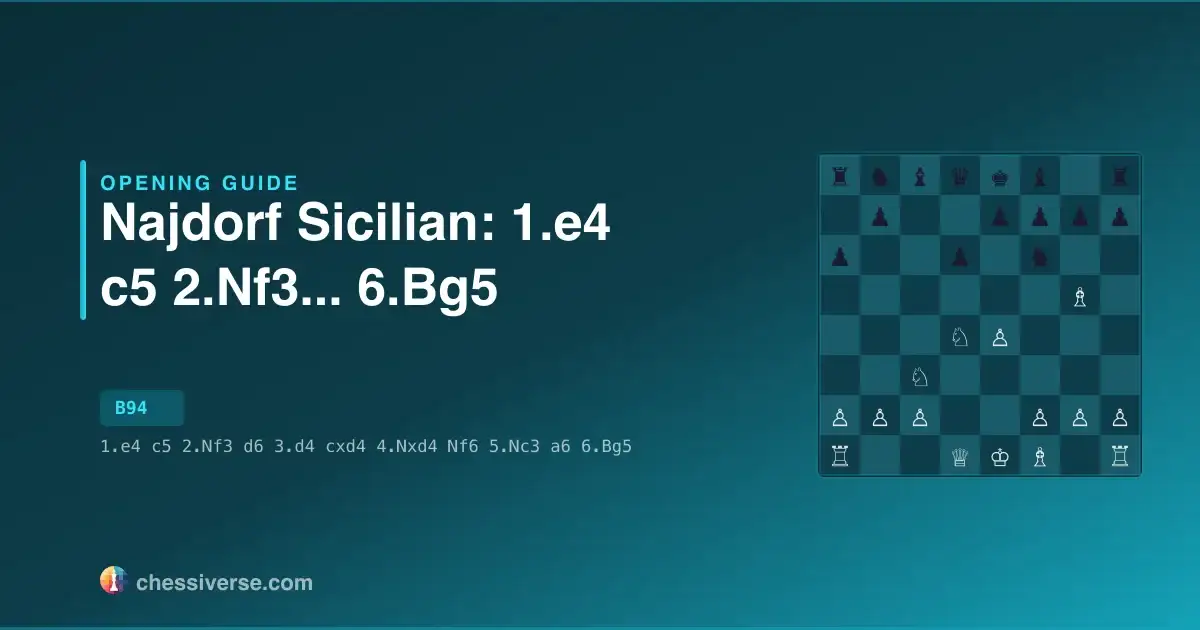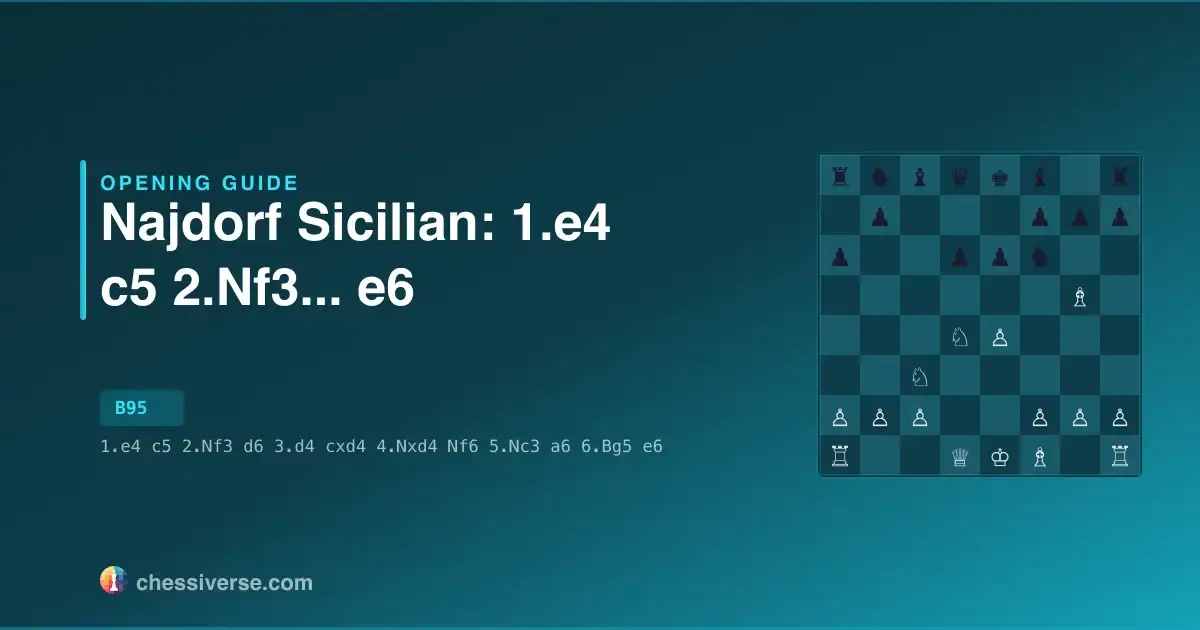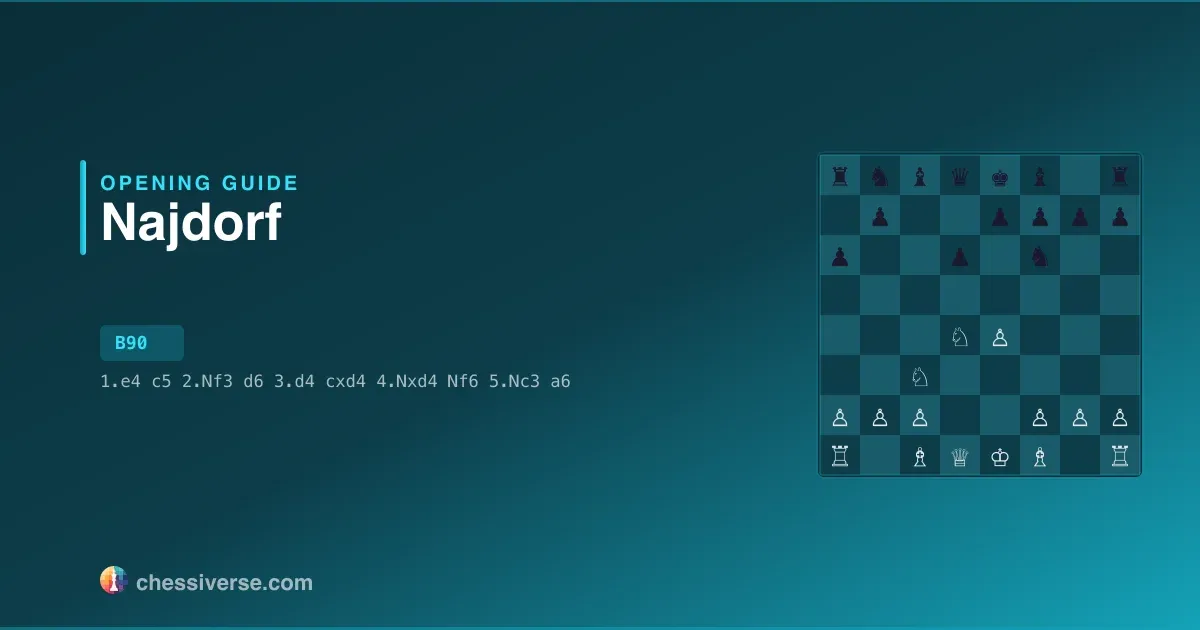
The Sicilian Defense: Najdorf Variation arises after 1.e4 c5 2.Nf3 d6 3.d4 cxd4 4.Nxd4 Nf6 5.Nc3 a6 and falls under ECO code B90. With 5...a6, Black takes prophylactic control of the b5 square, ruling out both Ndb5 and Bb5+ while laying the groundwork for queenside expansion via ...b5 and ...b4, which can be particularly threatening if White castles long. One of the defining features of the Najdorf is its remarkable flexibility: depending on the variation, the knight may develop to d7 or c6, and the bishops can land on b7, e6, e7 (when the e-pawn advances), or g7 (in ...g6 setups). The move 5...a6 also enables 6...e5, driving the knight back to b3, since the check on b5 is no longer available. Because 5...a6 poses no immediate tactical threat, White enjoys a wide choice of continuations. The most popular is 6. Bg5, developing the dark-squared bishop to an aggressive square and introducing the possibility of doubling Black's pawns with Bxf6. Since 6...e5 in response would critically weaken the d5 square and hand White too much control over it, Black typically answers with 6...e6, adopting a Scheveningen-type pawn formation. With 18.8 million Lichess games across all rating levels, it is one of the most popular openings.
- The quiet move ...a6 takes the b5 square away from White's knights and bishop while preparing queenside expansion with ...b5 and a bishop on b7.
- Black stays flexible, choosing between the ...e5 central strike, which kicks the d4 knight, and the alternative ...e6 setup.
- White's sharpest tries, 6.Bg5 and the English Attack with 6.Be3, often lead to opposite-side castling and pawn storms racing on both wings.
History and Notable Players
It arises from the Sicilian Defense (2.Nf3). Among the most prolific practitioners on the White side are Viswanathan Anand (183 games), Alexei Shirov (160 games), Peter Leko (145 games). On the Black side, notable exponents include Loek Van Wely (272 games), Lubomir Ftacnik (270 games), Boris Gelfand (257 games).
Players experimented with an early ...a6 from the 1920s, and Najdorf used it as early as 1937 before refining it with fellow Argentine players in the 1950s. The sharp 6.Bg5 lines ruled until the 1980s, when the English Attack with 6.Be3 took over as the modern main line, and the 1993 Kasparov-Short world title match brought 6.Bc4 back into the spotlight.
Named after: Polish-Argentine grandmaster Miguel Najdorf, who deepened the line's analysis, though he was not the first to play 5...a6.
Notable players: Miguel Najdorf, Bobby Fischer, Garry Kasparov
Modern Chess Openings dubbed the Najdorf the Cadillac or Rolls-Royce of openings - yet Najdorf himself eventually gave it up after opponents kept beating him with memorized book lines.
Statistics
Based on 18.8 million Lichess games across all rating levels:
- White wins: 47.7%
- Black wins: 47.7%
- Draws: 4.7%
The statistics show a roughly balanced opening where both sides have equal chances.
Main Lines and Variations
After 1.e4 c5 2.Nf3 d6 3.d4 cxd4 4.Nxd4 Nf6 5.Nc3 a6, the main continuations include:
- Sicilian Defense: Najdorf Variation, Zagreb Variation
- Sicilian Defense: Najdorf Variation, Opocensky Variation
- Sicilian Defense: Najdorf Variation, Amsterdam Variation
- Sicilian Defense: Najdorf Variation (6.Bg5)
Each of these lines leads to distinct types of positions and requires its own understanding of the resulting pawn structures and piece placements.
Common Mistakes to Avoid
- Ignoring the opponent's kingside attack: In many Sicilian lines, White will castle queenside and push pawns toward your king. If you don't create counterplay on the queenside or in the center, White's attack will arrive first.
Practice on Chessiverse
The best way to learn the Sicilian Defense: Najdorf Variation is through practice. On Chessiverse, you can play chess against computer opponents that specialize in this opening. Our AI bots range from beginner to grandmaster level, each with unique playing styles — from aggressive attackers to solid defenders. Choose a bot that matches your rating and work your way up as you master the opening's key ideas.
Performance Across Rating Levels
How well the Sicilian Defense: Najdorf Variation works depends on what level you're playing at. The 1200 bracket has 519,500 games (0.08% of all games at that level); White wins 47.3%, Black 49.3%, 3.4% are drawn. Move up to 1800 Elo and the share shifts to 0.64%, with White winning 47.2% versus Black's 48.3%. At the top end (2500+ Elo), popularity is 1.96% with 7.8% draws — a clear sign of how much theory rules the line at master level.
Time Control Patterns
The Sicilian Defense: Najdorf Variation skews toward blitz chess. In bullet, it appears in 0.26% of games (7,026,954); White wins 47%. Blitz shows 0.44% adoption across 15,680,566 games, White scoring 47.8%. In rapid, the share rises to 0.29% — 3,163,378 games, White 47.2%.
Move Diversity and Theory Depth
Looking at move selection shows how forcing — or not — the position really is. At 1200 Elo (519,500 games), the top reply is Bg5, played 26.3% of the time. Four other moves each take at least 5% of games, and the top three moves account for 63.2% of games. Entropy: 2.94. By 2500 (267,873 games), Bg5 is still the top reply, at 28.5%; five other moves reach 5% and the top three moves account for 56.5% of games. Entropy rises to 3.08. Even elite players don't fully agree on the best continuation here, which keeps the position dynamic.
Historical Trends
Year-over-year data tells you whether this opening is a contemporary fixture or a fading one. Adoption peaked in 2020 at 0.54% (3,074,278 games). By 2025 it sits at 0.29%, 46% below the peak and roughly back to its 2013 level, leaving the line flat over the full period.