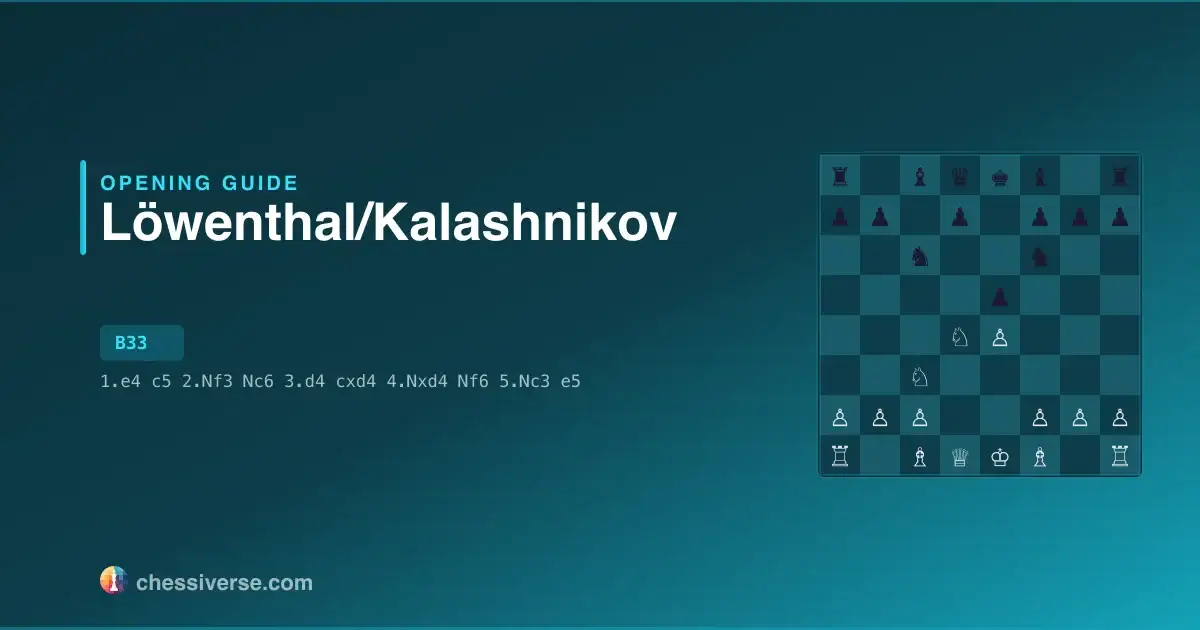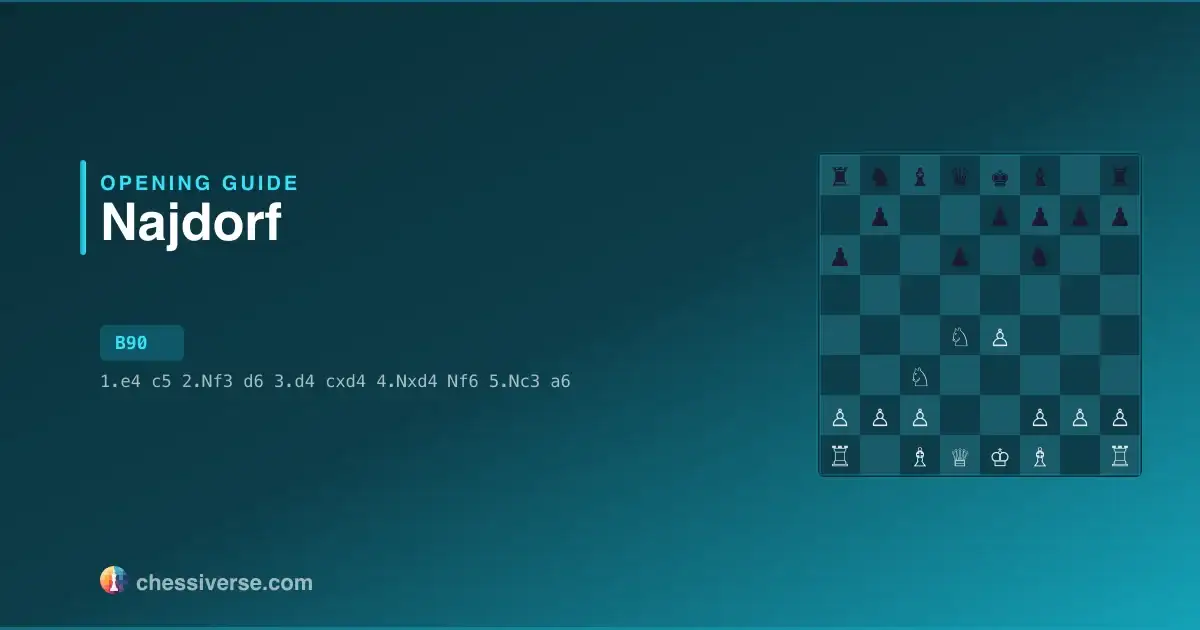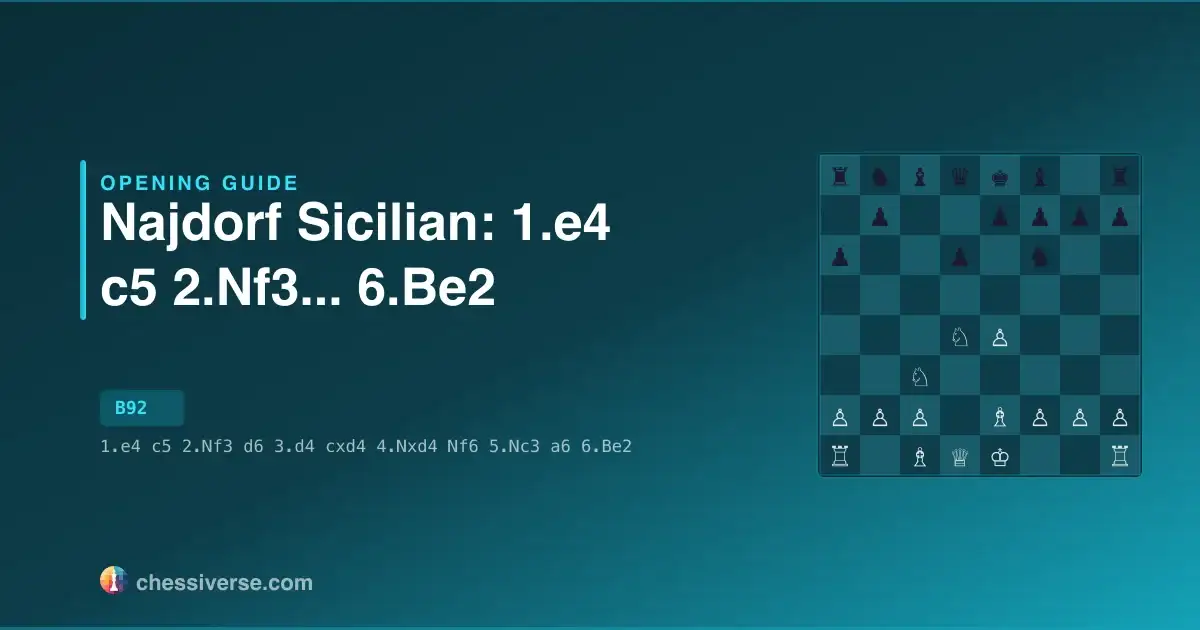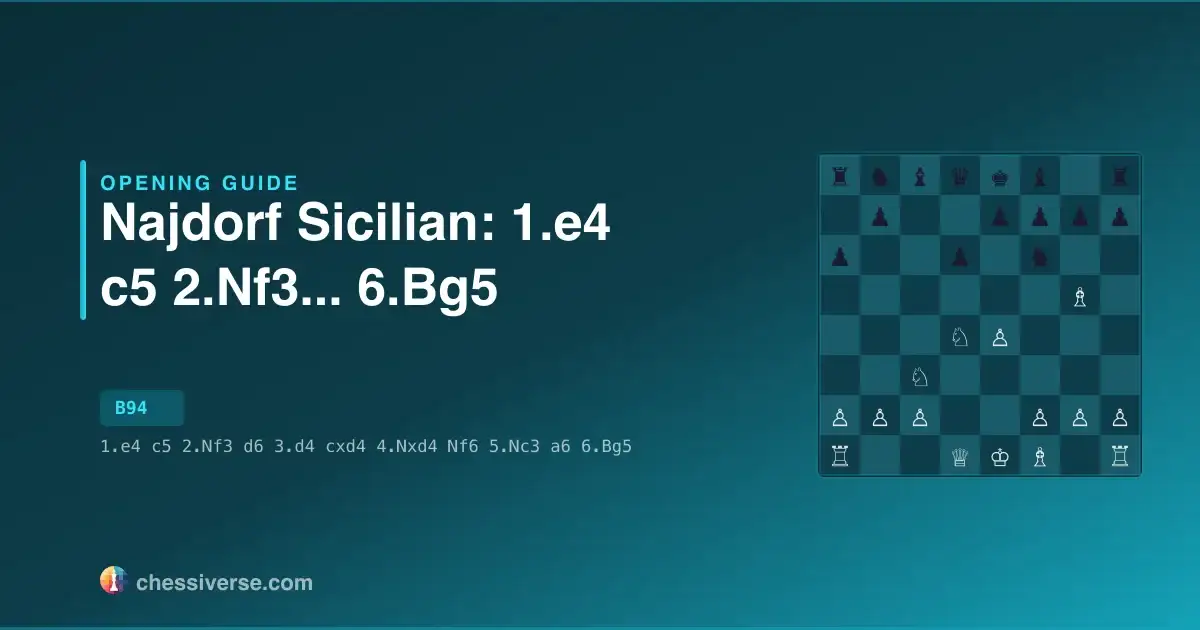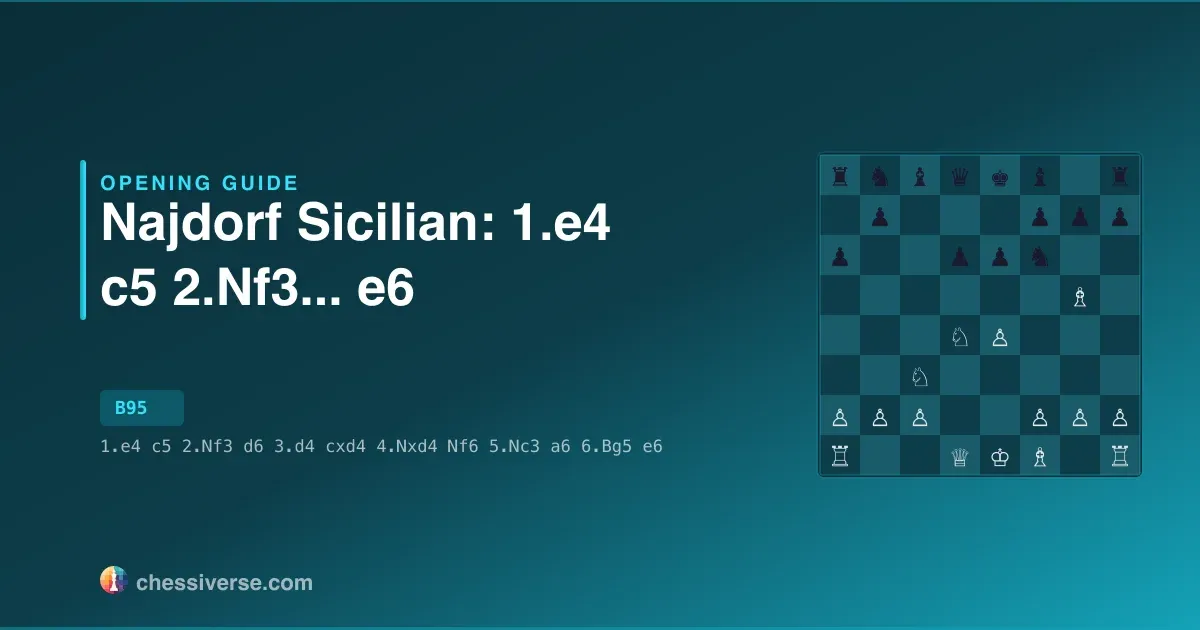
1.e4 c5 2.Nf3 d6 3.d4 cxd4 4.Nxd4 Nf6 5.Nc3 a6 6.Bg5 e6 opens the Sicilian Defense: Najdorf Variation (6...e6), ECO B95. Black breaks the pin and now White picks his weapon. 7.f4 is the main line — the others trade sharpness for stability but rarely survive top-level prep.
Strategic Overview
After 6...e6 Black has dissolved the immediate threat against the f6-knight, and now White faces the strategic question of how aggressively to continue. The mainstream answer is 7.f4, supporting an eventual e5 push, preparing kingside development, and keeping every attacking idea alive. Less ambitious tries include 7.Qf3 (preparing 0-0-0 with attacking ideas) and 7.Be2 (a quieter classical setup), but neither has the bite of the f4 main line at top level. The strategic position is sharp and double-edged: White has the bishop pair pointed at Black's kingside, advanced pieces, and clear attacking plans; Black has solid structure, the half-open c-file, and the typical Najdorf counterplay on the queenside with ...b5 and ...Bb7. The dark-squared bishop on g5 is doing a lot of work — pinning the knight, eyeing the kingside dark squares — and Black often has to factor in trades that change the character of the position dramatically. This is the gateway to the deepest preparation in modern Sicilian theory, and every White move from here commits to a specific battle plan that Black has to know how to fight.
Key Ideas
The recurring motifs below distinguish a confident handler of this opening from a beginner:
- 7.f4 is the main line — Supporting e5 and preparing kingside expansion, 7.f4 is the most ambitious continuation. It leads to the sharpest, most theoretical positions in the Najdorf and remains White's primary choice at the highest level.
- Queen moves are less ambitious alternatives — 7.Qf3 prepares queenside castling with attacking ideas, but lacks the immediate punch of f4. It's a perfectly playable sideline but rarely seen at the top because Black has good resources.
- 7.Be2 is the quiet route — Developing modestly with Be2 is solid but unambitious. Without f4 or queenside castling, White trades attacking chances for safety and ends up in a normal positional game rather than a Najdorf knockout fight.
- The g5-bishop is the key piece — White's dark-squared bishop on g5 pins the knight, controls dark squares, and eyes h6 if Black ever castles short. Trading it changes the character of the position, so the timing of any ...h6 or ...Nbd7-...Nxg5 idea matters.
History and Notable Players
It arises from the Sicilian Defense: Najdorf Variation (6.Bg5). Among the most prolific White practitioners are Thomas Luther (70 games), Jonny Hector (59 games), Milan Matulovic (47 games). Black-side regulars include Walter S Browne (67 games), Lev Polugaevsky (45 games), Igor A Novikov (40 games).
Performance Across Rating Levels
The picture changes a lot as you climb the rating ladder. The 1200 bracket has 61,101 games (0.01% of all games at that level); White wins 45.4%, Black 51.3%, 3.4% are drawn. By 1800, popularity is 0.10% and White's score is 46.7% to Black's 49.2%. At the top end (2500+ Elo), popularity is 0.37% with 7.4% draws — a clear sign of how much theory rules the line at master level.
Time Control Patterns
The Sicilian Defense: Najdorf Variation (6...e6) skews toward blitz chess. In bullet, it appears in 0.04% of games (1,170,384); White wins 46.2%. Blitz shows 0.07% adoption across 2,693,712 games, White scoring 47.6%. In rapid, the share rises to 0.04% — 465,899 games, White 46.9%.
Move Diversity and Theory Depth
Looking at move selection shows how forcing — or not — the position really is. At 1200 Elo (61,101 games), the top reply is Bd3, played 20.7% of the time. Six other moves each take at least 5% of games, and the top three moves account for 54.4% of games. Entropy: 3.11. By 2500 (49,959 games), f4 takes over as the top reply at 76.8%; only two other moves still reach 5% and the top three moves account for 91.5% of games. Entropy drops to 1.33. That entropy collapse is the signature of a line where preparation pays off: at the top, players know the best move and play it.
Historical Trends
Long-term, the trajectory of this opening is informative. Adoption peaked in 2017 at 0.09% (106,279 games). By 2025 it sits at 0.05%, 50% below the peak but still 14% above its 2013 level, so the line is up over the full period despite easing from the high.
Main Lines and Variations
The main branches off 1.e4 c5 2.Nf3 d6 3.d4 cxd4 4.Nxd4 Nf6 5.Nc3 a6 6.Bg5 e6 include:
Each branch leads to a different middlegame character — the resulting pawn structure decides what kind of game you get.
Common Mistakes
- Drifting away from main theory — At 400 Elo, the three most-played moves cover 59.2% of games, against 82.7% at 2000. The most popular deviation is Bc4 (played 20% of the time at 400, much less so up top). It looks fine but quietly hands the better-prepared side an edge.
- Neglecting development — It can feel productive to make extra pawn moves early, but falling behind in piece development is what loses most amateur games — especially in open positions where active pieces find squares fast.
- Ignoring the kingside attack — In sharp Sicilian lines, White typically castles long and pushes the h-pawn. Without your own counterplay on the queenside or in the centre, White's attack lands first.
Practice on Chessiverse
Ready to try the Sicilian Defense: Najdorf Variation (6...e6) against a bot? Pick an opponent at your level and play a game.