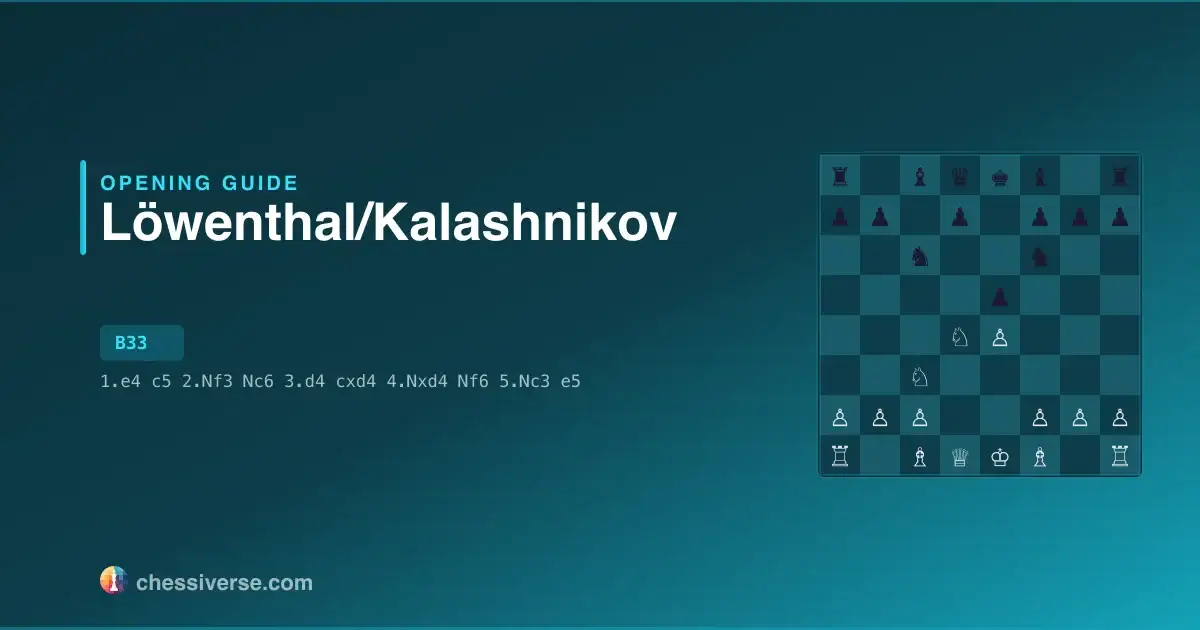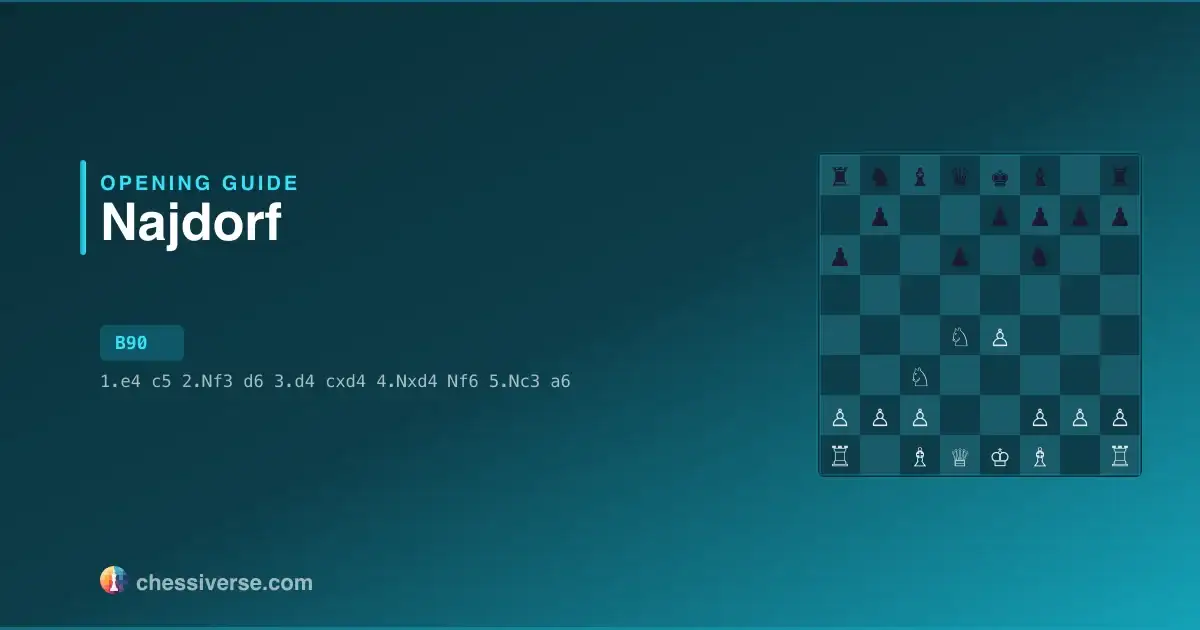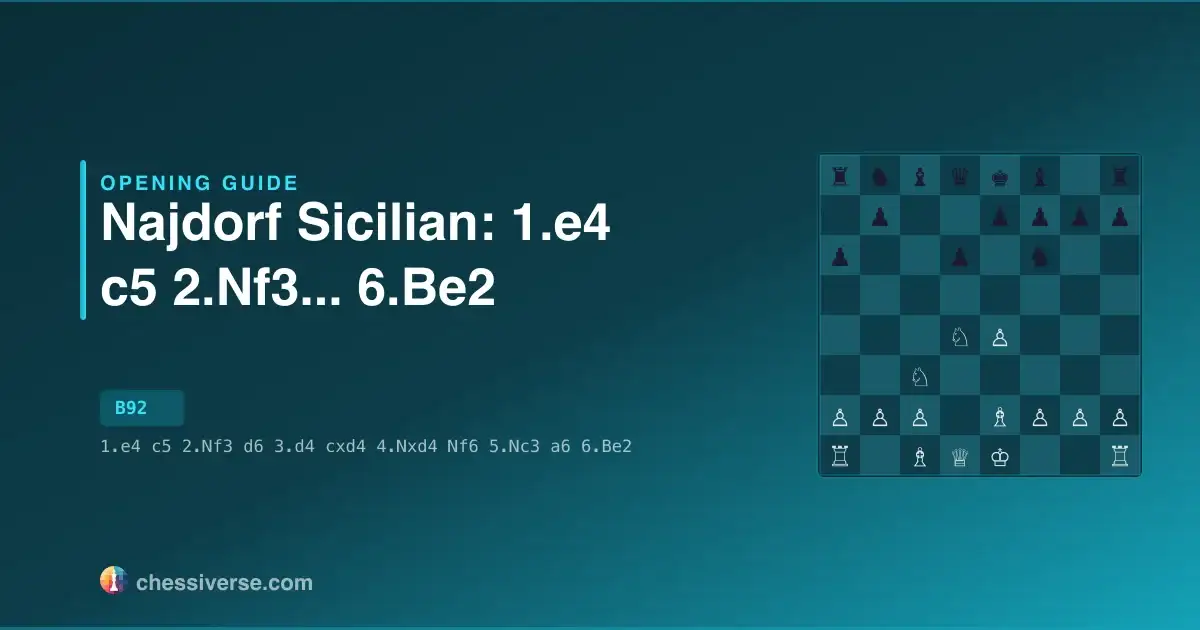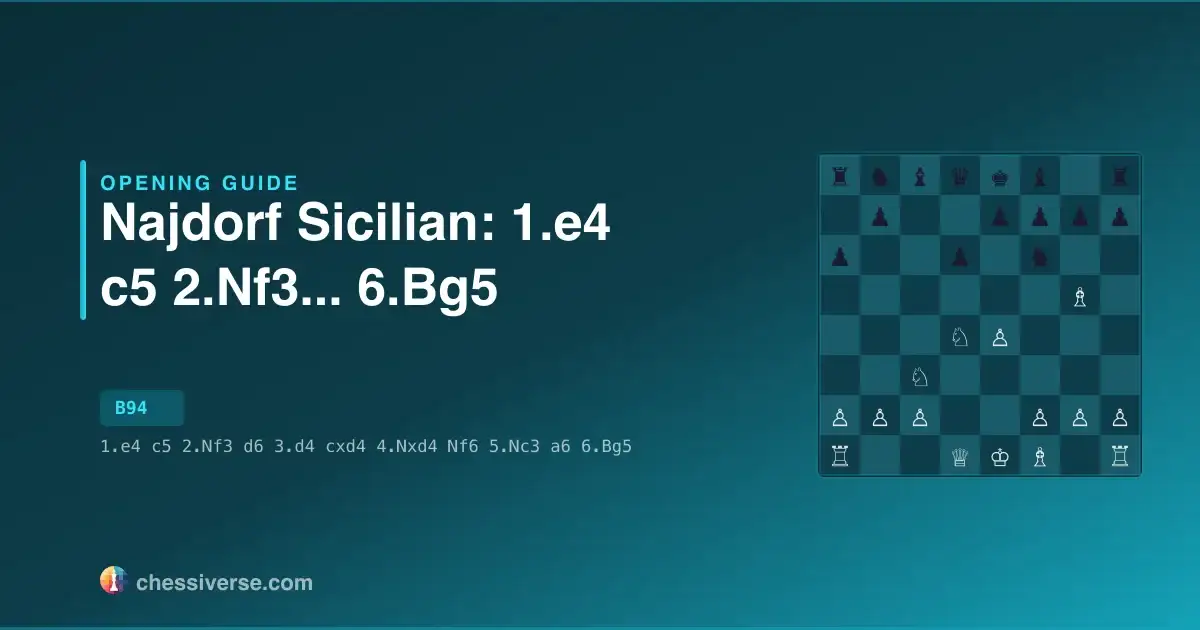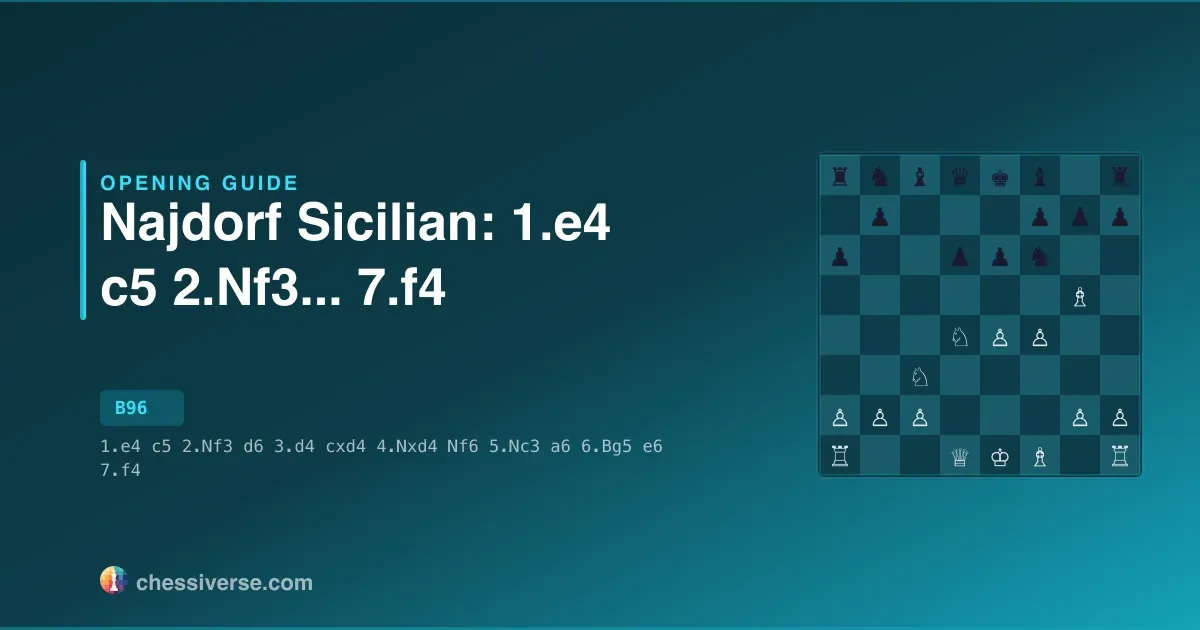
The Sicilian Defense: Najdorf Variation (7.f4) begins with 1.e4 c5 2.Nf3 d6 3.d4 cxd4 4.Nxd4 Nf6 5.Nc3 a6 6.Bg5 e6 7.f4 (ECO B96). The Najdorf main line is now fully loaded. Black gets to pick the poison — Poisoned Pawn, Polugaevsky, or something quieter — and each option leads into the deepest theory in chess.
Strategic Overview
This is the Najdorf main line in full force, and the branching point where Black commits to one of several massively theoretical paths. The Poisoned Pawn Variation with 7...Qb6 is the most legendary: Black grabs the b2-pawn, forces White to demonstrate concrete compensation, and the game often turns into a wild tactical melee where engines and World Champions have spent decades mapping the precise lines. The Polugaevsky Variation with 7...b5 is similarly aggressive, pushing queenside expansion and creating immediate threats against the c3-knight. Quieter alternatives like 7...Be7 or 7...Nbd7 (the Browne) trade some sharpness for more stable positions but are still highly theoretical. White's plan is unified across these lines: maintain the attacking initiative with pieces, prepare e5 to crack the center, castle queenside, and aim everything at Black's kingside. The strategic essence is asymmetric: White is going for the throat, Black is grabbing material or counterattacking on the other flank, and the question is who arrives first. These are the sharpest, most studied positions in the entire opening, and the games tend to be decisive. Knowing the theory cold is essential at any serious level.
Key Ideas
The recurring motifs below distinguish a confident handler of this opening from a beginner:
- Poisoned Pawn with 7...Qb6 — Black grabs the b2-pawn and dares White to prove compensation. The line is the most legendary in modern chess theory and has been a battleground from Fischer-Spassky to contemporary world championship matches. Tactics decide everything.
- Polugaevsky with 7...b5 — Black pushes queenside immediately, attacking the e4-pawn indirectly and creating immediate threats. The lines are sharp and concrete — players who don't know the theory often get blown off the board.
- Quieter 7...Be7 setups — Black can also play classically with ...Be7, ...Nbd7, ...0-0 or queenside castling depending on White's setup. Less sharp than the main lines but still highly theoretical and respected.
- Asymmetric race — Both sides attack on opposite sides. White goes after Black's king, Black goes after material or White's king after queenside castling. The games are unbalanced from move ten and decisive results are the norm.
- Top theoretical battleground — More analysis has been done on this position than almost any other in chess. World championship matches have been decided here, and engine theory continues to evolve. Preparation matters more than understanding alone.
History and Notable Players
It arises from the Sicilian Defense: Najdorf Variation (6...e6). On the White side, Thomas Luther (69 games), Jonny Hector (59 games), Milan Matulovic (47 games) top the database. Notable Black exponents: Walter S Browne (62 games), Lev Polugaevsky (40 games), Miguel Angel Quinteros (37 games).
Performance Across Rating Levels
Popularity and results vary sharply by rating level. At 1200 Elo, the opening shows up in 0.00% of games (8,408 samples). White scores 49.2%, Black 47.7%, draws 3%. By 1800, popularity is 0.04% and White's score is 50.5% to Black's 45.7%. At the top end (2500+ Elo), popularity is 0.28% with 7.4% draws — a clear sign of how much theory rules the line at master level.
Time Control Patterns
The Sicilian Defense: Najdorf Variation (7.f4) skews toward blitz chess. In bullet, it appears in 0.02% of games (503,255); White wins 48.6%. Blitz shows 0.04% adoption across 1,403,711 games, White scoring 49.8%. In rapid, the share rises to 0.02% — 206,605 games, White 51.2%. White's score swings 2.6pp across formats, so time control isn't just a stylistic choice here — it shifts the actual results.
Move Diversity and Theory Depth
What players actually play after the opening moves depends heavily on rating. At 1200 Elo (8,408 games), the top reply is Be7, played 67.8% of the time. Two other moves each take at least 5% of games, and the top three moves account for 85.3% of games. Entropy: 1.76. By 2500 (38,314 games), Be7 is still the top reply, at 37.3%; four other moves reach 5% and the top three moves account for 76.5% of games. Entropy rises to 2.35. Even elite players don't fully agree on the best continuation here, which keeps the position dynamic.
Historical Trends
Long-term, the trajectory of this opening is informative. Adoption peaked in 2017 at 0.05% (55,495 games). By 2025 it sits at 0.02%, 50% below the peak but still 61% above its 2013 level, so the line is up over the full period despite easing from the high.
Main Lines and Variations
From the position after 1.e4 c5 2.Nf3 d6 3.d4 cxd4 4.Nxd4 Nf6 5.Nc3 a6 6.Bg5 e6 7.f4, the recognised continuations are:
Each branch leads to a different middlegame character — the resulting pawn structure decides what kind of game you get.
Common Mistakes
- Neglecting development — Extra pawn moves in the opening are tempting, especially when you "know the moves". Developing a piece each turn is the simple correction.
- Ignoring the kingside attack — In sharp Sicilian lines, White typically castles long and pushes the h-pawn. Without your own counterplay on the queenside or in the centre, White's attack lands first.
Practice on Chessiverse
Ready to try the Sicilian Defense: Najdorf Variation (7.f4) against a bot? Pick an opponent at your level and play a game.