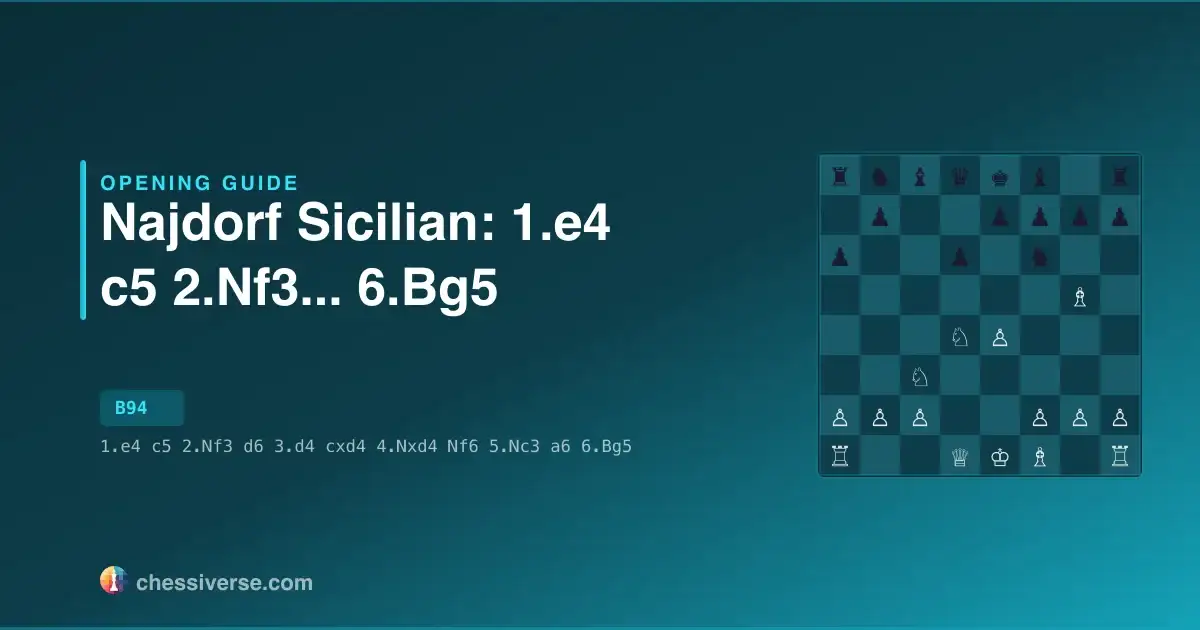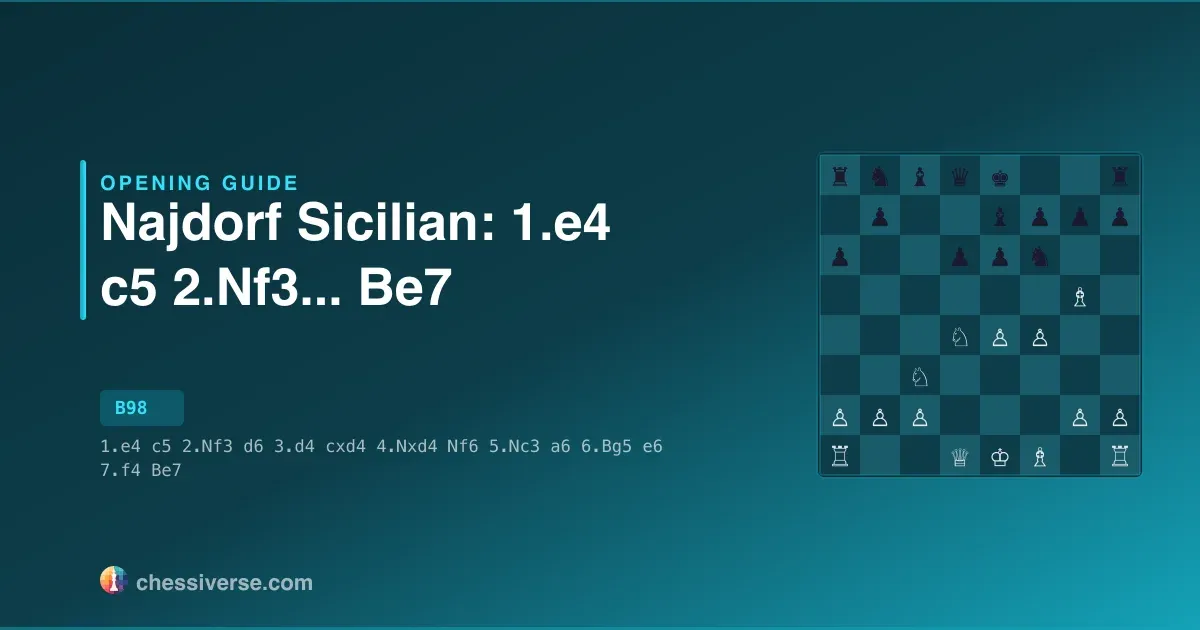
Starting from 1.e4 c5 2.Nf3 d6 3.d4 cxd4 4.Nxd4 Nf6 5.Nc3 a6 6.Bg5 e6 7.f4 Be7, players enter the Sicilian Defense: Najdorf Variation (7...Be7) — ECO B98. Black breaks the pin with the quietest available move, declining to grab b2 and instead inviting White to launch the full Bg5/f4 attacking machine.
Strategic Overview
7...Be7 is the classical answer to the most aggressive Najdorf setup. Black unpins the f6 knight, prepares to castle, and signals that the game will be won or lost on calm development rather than a Poisoned Pawn raid. That does not make it slow chess. White's pieces are already pointed at the kingside: pawns on e4 and f4, bishop on g5, knight on d4, and the queen ready to swing to f3 or g3. The sacrificial themes on d5, e6, g7 and f7 are all live. Black's job is to complete development without falling into one of them. The main path runs through ...Nbd7, ...Qc7, and short castling, after which Black aims for the freeing break ...b5 or ...e5 at the right moment. White typically goes long, with Qf3, O-O-O, g4 and h4, hunting the king with pawns. This used to be the absolute main line of the Najdorf and it produced enormous chunks of theory, including some of the most famous attacking games of the twentieth century. The Poisoned Pawn has stolen most of its attention since, but 7...Be7 remains a robust, principled choice for players who would rather castle than count tempi against a forced sacrifice.
Key Ideas
When players succeed in this line, they usually do so by leaning on the following themes:
- Quietly unpin and head for short castle — 7...Be7 keeps the position classical. Black wants to develop, castle kingside, and only then think about ...b5 or central pawn breaks.
- All four sac squares are loaded — White's pieces aim at d5, e6, g7, and f7. Any slow move by Black risks being met with a piece sacrifice that opens the position before the king is safe.
- Opposite-side castling is the usual frame — White typically goes long after Qf3 and O-O-O, then races forward with g4 and h4 against Black's short-castled king. Both sides storm pawns at each other.
- Theory runs deep and stays sharp — This line built a huge body of forced variations. Anyone playing either colour needs to know specific move orders rather than rely on general Sicilian feel.
- Now a sideline to the Poisoned Pawn — Once the main road, 7...Be7 has lost ground to 7...Qb6 in elite practice. It remains fully sound and is a saner practical choice for most players.
History and Notable Players
It arises from the Sicilian Defense: Najdorf Variation (7.f4). Among the most prolific White practitioners are Milan Matulovic (22 games), Thomas Luther (16 games), Bruno Parma (15 games). Black-side regulars include Walter S Browne (45 games), Nick E De Firmian (24 games), Robert James Fischer (21 games).
Performance Across Rating Levels
Popularity and results vary sharply by rating level. The 1200 bracket has 5,882 games (0.00% of all games at that level); White wins 48.7%, Black 48.3%, 2.9% are drawn. At 1800 the opening surfaces in 0.03% of games; White wins 51.6%, Black 44.6%, draws 3.8%. Among 2500-rated players the line appears in 0.11% of games and draws spike to 7.8%, indicating tight preparation.
Time Control Patterns
The Sicilian Defense: Najdorf Variation (7...Be7) skews toward blitz chess. In bullet, it appears in 0.01% of games (319,094); White wins 50%. Blitz shows 0.02% adoption across 862,028 games, White scoring 51.3%. In rapid, the share rises to 0.01% — 141,932 games, White 52.5%. White's score swings 2.5pp across formats, so time control isn't just a stylistic choice here — it shifts the actual results.
Move Diversity and Theory Depth
What players actually play after the opening moves depends heavily on rating. At 1200 Elo (5,882 games), the top reply is Qf3, played 35.7% of the time. Four other moves each take at least 5% of games, and the top three moves account for 72.4% of games. Entropy: 2.62. By 2500 (14,376 games), Qf3 dominates at 92.1% of replies; only one other move still reaches 5% and the top three moves account for 98.5% of games. Entropy drops to 0.52. That entropy collapse is the signature of a line where preparation pays off: at the top, players know the best move and play it.
Historical Trends
Long-term, the trajectory of this opening is informative. Adoption peaked in 2017 at 0.03% (34,062 games). By 2025 it sits at 0.02%, 49% below the peak but still 27% above its 2013 level, so the line is up over the full period despite easing from the high.
Main Lines and Variations
From the position after 1.e4 c5 2.Nf3 d6 3.d4 cxd4 4.Nxd4 Nf6 5.Nc3 a6 6.Bg5 e6 7.f4 Be7, the recognised continuations are:
Each branch leads to a different middlegame character — the resulting pawn structure decides what kind of game you get.
Common Mistakes
- Drifting away from main theory — At 1000 Elo, the three most-played moves cover 72.9% of games, against 93.2% at 2000. The most popular deviation is Bc4 (played 8.2% of the time at 1000, much less so up top). It looks fine but quietly hands the better-prepared side an edge.
- Neglecting development — It can feel productive to make extra pawn moves early, but falling behind in piece development is what loses most amateur games — especially in open positions where active pieces find squares fast.
- Ignoring the kingside attack — In sharp Sicilian lines, White typically castles long and pushes the h-pawn. Without your own counterplay on the queenside or in the centre, White's attack lands first.
Practice on Chessiverse
Ready to try the Sicilian Defense: Najdorf Variation (7...Be7) against a bot? Pick an opponent at your level and play a game.