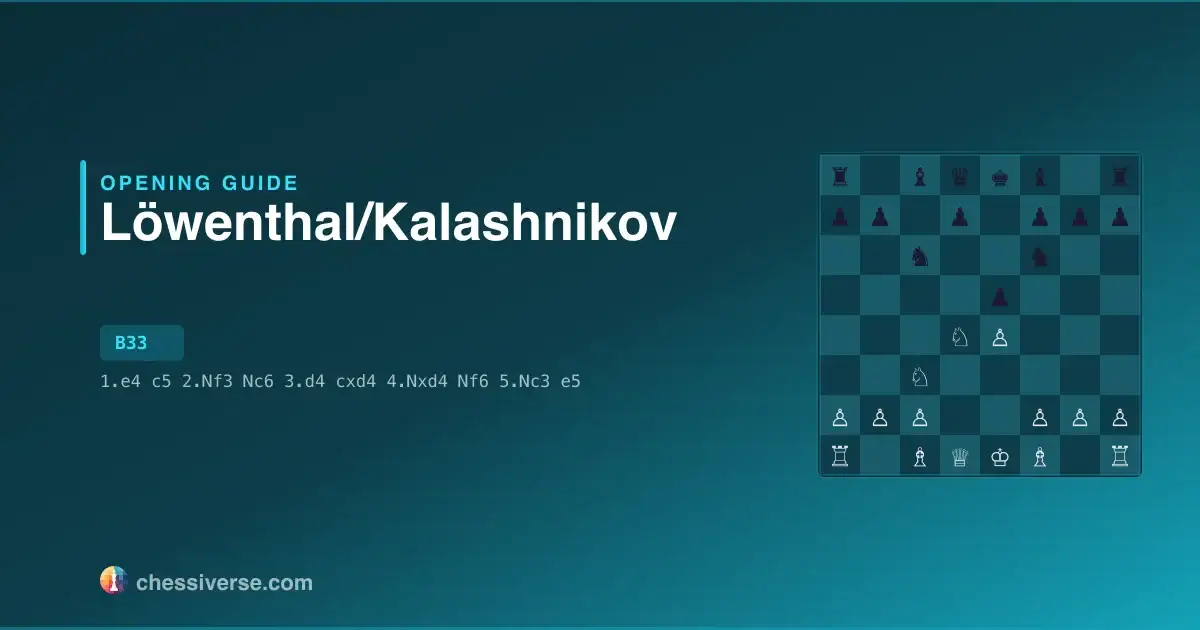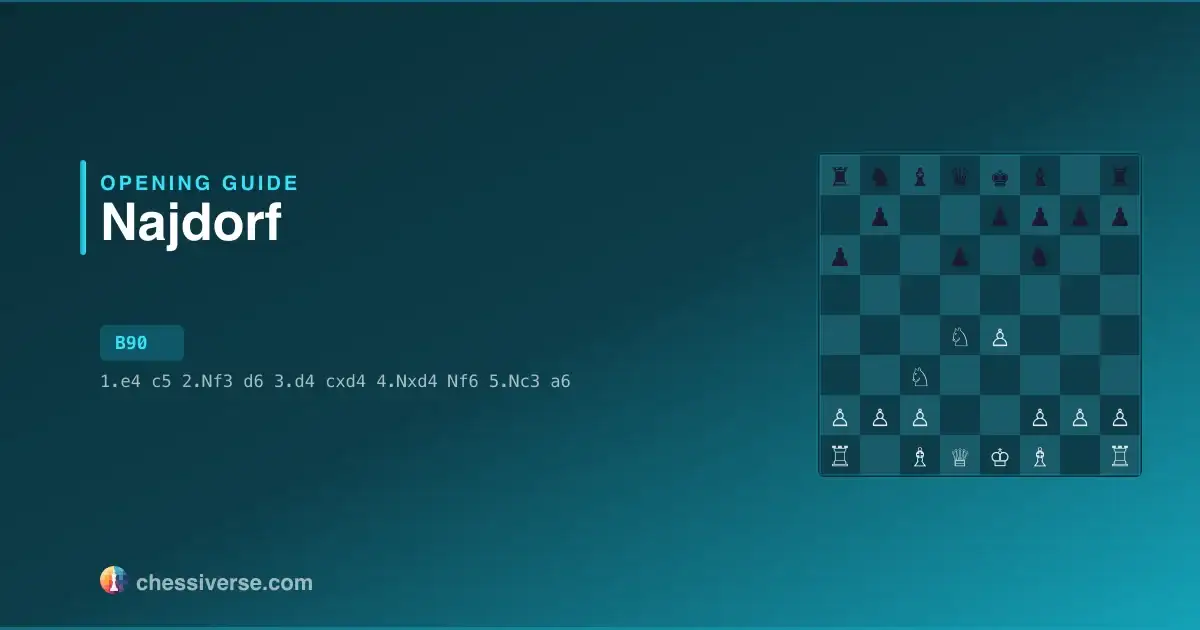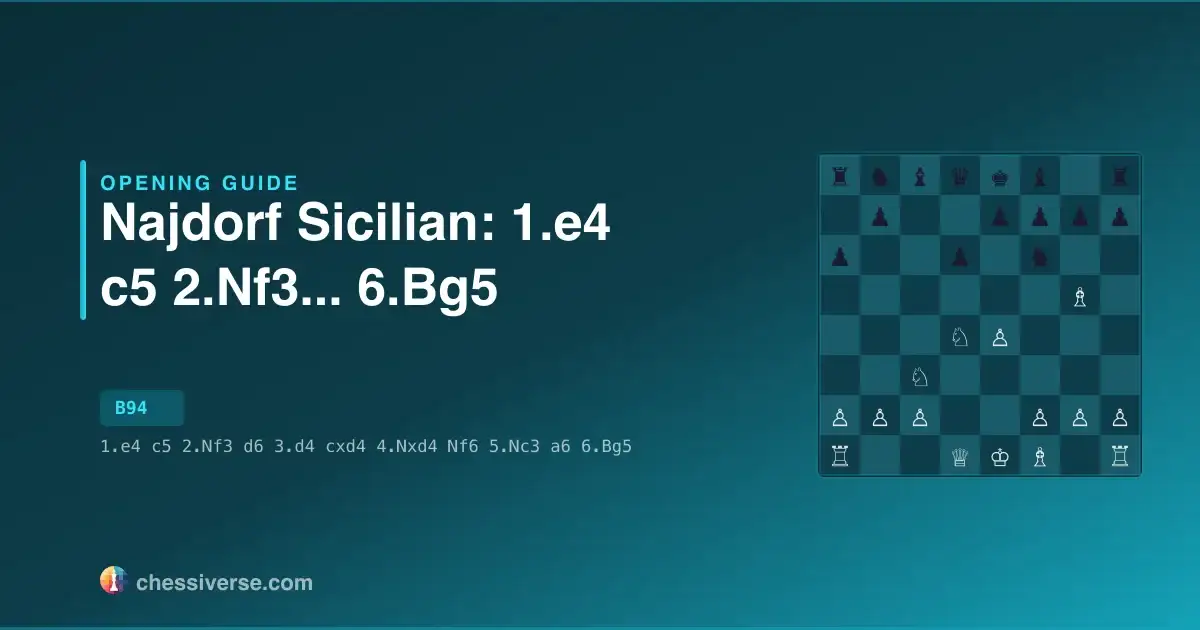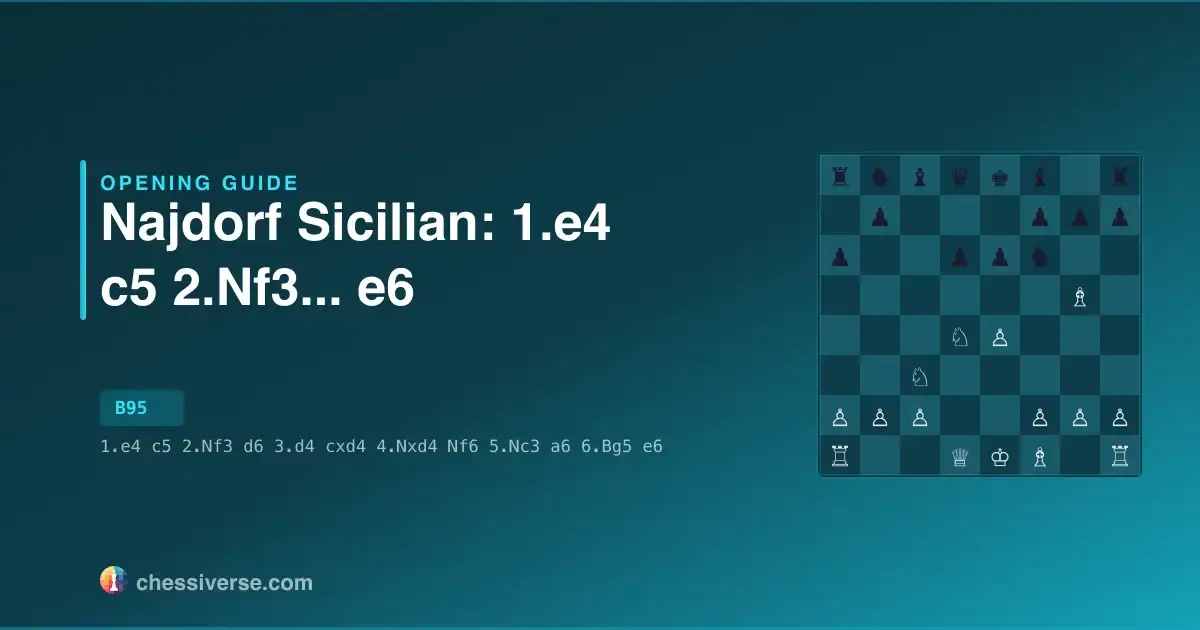




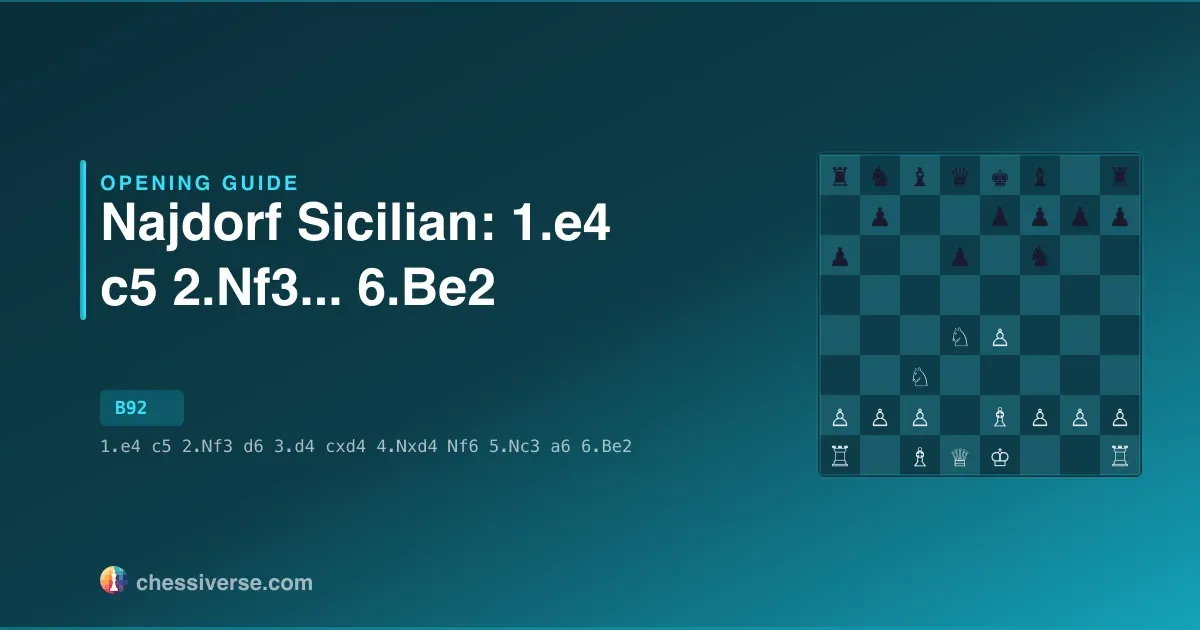
1.e4 c5 2.Nf3 d6 3.d4 cxd4 4.Nxd4 Nf6 5.Nc3 a6 6.Be2 opens the Sicilian Defense: Najdorf Variation, Opocensky Variation, ECO B92. White picks the calm, classical response to the Najdorf — bishop to e2, watch g4, castle short, and let Black solve his own problems. It's not the sharpest line, but it's bulletproof.
Strategic Overview
The 6.Be2 line, sometimes called the Classical Najdorf or Opocensky Variation, is one of the most respected positional approaches against Black's Najdorf setup. Rather than crashing in with 6.Bg5 or 6.Be3 sharp attacks, White develops modestly and keeps everything together: Be2, 0-0, f4 or a4 depending on Black's setup, and a balanced fight for the central squares. The bishop on e2 covers g4, which means Black can't easily generate counterplay with ...Bg4 ideas, and it leaves the kingside structure intact for a short castle. Black's main setups against this involve ...e5 (taking space and locking the center) or ...e6 (going for a Scheveningen-style structure with more flexibility). The middlegame becomes a maneuvering battle over the d5-square and the queenside expansion: White typically plays a4 to slow ...b5, then looks for piece play in the center; Black expands with ...Nbd7, ...b5 at the right moment, ...Bb7, and tries to exploit the half-open c-file. The whole line favors players who understand the typical Sicilian structures well and aren't looking for a quick tactical hit. At club level it's a great practical choice — sound, easy to play, and avoids the gigantic theoretical tunnels of the more aggressive Najdorf systems.
Key Ideas
A few ideas come up again and again in this opening:
- Solid, not flashy — 6.Be2 trades sharpness for solidity. White isn't looking for a forced theoretical advantage — he's looking for a well-coordinated middlegame where his structural understanding can outplay Black over thirty moves.
- Bishop on e2 covers g4 — By placing the bishop on e2, White prevents annoying ...Bg4 ideas and keeps the kingside ready for short castling. It's a small but real positional service that makes the rest of the setup function smoothly.
- Choose between ...e5 and ...e6 — Black's two main setups against 6.Be2 lead to fundamentally different middlegames. ...e5 grabs space and fixes the structure, ...e6 keeps flexibility and aims for Scheveningen-style play. The choice shapes everything that follows.
- a4 stops ...b5 — White's standard prophylactic move is a4, which slows or prevents Black's standard ...b5 expansion. Without queenside counterplay, Black has to find alternative ways to generate activity.
History and Notable Players
It arises from the Sicilian Defense: Najdorf Variation. On the White side, Vlastimil Jansa (96 games), Vitaly Tseshkovsky (66 games), Natalija Pogonina (62 games) top the database. Notable Black exponents: Lubomir Ftacnik (77 games), Robert Kempinski (60 games), Loek Van Wely (52 games).
Performance Across Rating Levels
The picture changes a lot as you climb the rating ladder. At 1200 Elo, the opening shows up in 0.01% of games (36,025 samples). White scores 47.9%, Black 48.7%, draws 3.4%. At 1800 the opening surfaces in 0.09% of games; White wins 47%, Black 48%, draws 5%. Among 2500-rated players the line appears in 0.20% of games and draws spike to 8.7%, indicating tight preparation. Positions also become less sharp as level rises (sharpness 0.97 → 0.91).
Time Control Patterns
Look at the same opening across time controls and blitz stands out. In bullet, it appears in 0.02% of games (636,831); White wins 46.9%. Blitz shows 0.05% adoption across 1,845,263 games, White scoring 47.1%. In rapid, the share rises to 0.04% — 392,685 games, White 47%.
Move Diversity and Theory Depth
What players actually play after the opening moves depends heavily on rating. At 1200 Elo (36,025 games), the top reply is e5, played 41.3% of the time. Four other moves each take at least 5% of games, and the top three moves account for 76.4% of games. Entropy: 2.41. By 2500 (26,698 games), e5 dominates at 73.9% of replies; only one other move still reaches 5% and the top three moves account for 97.3% of games. Entropy drops to 1.12. The narrowing is significant — strong players consolidate around a small set of best moves, while amateurs scatter across many plausible-looking options.
Historical Trends
Long-term, the trajectory of this opening is informative. Adoption peaked in 2016 at 0.08% (47,195 games). By 2025 it sits at 0.03%, 56% below the peak and 33% under its 2013 level, leaving the line in decline.
Common Mistakes
- Drifting away from main theory — At 400 Elo, the three most-played moves cover 77.2% of games, against 89.4% at 2000. The most popular deviation is g6 (played 16.8% of the time at 400, much less so up top). It looks fine but quietly hands the better-prepared side an edge.
- Neglecting development — Extra pawn moves in the opening are tempting, especially when you "know the moves". Developing a piece each turn is the simple correction.
- Ignoring the kingside attack — In sharp Sicilian lines, White typically castles long and pushes the h-pawn. Without your own counterplay on the queenside or in the centre, White's attack lands first.
Practice on Chessiverse
Ready to try the Sicilian Defense: Najdorf Variation, Opocensky Variation against a bot? Pick an opponent at your level and play a game.