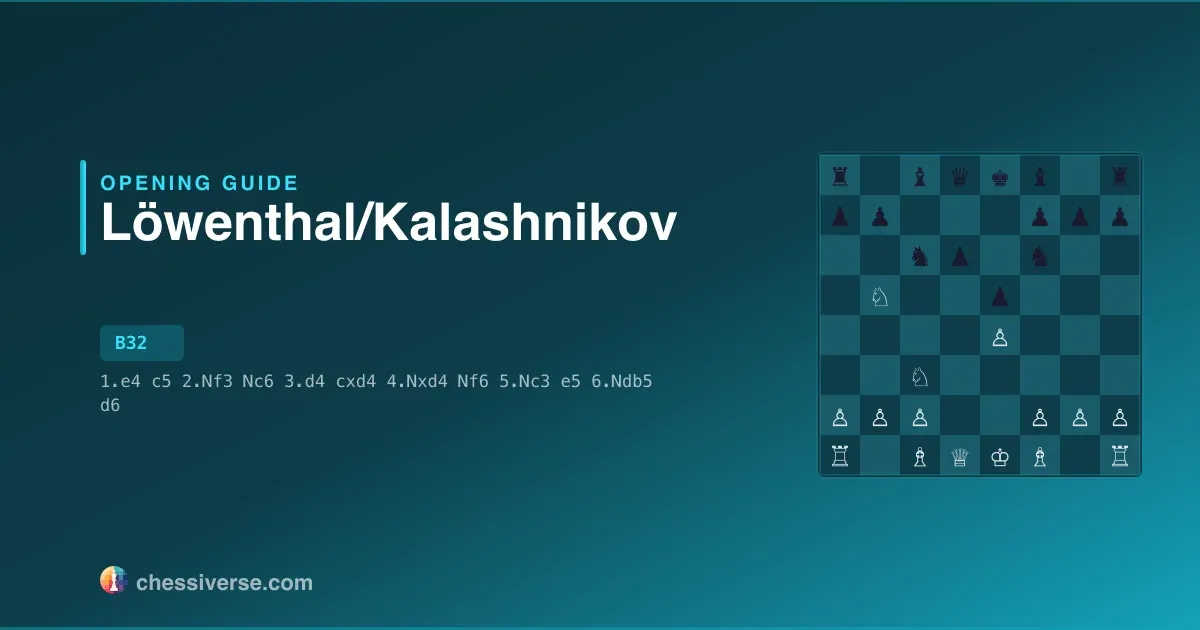
The Sicilian Defense: Löwenthal-Kalashnikov arises after 1.e4 c5 2.Nf3 Nc6 3.d4 cxd4 4.Nxd4 e5 and falls under ECO code B32. Black attacks the d4 knight at once instead of developing with ...Nf6 first, so White has to decide where the knight goes before Black has committed the g8 knight or the d-pawn. The move ...e5 takes the e-pawn's control away from d6 and leaves d5 without pawn cover, and White's most testing reply, 5.Nb5, goes straight for d6. Black then chooses between two systems: 5...a6, the Löwenthal Variation, and 5...d6, the Kalashnikov Variation. With 12.7 million Lichess games across all rating levels, it is a well-established opening choice.
- Black takes on a backward d6-pawn and a weakened d5-square, but gains time by chasing White's knight around.
- White's plan of Bg5 and Bxf6 to inflict doubled f-pawns can be sidestepped if Black develops the knight to e7 rather than f6.
History and Notable Players
It arises from the Sicilian Defense: Open. The two names on this page belong to the two answers to 5.Nb5: the Löwenthal Variation (5...a6) and the Kalashnikov Variation (5...d6). Among the most active players in ECO B32 games are Oleg Korneev (188 games), Janis Klovans (132 games) and Vlastimil Jansa (124 games) with White, and Milan Matulovic (176 games), Mark E Taimanov (165 games) and Evgeny Sveshnikov (142 games) with Black.
The early ...e5 idea in the Sicilian goes back to La Bourdonnais's 1834 matches against McDonnell.
Named after: Johann Löwenthal, one of the strongest masters of the mid-19th century.
Notable players: Evgeny Sveshnikov
Statistics
Based on 12.7 million Lichess games across all rating levels:
- White wins: 48.5%
- Black wins: 46.6%
- Draws: 5%
White holds a small edge of about two points, and the split barely moves between the 1000 and 2000 brackets. At 2500 and above, draws rise to 10.5% and Black's share drops to 43.1%. Bullet is the exception: there Black wins 49.1% of games to White's 47.4%.
Main Lines and Variations
After 1.e4 c5 2.Nf3 Nc6 3.d4 cxd4 4.Nxd4 e5, the main continuations include:
- 5.Nb5 a6 (Löwenthal Variation): Black lets the knight in. 6.Nd6+ Bxd6 7.Qxd6 gives White the bishop pair and the dark squares, and Black usually continues 7...Qf6, relying on quick development.
- 5.Nb5 d6 (Kalashnikov Variation): Black covers d6 with the pawn and keeps the dark-squared bishop. White chooses between 6.c4, which tightens the grip on d5, and 6.N1c3 a6 7.Na3 b5 8.Nd5, with the fight centred on d5. The pawn structure is close to the Sicilian Defense: Sveshnikov Variation, but the g8 knight is still free to choose its square.
- 5.Nxc6 bxc6: the exchange brings Black's b-pawn toward the centre, and the c6 pawn supports a later ...d5.
- 5.Nf3, 5.Nb3 and 5.Nf5: the other knight moves, played mostly below master level.
White's choice depends heavily on rating. 5.Nxc6 is the most played move up to the 1600 bracket, and 5.Nb5 takes over from 1800, reaching 88.6% of games at 2500 and above. The three other knight moves together make up about 30% of games between the 1400 and 1800 brackets, and less than a tenth from 2200 up.
Practice on Chessiverse
The best way to learn the Sicilian Defense: Löwenthal-Kalashnikov is through practice. On Chessiverse, you can play chess against computer opponents that specialize in this opening. Our AI bots range from beginner to grandmaster level, each with unique playing styles — from aggressive attackers to solid defenders. Choose a bot that matches your rating and work your way up as you master the opening's key ideas.
Performance Across Rating Levels
How well the Sicilian Defense: Löwenthal-Kalashnikov works depends on what level you're playing at. Among 1200-rated players, it appears in 0.08% of games — 525,839 of them on record — with White winning 48.5% and Black 47.8%. At 1800 the opening surfaces in 0.48% of games; White wins 48.8%, Black 46.2%, draws 5%. At 2500, 0.35% of games go into this opening; draws sit at 10.5% — the line is well-mapped at this level.
Time Control Patterns
Look at the same opening across time controls and blitz stands out. In bullet, it appears in 0.23% of games (6,217,488); White wins 47.4%. Blitz shows 0.29% adoption across 10,585,719 games, White scoring 48.4%. In rapid, the share rises to 0.19% — 2,076,331 games, White 48.6%.
Move Diversity and Theory Depth
Move choice is far from uniform in the Sicilian Defense: Löwenthal-Kalashnikov. At 1200 Elo (525,839 games), the top reply is Nxc6, played 66.2% of the time. Three other moves each take at least 5% of games, and the top three moves account for 89.1% of games. Entropy: 1.58. By 2500 (47,187 games), Nb5 takes over as the top reply at 88.6%; no other move reaches 5% and the top three moves account for 95.6% of games. Entropy drops to 0.78. The narrowing is significant — strong players consolidate around a small set of best moves, while amateurs scatter across many plausible-looking options.