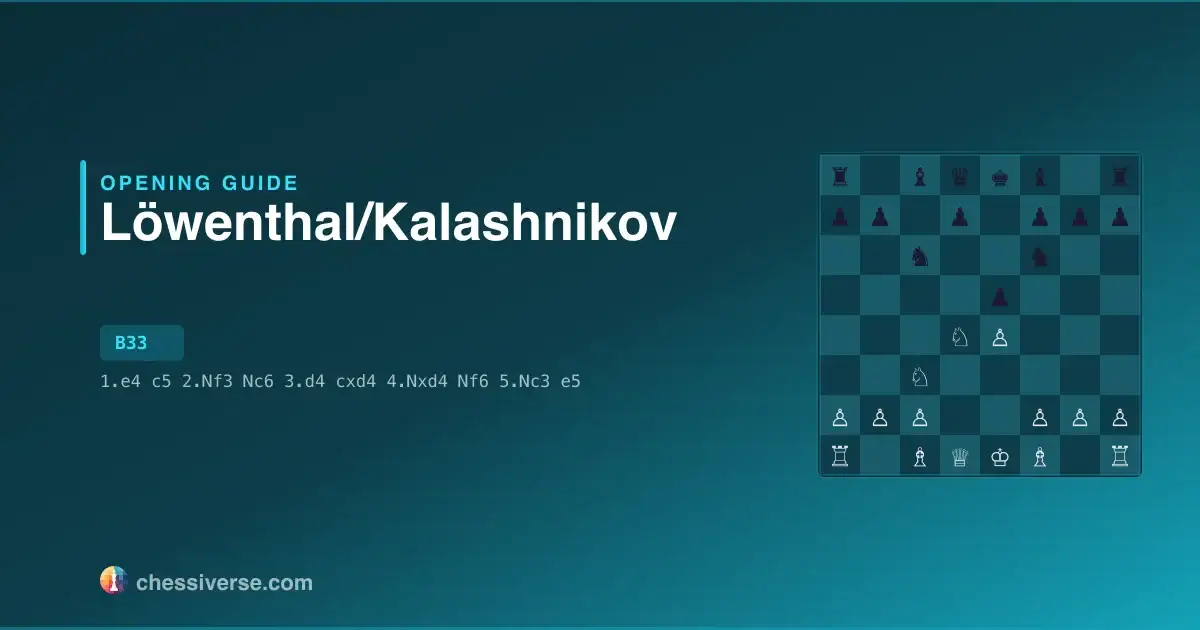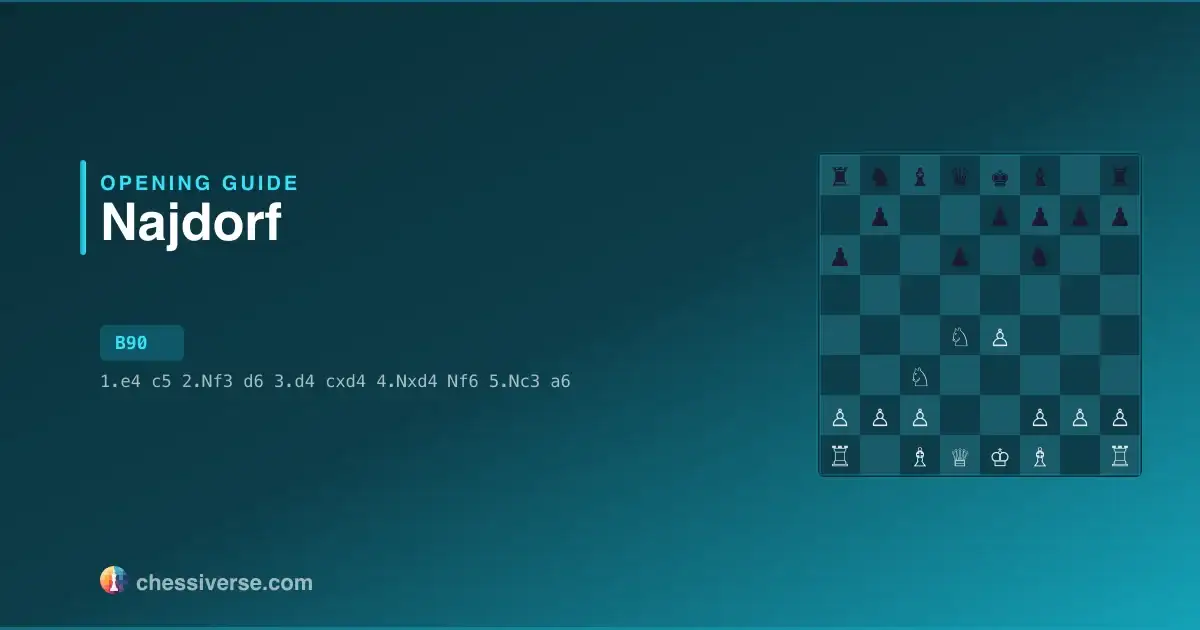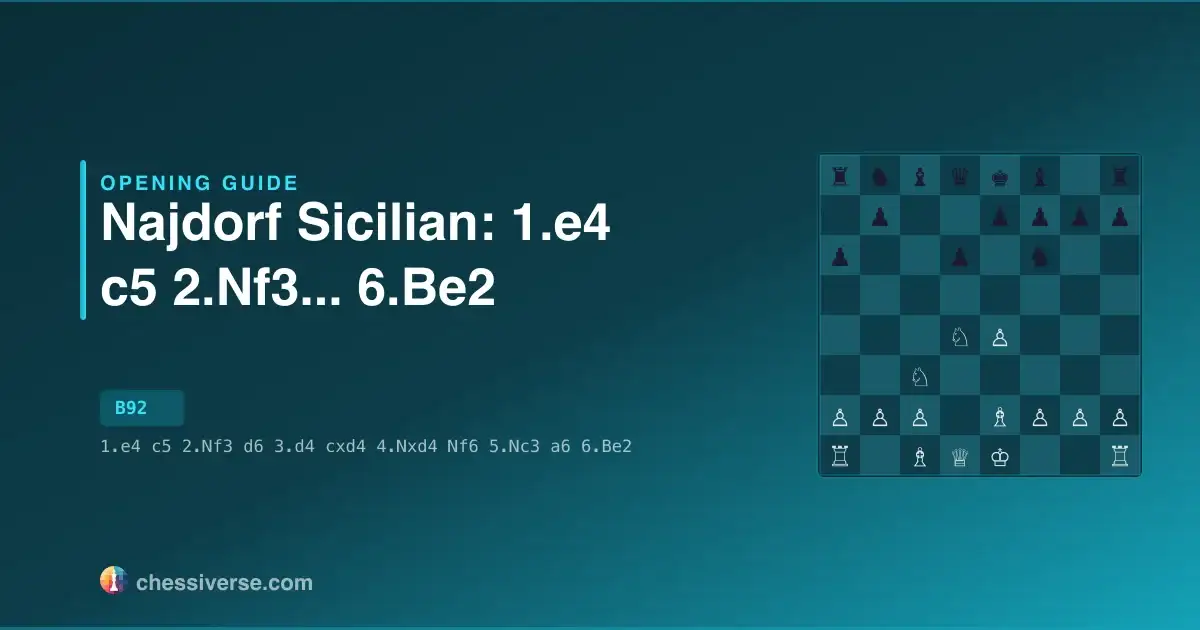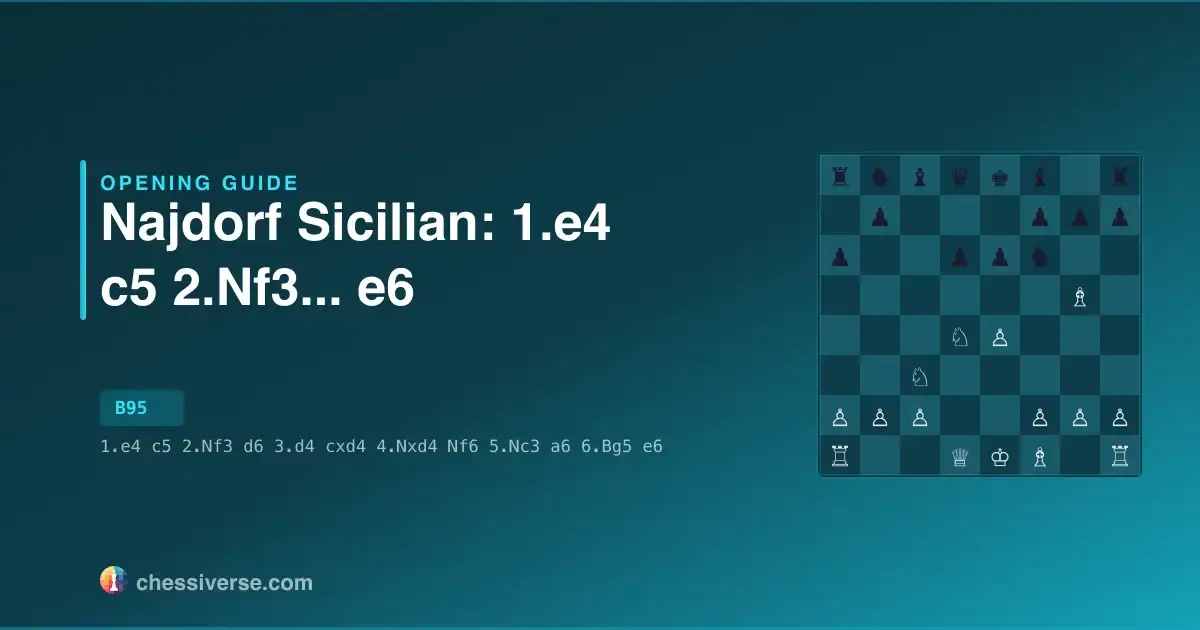




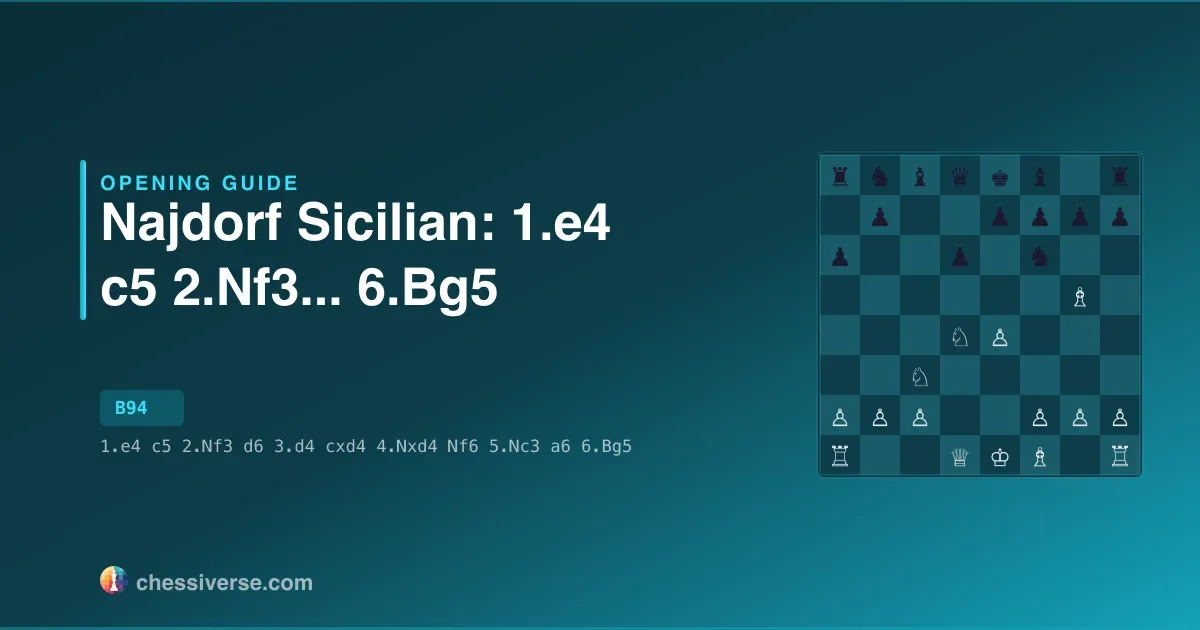
The Sicilian Defense: Najdorf Variation (6.Bg5) begins with 1.e4 c5 2.Nf3 d6 3.d4 cxd4 4.Nxd4 Nf6 5.Nc3 a6 6.Bg5 (ECO B94). White pins the f6-knight and threatens to ruin Black's structure if the bishop is allowed to capture. Black has essentially one move that doesn't fall apart.
Strategic Overview
6.Bg5 is the sharpest, most theoretical, and most aggressive answer to the Najdorf. White pins the f6-knight against the d8-queen, and the threat of Bxf6 followed by doubled pawns on the f-file is real and immediate. Black's response is essentially forced: 6...e6, the standard developing move that breaks the pin once the bishop swings to e7 or Nbd7 supports the knight. The lines that follow are some of the deepest, most analyzed positions in chess — the 7.f4 main line branches into the Poisoned Pawn Variation with 7...Qb6 (where Black snatches the b2-pawn under threat and dares White to prove compensation), the Polugaevsky with 7...b5, the Browne Variation with 7...Be7, and several others. The whole 6.Bg5 complex is the battlefield where world championship matches have been won and lost. Strategically, White accepts an early commitment of the dark-squared bishop in exchange for maximum tactical pressure on Black's position; Black accepts that the position is sharp and concrete in exchange for chances to grab material or generate counterplay along the queenside. There's no middle ground here — Black either knows the theory cold or gets crushed, and the same applies to White. It's the line for players who love sharp Sicilian theory.
Key Ideas
The recurring motifs below distinguish a confident handler of this opening from a beginner:
- The pin is the whole point — Bg5 pins the f6-knight and threatens Bxf6 with doubled f-pawns for Black. The threat shapes everything that follows — Black has to address it immediately or accept a permanent structural concession.
- 6...e6 is essentially forced — Almost any other move leaves Black with a damaged structure or worse problems. The e6 push prepares ...Be7 to break the pin and is the foundation of all the main theoretical lines that follow.
- Maximum theoretical depth — The 6.Bg5 complex contains some of the deepest preparation in chess — Poisoned Pawn, Polugaevsky, Najdorf Main Line, Browne. World championship matches have been decided here. Both sides need serious preparation.
- Sharp from move six — There's no slow maneuvering in this line. White is committed to attacking, Black is committed to counterpunching, and the games tend to be wildly tactical and decisive. It's the antithesis of a quiet positional Sicilian.
History and Notable Players
It arises from the Sicilian Defense: Najdorf Variation. Among the most prolific White practitioners are Thomas Luther (78 games), Jonny Hector (67 games), Milan Matulovic (50 games). Black-side regulars include Walter S Browne (72 games), Lev Polugaevsky (54 games), Miguel Angel Quinteros (40 games).
Performance Across Rating Levels
How well the Sicilian Defense: Najdorf Variation (6.Bg5) works depends on what level you're playing at. At 1200 Elo, the opening shows up in 0.02% of games (131,035 samples). White scores 48.2%, Black 48.3%, draws 3.5%. At 1800 the opening surfaces in 0.14% of games; White wins 47.4%, Black 48.4%, draws 4.2%. Among 2500-rated players the line appears in 0.54% of games and draws spike to 7.2%, indicating tight preparation.
Time Control Patterns
Look at the same opening across time controls and blitz stands out. In bullet, it appears in 0.07% of games (1,767,426); White wins 46.7%. Blitz shows 0.11% adoption across 3,898,761 games, White scoring 48.1%. In rapid, the share rises to 0.06% — 699,666 games, White 48%.
Move Diversity and Theory Depth
Looking at move selection shows how forcing — or not — the position really is. At 1200 Elo (131,035 games), the top reply is e6, played 45.2% of the time. Two other moves each take at least 5% of games, and the top three moves account for 84.2% of games. Entropy: 2.15. By 2500 (73,362 games), e6 dominates at 67.9% of replies; only one other move still reaches 5% and the top three moves account for 98.4% of games. Entropy drops to 1.11. The narrowing is significant — strong players consolidate around a small set of best moves, while amateurs scatter across many plausible-looking options.
Historical Trends
Year-over-year data tells you whether this opening is a contemporary fixture or a fading one. Adoption peaked in 2017 at 0.13% (151,327 games). By 2025 it sits at 0.07%, 49% below the peak but still 27% above its 2013 level, so the line is up over the full period despite easing from the high.
Main Lines and Variations
The main branches off 1.e4 c5 2.Nf3 d6 3.d4 cxd4 4.Nxd4 Nf6 5.Nc3 a6 6.Bg5 include:
Each branch leads to a different middlegame character — the resulting pawn structure decides what kind of game you get.
Common Mistakes
- Drifting away from main theory — At 400 Elo, the three most-played moves cover 76.5% of games, against 95.4% at 2000. The most popular deviation is e5 (played 34.5% of the time at 400, much less so up top). It looks fine but quietly hands the better-prepared side an edge.
- Neglecting development — It can feel productive to make extra pawn moves early, but falling behind in piece development is what loses most amateur games — especially in open positions where active pieces find squares fast.
- Ignoring the kingside attack — In sharp Sicilian lines, White typically castles long and pushes the h-pawn. Without your own counterplay on the queenside or in the centre, White's attack lands first.
Practice on Chessiverse
Ready to try the Sicilian Defense: Najdorf Variation (6.Bg5) against a bot? Pick an opponent at your level and play a game.