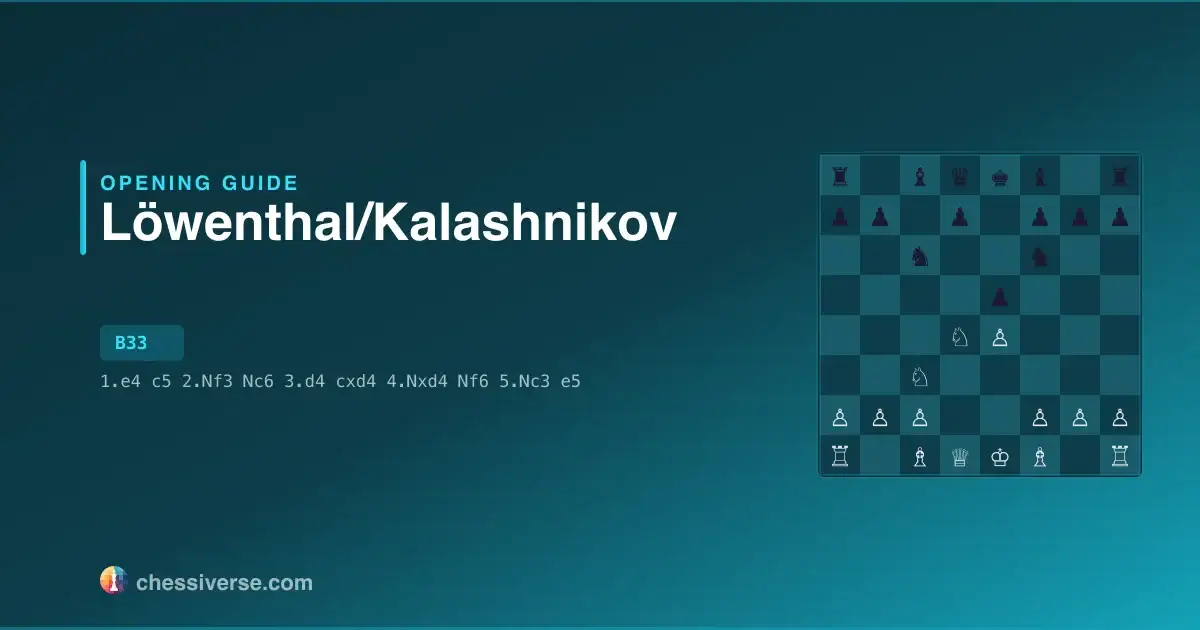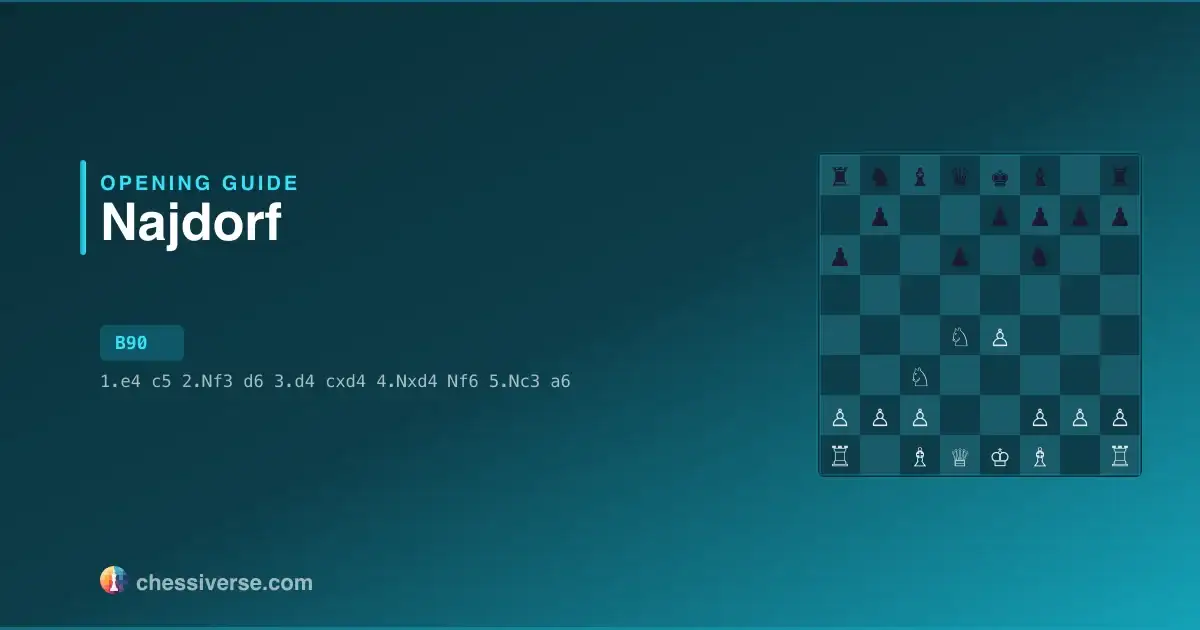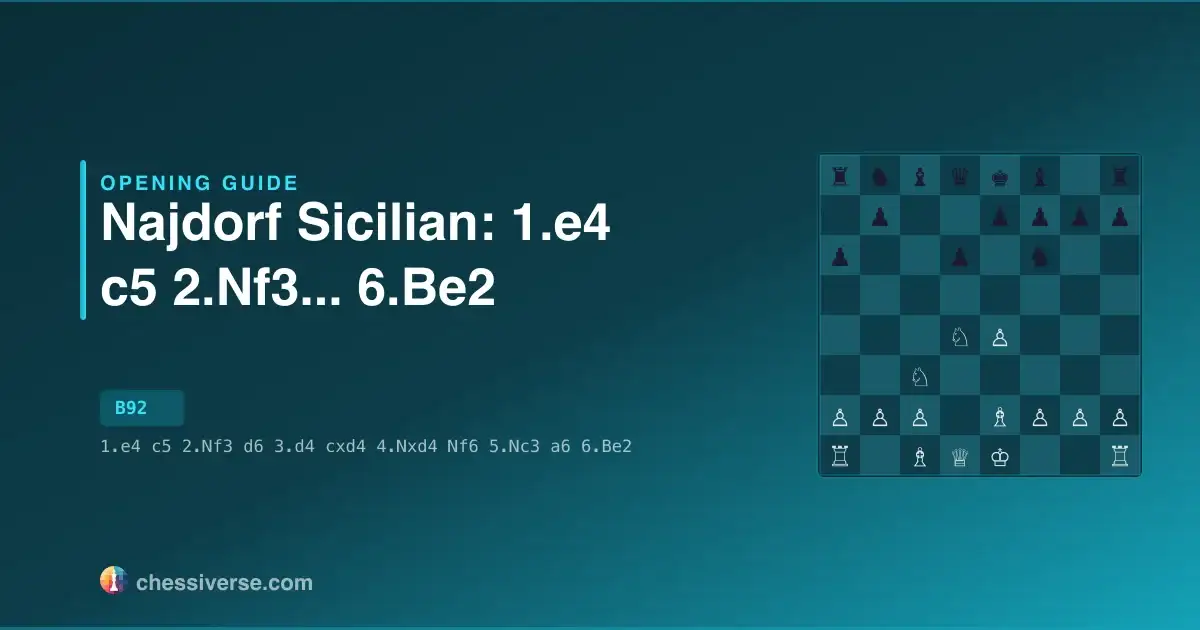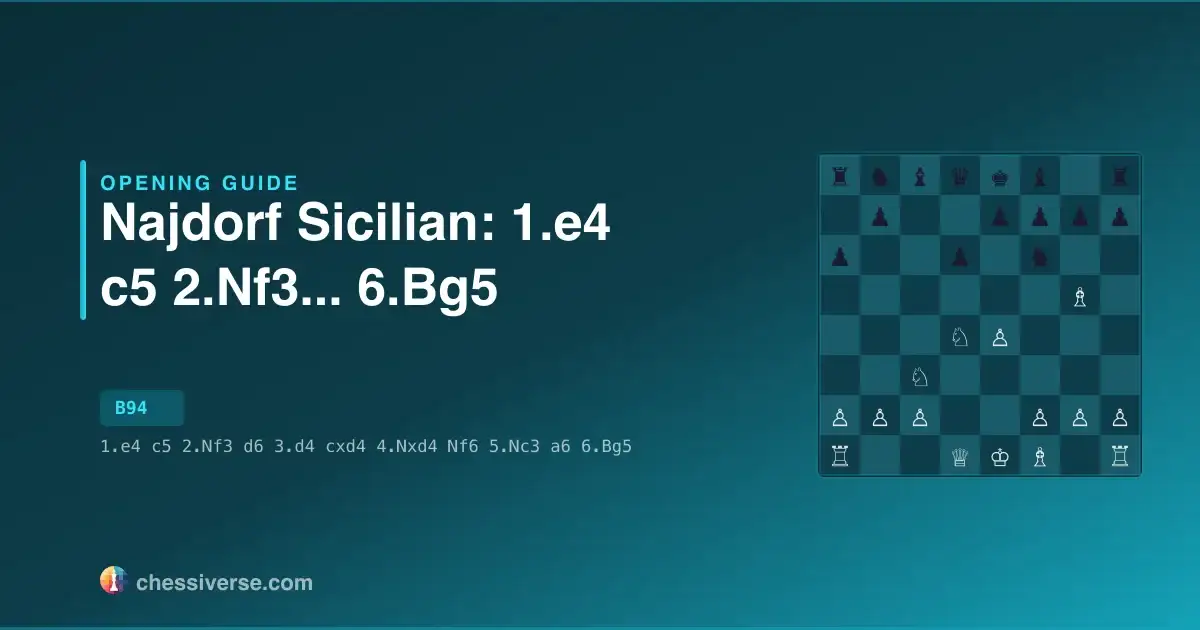


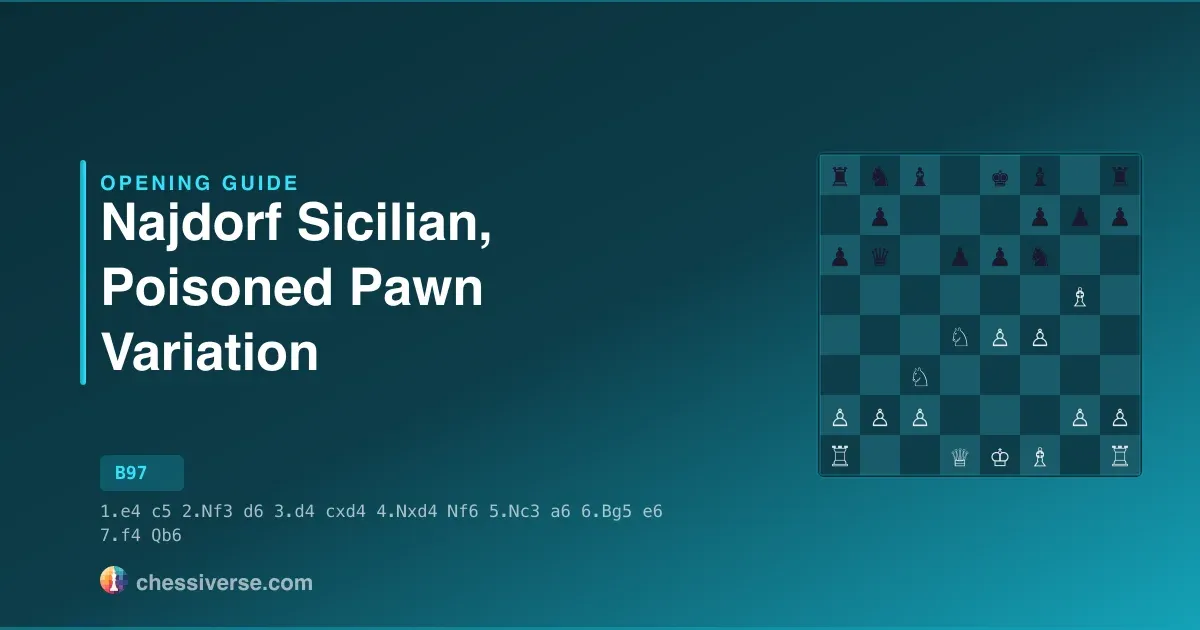
Starting from 1.e4 c5 2.Nf3 d6 3.d4 cxd4 4.Nxd4 Nf6 5.Nc3 a6 6.Bg5 e6 7.f4 Qb6, players enter the Najdorf Sicilian, Poisoned Pawn Variation — ECO B97. Black's queen lunges to b6 and grabs at b2 before development is even close to finished, daring White to prove that the pawn is too hot to swallow safely.
Strategic Overview
The Poisoned Pawn is one of the most uncompromising replies in all of opening theory. Black's whole plan is to lift the queen out early, snatch the b2 pawn, and then survive long enough to convert the extra material. Computers love it; humans need nerves of steel. After 7...Qb6, White has the choice of defending b2 with 8.Nb3 or simply letting Black take with 8.Qd2. The Nb3 lines aim for a slow squeeze: White keeps the bishop pair, builds pressure on the d-file, and counts on Black's queen being a target. The Qd2 lines turn the position into a fistfight, with both sides racing on opposite wings. Fischer's stamp is all over this variation. He treated the pawn grab as a technical problem: take the material, blunt the initiative with precise defence, and convert the endgame. Modern Najdorf players know that one slip in move order and the king on e8 gets blown off the board, so deep preparation is non-negotiable. Anyone playing either side should expect long forcing lines, sharp piece sacrifices on d5 or e6, and very little room for general principles.
Key Ideas
A few ideas come up again and again in this opening:
- Pawn-grab on b2 is the entire point — 7...Qb6 commits Black to a concrete plan: win the b2 pawn, suffer through White's initiative, and try to convert in the endgame. There is no half-measure version of this line.
- 8.Nb3 keeps the bishop pair — Defending b2 with the knight is the quiet route. White concedes nothing material and tries to make Black's queen on b6 look misplaced, often pressing slowly on d6 and the dark squares.
- 8.Qd2 invites the chaos — Letting Black take on b2 is the principled gambit. White accepts a pawn deficit for a huge lead in development and a static attack against the king stuck in the centre or on the kingside.
- King on e8 is a permanent issue — Black almost never castles short cleanly. Until the queen retreats and the centre stabilises, the e6 and d5 squares are constantly under threat of sacrifices.
- Memory matters more than ideas — Both sides need precise move orders. The Poisoned Pawn is a theory minefield where general principles will not save you from a 25-move prepared line.
History and Notable Players
It arises from the Sicilian Defense: Najdorf Variation (7.f4). On the White side, Thomas Luther (23 games), Jonny Hector (20 games), Jan H Timman (16 games) top the database. Notable Black exponents: Igor A Novikov (35 games), Peter Szekely (23 games), Miguel Angel Quinteros (22 games).
Performance Across Rating Levels
The picture changes a lot as you climb the rating ladder. The 1200 bracket has 396 games (0.00% of all games at that level); White wins 40.7%, Black 56.6%, 2.8% are drawn. By 1800, popularity is 0.00% and White's score is 46.1% to Black's 50.3%. At the top end (2500+ Elo), popularity is 0.05% with 8.5% draws — a clear sign of how much theory rules the line at master level. White's score improves by 4.8pp from the 1200 bracket to the 2500 bracket — the line rewards preparation.
Move Diversity and Theory Depth
Move choice is far from uniform in the Najdorf Sicilian, Poisoned Pawn Variation. At 1200 Elo (396 games), the top reply is Qd2, played 29% of the time. Five other moves each take at least 5% of games, and the top three moves account for 57.8% of games. Entropy: 2.97. By 2500 (6,165 games), Qd2 dominates at 60.8% of replies; only three other moves still reach 5% and the top three moves account for 86.9% of games. Entropy drops to 1.74. The narrowing is significant — strong players consolidate around a small set of best moves, while amateurs scatter across many plausible-looking options.
Common Mistakes
- Drifting away from main theory — At 1200 Elo, the three most-played moves cover 57.8% of games, against 86% at 2000. The most popular deviation is Bxf6 (played 14.2% of the time at 1200, much less so up top). It looks fine but quietly hands the better-prepared side an edge.
- Neglecting development — Extra pawn moves in the opening are tempting, especially when you "know the moves". Developing a piece each turn is the simple correction.
- Ignoring the kingside attack — In sharp Sicilian lines, White typically castles long and pushes the h-pawn. Without your own counterplay on the queenside or in the centre, White's attack lands first.
Practice on Chessiverse
Ready to try the Najdorf Sicilian, Poisoned Pawn Variation against a bot? Pick an opponent at your level and play a game.