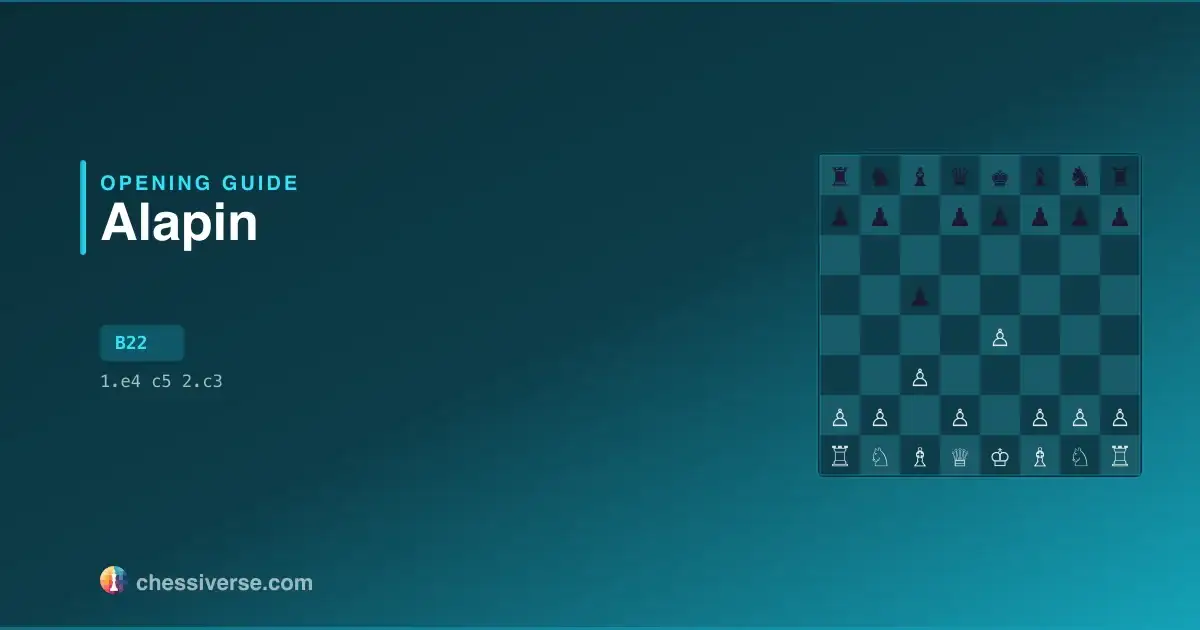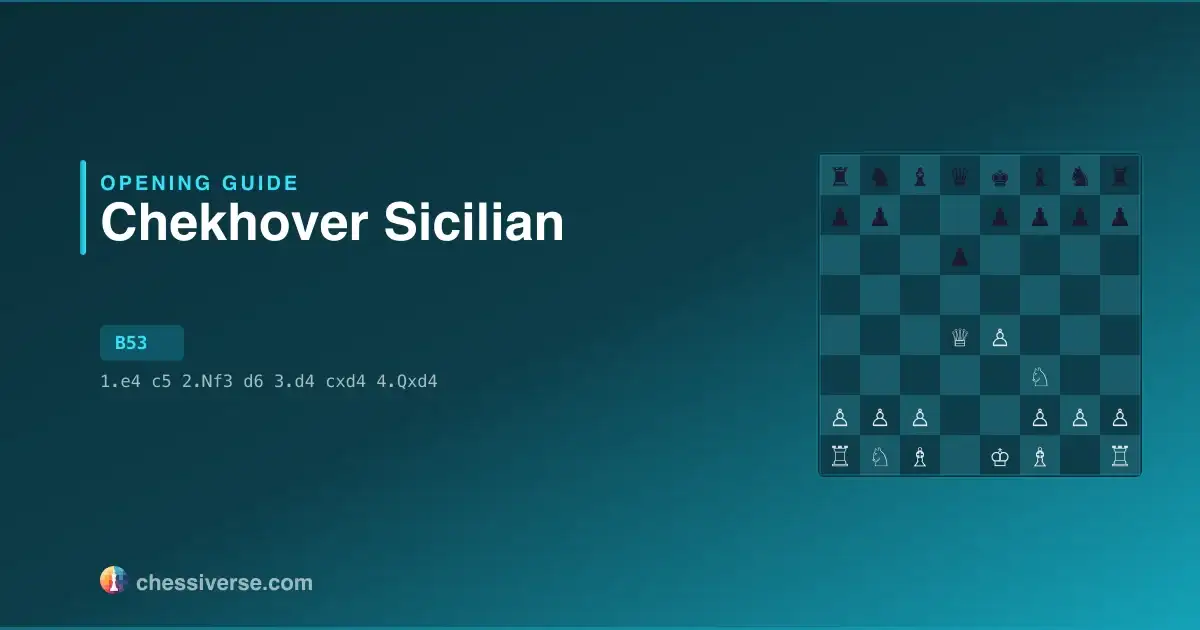


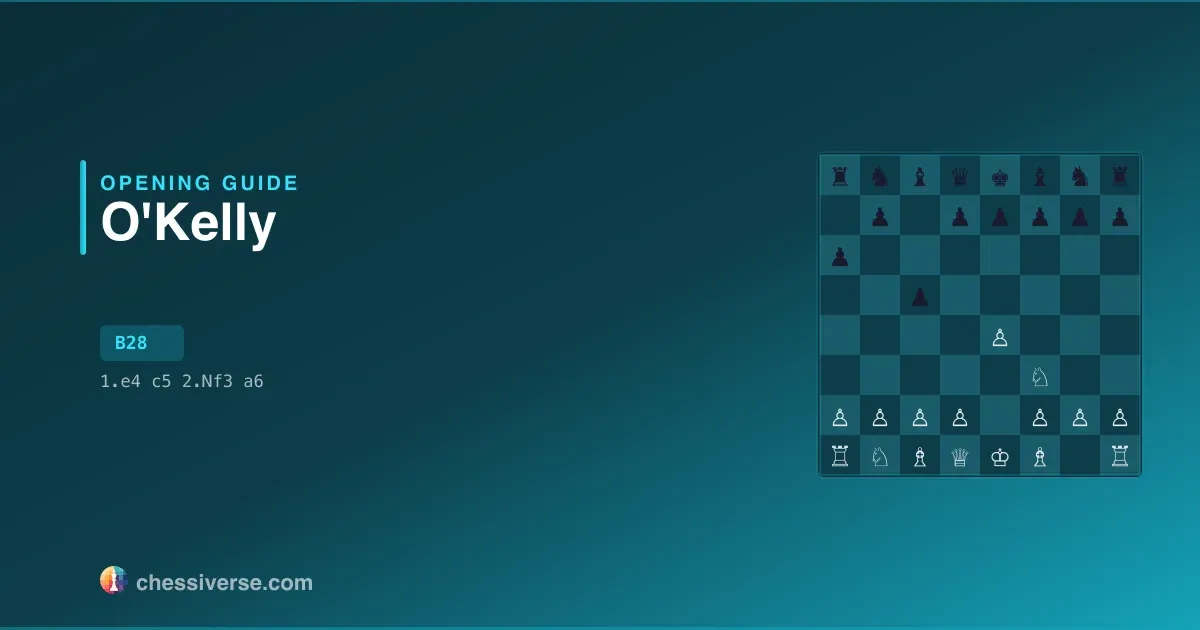
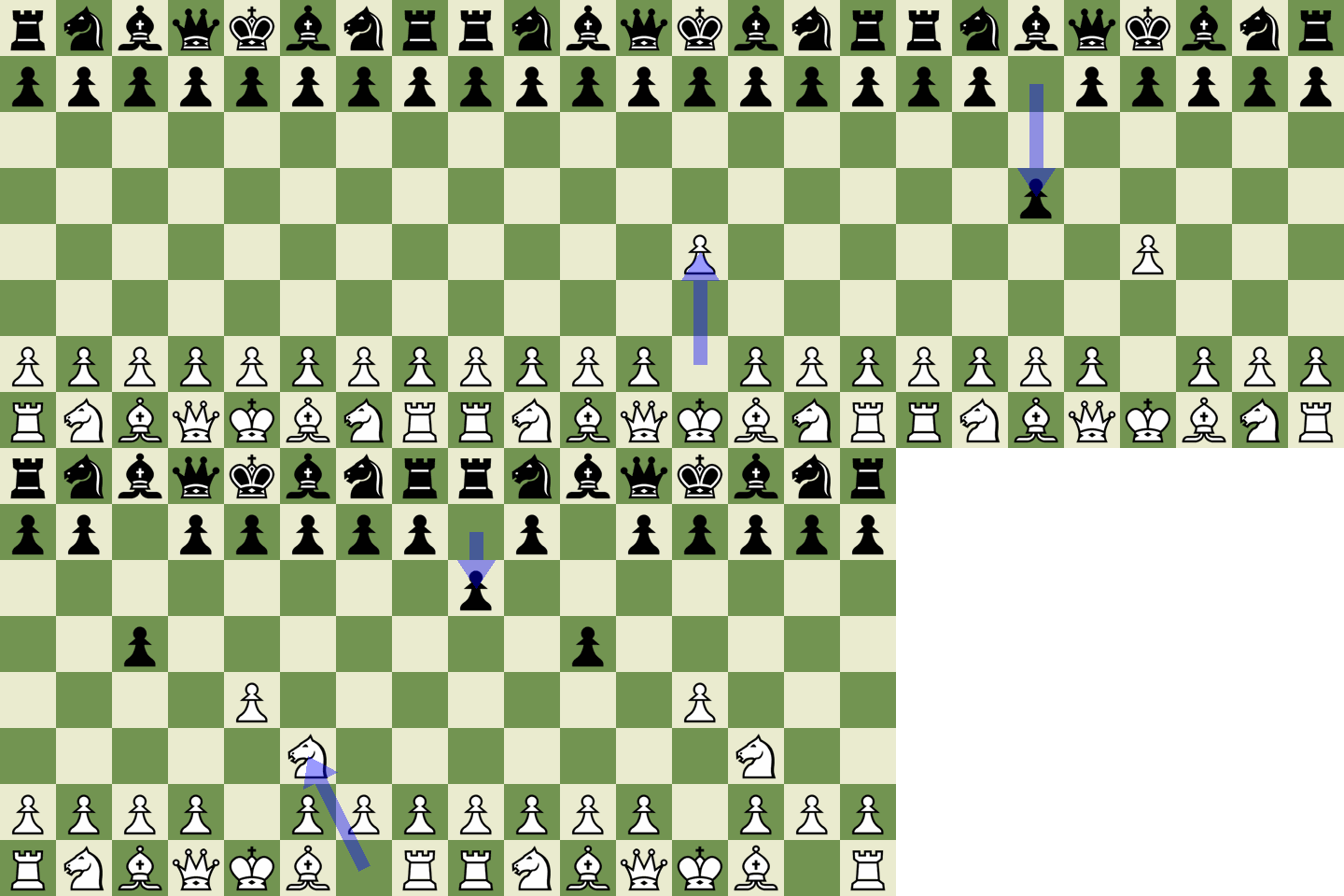
The Sicilian Defense: O'Kelly Variation arises after 1.e4 c5 2.Nf3 a6 and falls under ECO code B28. At first glance, 2...a6 looks odd since Black has now made two pawn moves without developing any pieces. However, ...a6 is a standard move in many Sicilian lines — most notably the Najdorf, where it appears after 1.e4 c5 2.Nf3 d6 3.d4 cxd4 4.Nxd4 Nf6 5.Nc3 a6 — so the O'Kelly can be understood as an accelerated move-order trick. By playing ...a6 early, Black takes control of b5 and prepares to answer Be3 with ...e5, safe in the knowledge that the Bb5+ intermezzo is ruled out (without ...a6, the Venice Attack 6.Bb5+! would be available). Even in lines where Black plays ...Nc6 instead, White can sometimes jump to b5 with the knight (6.Ndb5), which ...a6 also prevents. The cost is a potential tempo loss if White avoids the Open Sicilian altogether. In the main continuation 3.d4 cxd4 4.Nxd4 Nf6 5.Nc3 (since 5.e5? loses to 5...Qa5+!), Black is already able to play 5...e5!, attacking the centralized knight and forcing it to relocate. With 6.3 million Lichess games across all rating levels, it is a specialized opening choice.
- The early ...a6 takes the b5 square away from White's pieces, ruling out Bb5+ checks and knight hops.
- If White plays the natural 3.d4, Black answers with ...e5 setups and reaches a comfortable, Najdorf-flavoured game.
- White's critical tries avoid 3.d4: 3.c3 or the Maroczy-bind move 3.c4 aim to turn ...a6 into a wasted tempo.
History and Notable Players
It arises from the Sicilian Defense (2.Nf3). Among the most prolific practitioners on the White side are Janis Klovans (9 games), Friso Nijboer (8 games), Elisabeth Paehtz (8 games). On the Black side, notable exponents include Istvan Csom (98 games), Michael J Franklin (50 games), Bojan Kurajica (39 games).
The line is named in honour of Belgian grandmaster Alberic O'Kelly de Galway, winner of thirteen Belgian championships and the third World Correspondence Chess Championship (1959–1962). Its calling card is a sly move order: if White responds with the routine 3.d4, Black equalizes comfortably with a quick ...e5.
Named after: Alberic O'Kelly de Galway (1911–1980), Belgian grandmaster and the third World Correspondence Chess Champion.
It is a rare opening trap in slow motion: White's most natural move, 3.d4, is exactly what Black hopes for, so the real tests are the modest-looking 3.c3 and 3.c4.
Statistics
Based on 6.3 million Lichess games across all rating levels:
- White wins: 47.3%
- Black wins: 48.3%
- Draws: 4.4%
The statistics show a roughly balanced opening where both sides have equal chances.
Practice on Chessiverse
The best way to learn the Sicilian Defense: O'Kelly Variation is through practice. On Chessiverse, you can play chess against computer opponents that specialize in this opening. Our AI bots range from beginner to grandmaster level, each with unique playing styles — from aggressive attackers to solid defenders. Choose a bot that matches your rating and work your way up as you master the opening's key ideas.
Performance Across Rating Levels
The picture changes a lot as you climb the rating ladder. The 1200 bracket has 546,575 games (0.08% of all games at that level); White wins 48.3%, Black 48.4%, 3.3% are drawn. Move up to 1800 Elo and the share shifts to 0.17%, with White winning 46.5% versus Black's 48.9%. Among 2500-rated players the line appears in 0.22% of games and draws spike to 9.8%, indicating tight preparation.
Time Control Patterns
The Sicilian Defense: O'Kelly Variation skews toward rapid chess. In bullet, it appears in 0.08% of games (2,139,184); White wins 46.8%. Blitz shows 0.13% adoption across 4,756,133 games, White scoring 47.2%. In rapid, the share rises to 0.14% — 1,505,397 games, White 47.6%.
Move Diversity and Theory Depth
What players actually play after the opening moves depends heavily on rating. At 1200 Elo (546,575 games), the top reply is d4, played 37.5% of the time. Three other moves each take at least 5% of games, and the top three moves account for 81.2% of games. Entropy: 2.41. By 2500 (30,030 games), c3 takes over as the top reply at 33.8%; four other moves reach 5% and the top three moves account for 77.2% of games. Entropy rises to 2.52. Even elite players don't fully agree on the best continuation here, which keeps the position dynamic.
Historical Trends
Long-term, the trajectory of this opening is informative. Adoption peaked in 2015 at 0.18% (40,661 games). By 2025 it sits at 0.13%, 28% below the peak but still 23% above its 2013 level, so the line is up over the full period despite easing from the high.