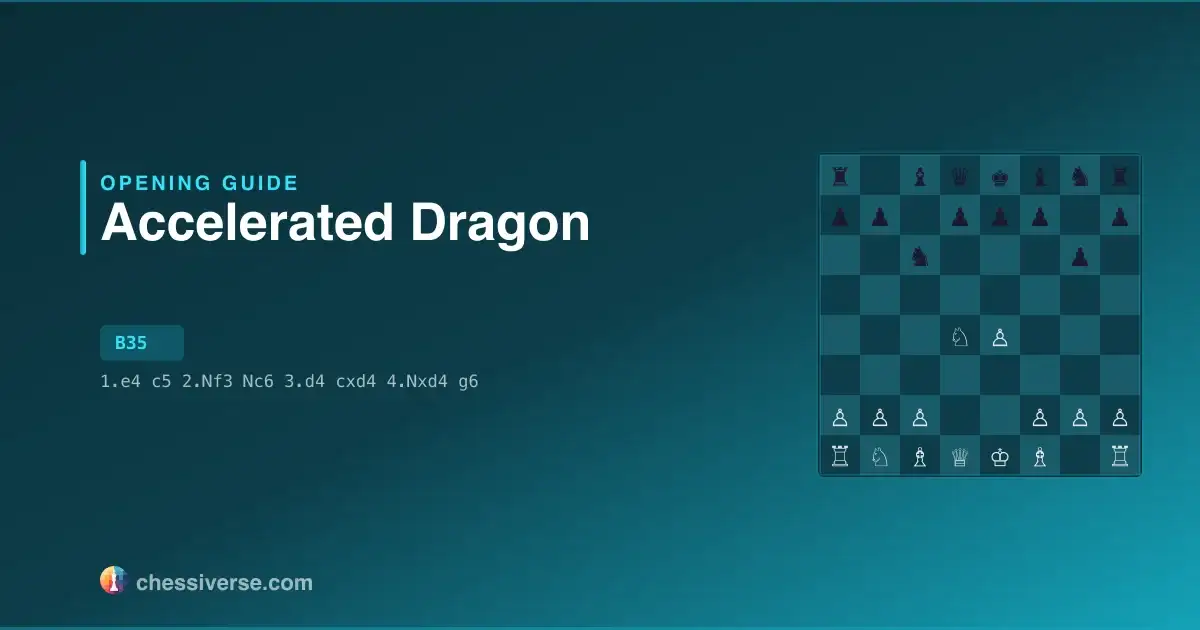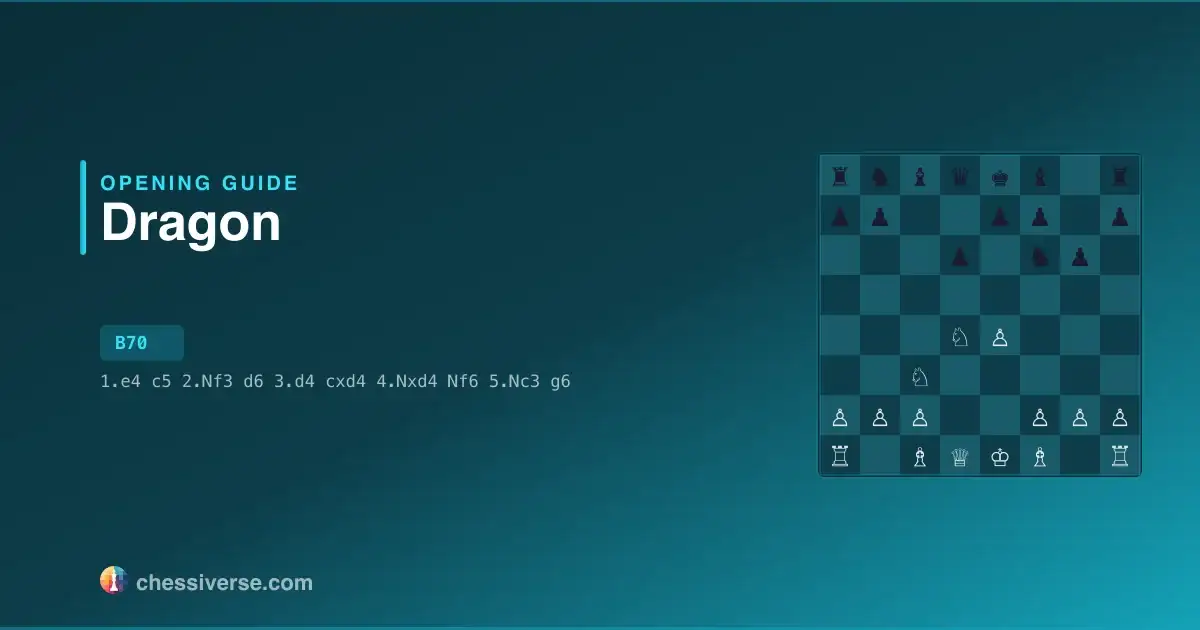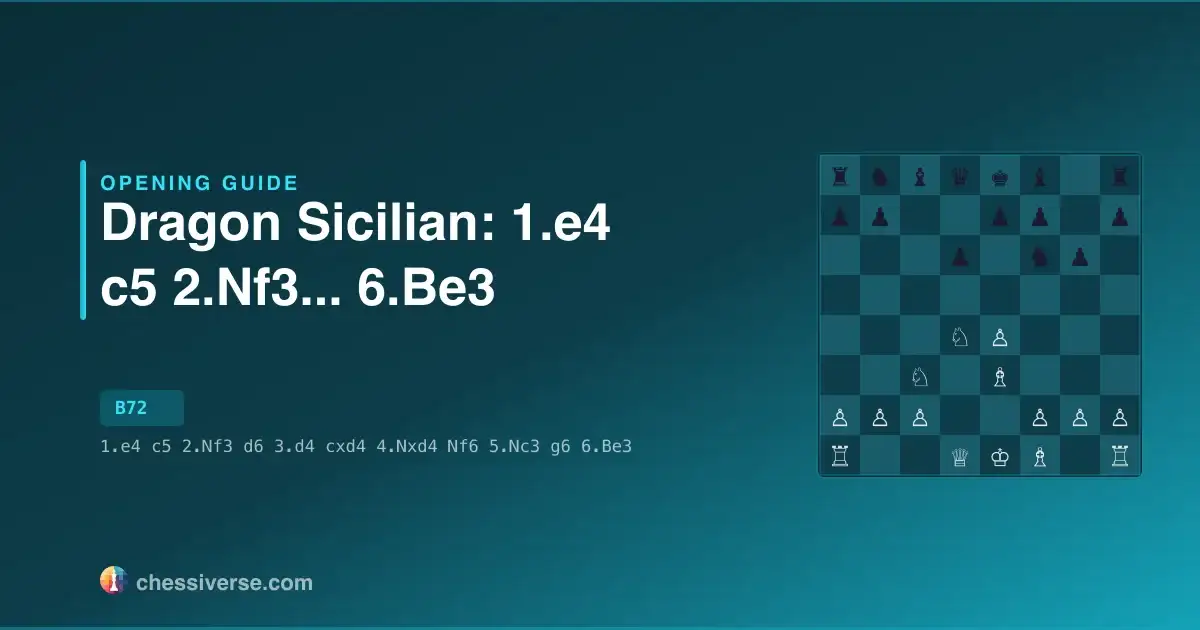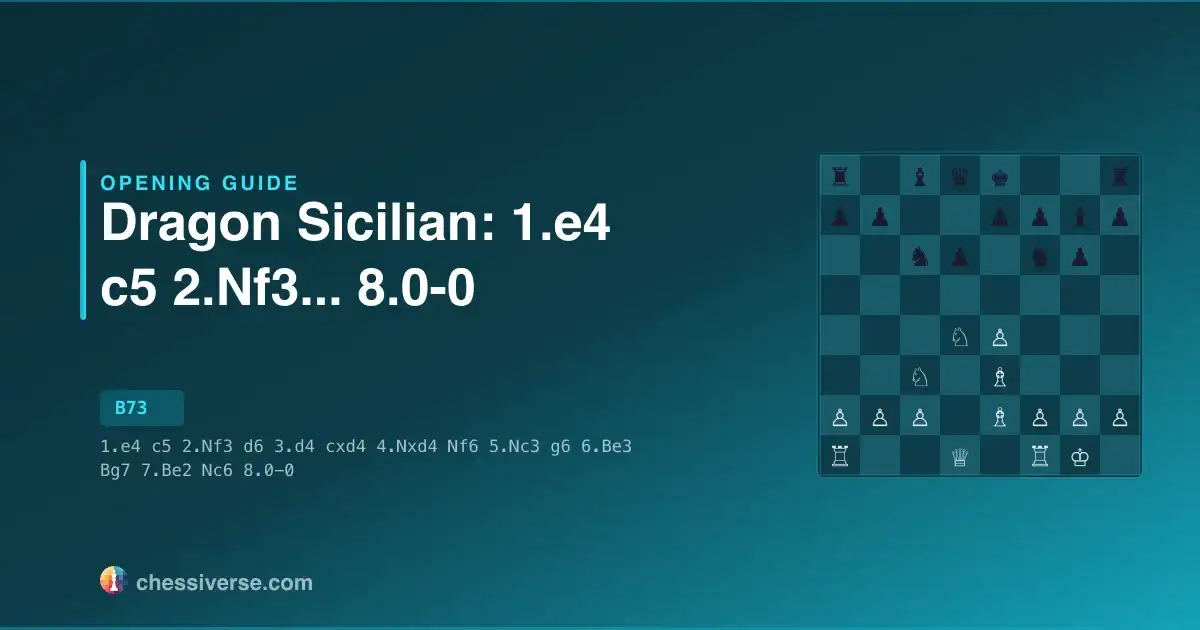



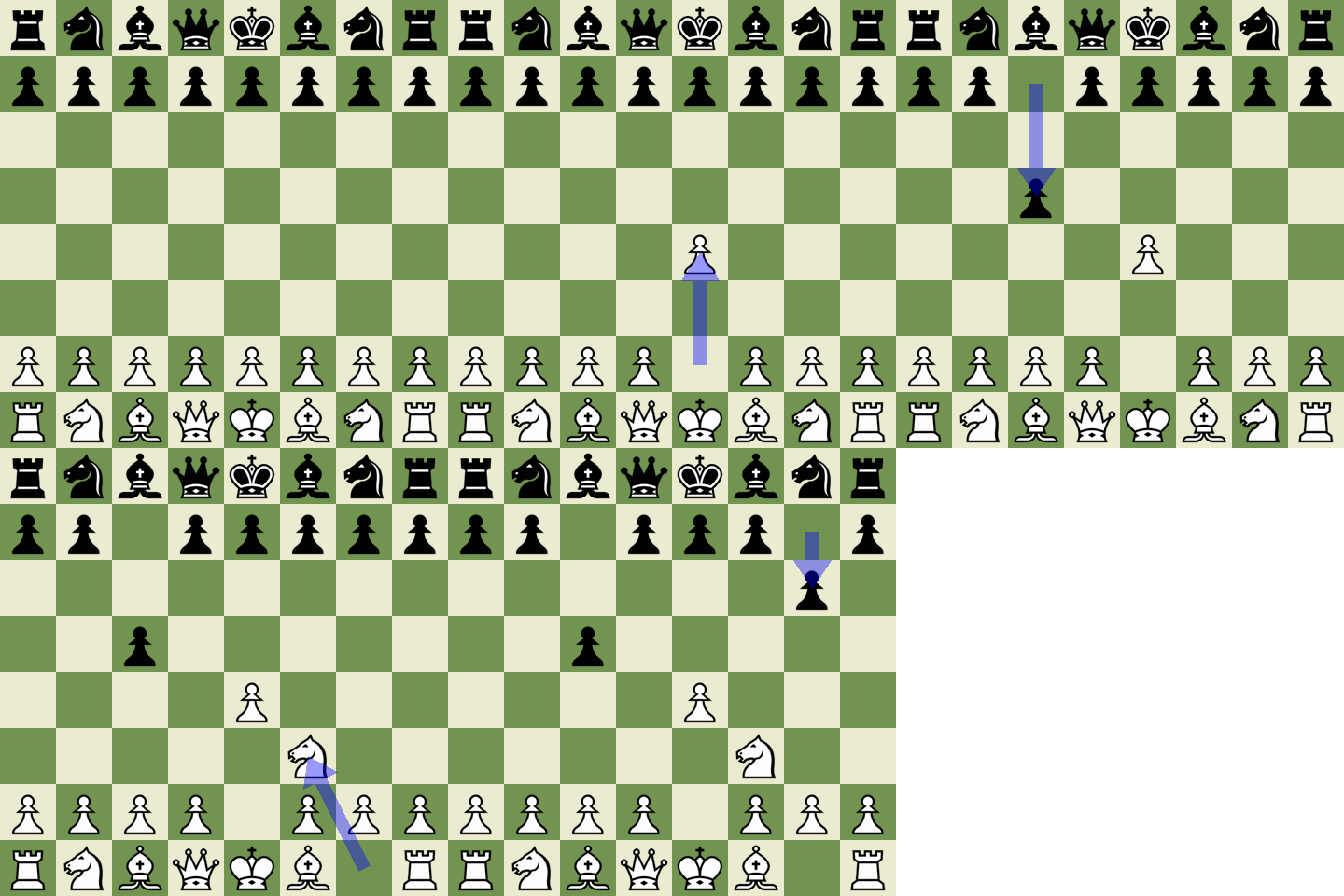
The Sicilian Defense: Hyper-Accelerated Dragon arises after 1.e4 c5 2.Nf3 g6 and falls under ECO code B27. By playing 2...g6, Black signals the intention to fianchetto the king's bishop to g7. The key difference from the standard Accelerated Dragon, where Black typically plays 2...Nc6 first, is that 2...g6 avoids giving White the chance to enter the Rossolimo Attack with 3. Bb5. After the standard Open Sicilian sequence 3. d4 cxd4 4. Nxd4, the move 4...Nc6 transposes into the Accelerated Dragon with the Rossolimo safely bypassed. From there, White can proceed with 5. Nc3, the conventional Open Sicilian approach, or opt for 5. c4, the Maroczy Bind, which restricts the d5 square by placing both the e- and c-pawns on it. That said, the 2...g6 move order does open the door for White to pursue independent lines that do not transpose into a regular Accelerated Dragon, so Black needs to be prepared for those alternatives. With 12.9 million Lichess games across all rating levels, it is one of the most popular openings.
- By skipping ...d6, Black hopes to free the position with ...d5 in a single move rather than two, equalizing on the spot if White is careless.
- White's critical try is the Maroczy Bind with c4, grabbing space; Black chips away at it with breaks like ...b5, ...d5 or ...f5.
- Playing 2...g6 immediately sidesteps both the Rossolimo and the fearsome Yugoslav Attack, steering the game toward calmer positional waters.
History and Notable Players
It arises from the Sicilian Defense (2.Nf3). Among the most prolific practitioners on the White side are Vlastimil Jansa (633 games), Oleg Korneev (584 games), Viswanathan Anand (550 games). On the Black side, notable exponents include Loek Van Wely (611 games), Zdenko Kozul (475 games), Vlastimil Jansa (470 games).
The Sicilian fianchetto setup goes back to Louis Paulsen around 1880, was a favorite of Henry Bird, and entered the mainstream around 1900 with masters such as Pillsbury. The Dragon label, coined in 1901, first reached print in the Wiener Schachzeitung in 1914.
Named after: The Dragon name comes from Fyodor Dus-Chotimirsky, who claimed he coined it in 1901 for the likeness of Black's kingside pawns to the constellation Draco.
The 2...g6 move order comes with a catch: it gives White the extra option of recapturing on d4 with the queen, 4.Qxd4, instead of the usual 4.Nxd4.
Statistics
Based on 12.9 million Lichess games across all rating levels:
- White wins: 46.7%
- Black wins: 48.5%
- Draws: 4.8%
The statistics show a roughly balanced opening where both sides have equal chances.
Common Mistakes to Avoid
- Ignoring the opponent's kingside attack: In many Sicilian lines, White will castle queenside and push pawns toward your king. If you don't create counterplay on the queenside or in the center, White's attack will arrive first.
Practice on Chessiverse
The best way to learn the Sicilian Defense: Hyper-Accelerated Dragon is through practice. On Chessiverse, you can play chess against computer opponents that specialize in this opening. Our AI bots range from beginner to grandmaster level, each with unique playing styles — from aggressive attackers to solid defenders. Choose a bot that matches your rating and work your way up as you master the opening's key ideas.
Performance Across Rating Levels
The picture changes a lot as you climb the rating ladder. The 1200 bracket has 911,226 games (0.14% of all games at that level); White wins 47.6%, Black 49.1%, 3.3% are drawn. By 1800, popularity is 0.39% and White's score is 46.4% to Black's 48.8%. At 2500, 0.59% of games go into this opening; draws sit at 10.4% — the line is well-mapped at this level.
Time Control Patterns
The Sicilian Defense: Hyper-Accelerated Dragon skews toward blitz chess. In bullet, it appears in 0.20% of games (5,339,797); White wins 47.2%. Blitz shows 0.29% adoption across 10,441,101 games, White scoring 46.8%. In rapid, the share rises to 0.22% — 2,474,659 games, White 46.2%.
Move Diversity and Theory Depth
Move choice is far from uniform in the Sicilian Defense: Hyper-Accelerated Dragon. At 1200 Elo (911,226 games), the top reply is d4, played 36.2% of the time. Three other moves each take at least 5% of games, and the top three moves account for 82.5% of games. Entropy: 2.33. By 2500 (79,897 games), d4 dominates at 59.7% of replies; only one other move still reaches 5% and the top three moves account for 87% of games. Entropy drops to 1.83.
Historical Trends
Long-term, the trajectory of this opening is informative. Adoption peaked in 2018 at 0.34% (635,769 games). By 2025 it sits at 0.24%, 29% below the peak but still 90% above its 2013 level, so the line is up over the full period despite easing from the high.