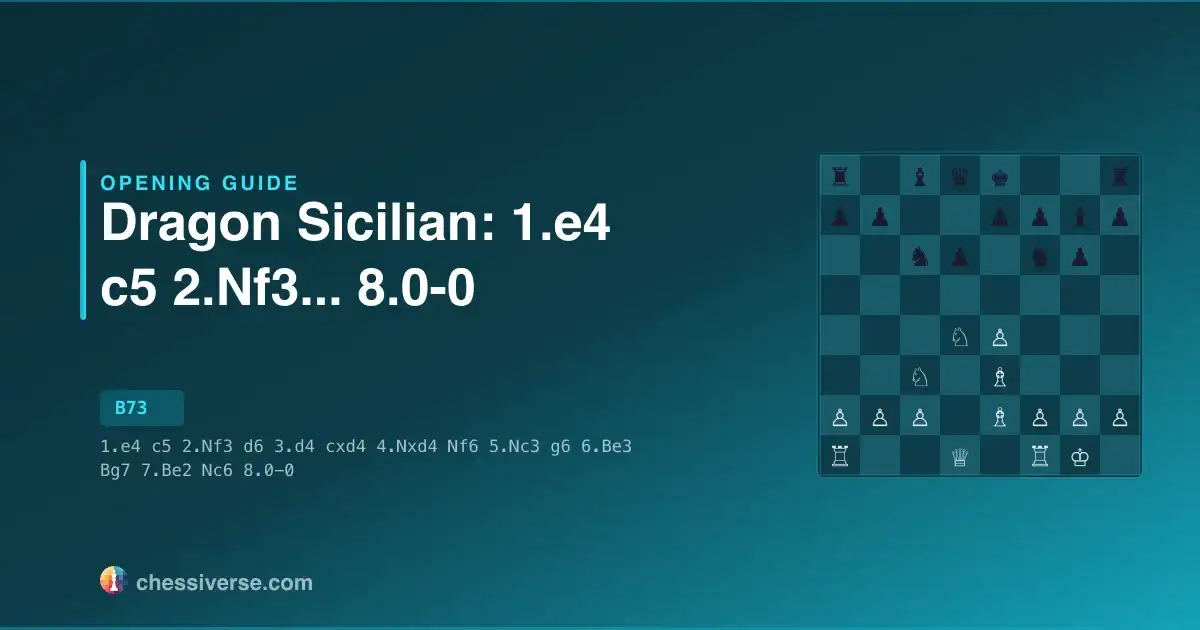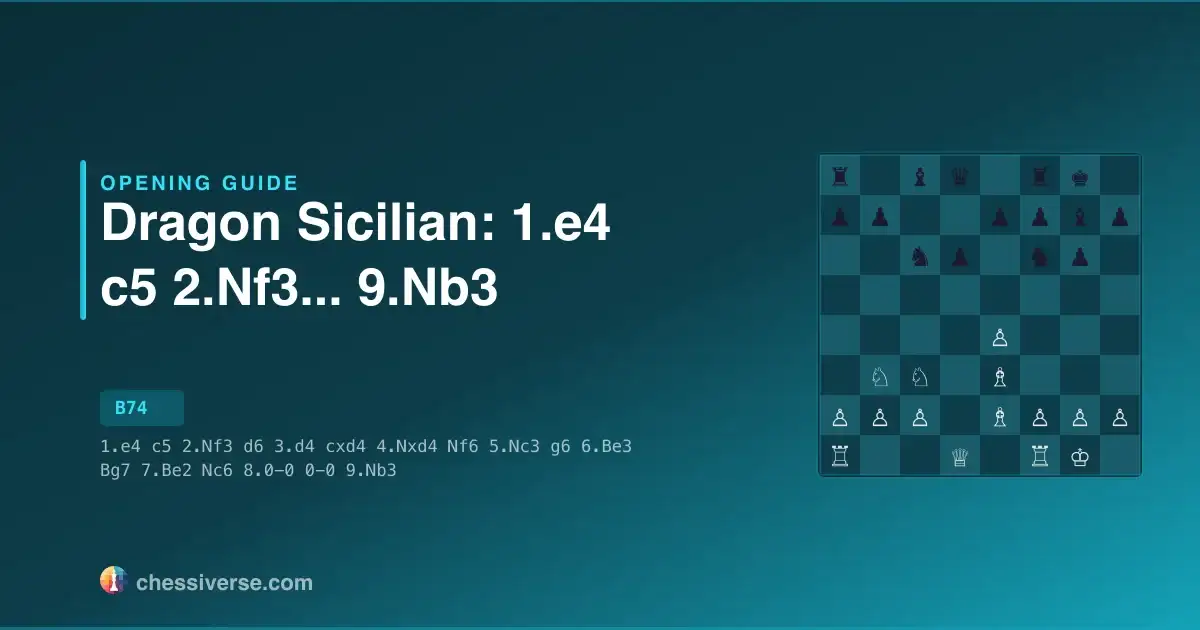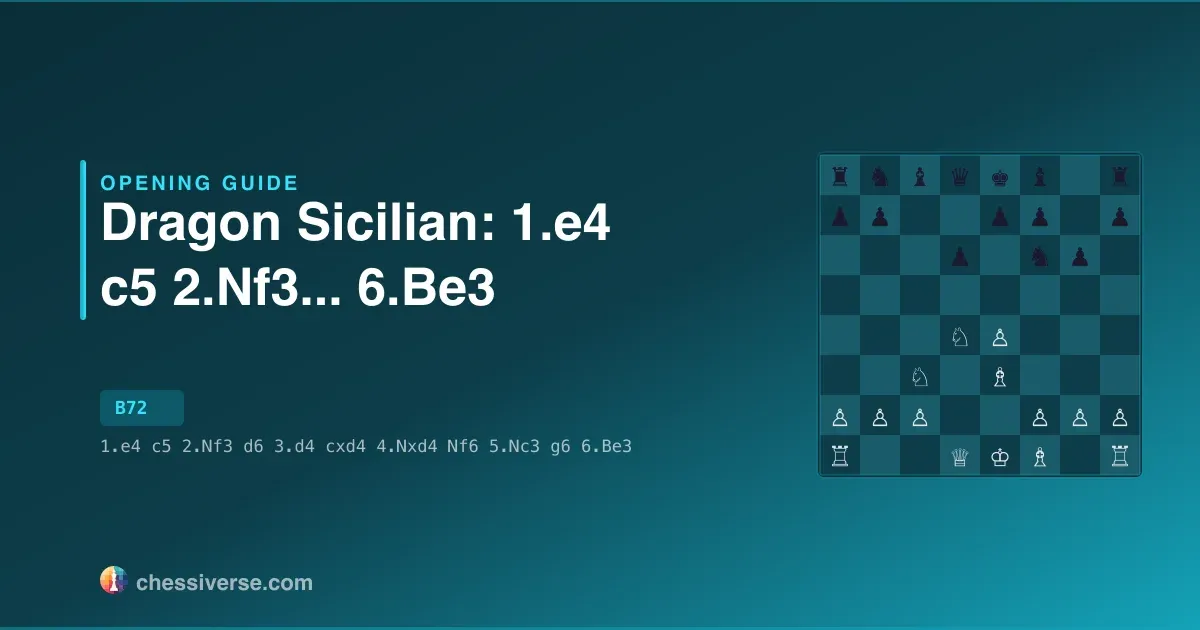
The Sicilian Defense: Dragon Variation begins with 1.e4 c5 2.Nf3 d6 3.d4 cxd4 4.Nxd4 Nf6 5.Nc3 g6 6.Be3 (ECO B72). White develops the dark-squared bishop and Black faces an immediate tactical question — should the knight jump to g4? The answer is a hard no.
Strategic Overview
After 6.Be3 White is heading toward the Yugoslav Attack, the sharpest and most famous setup against the Dragon. The 6.Be3 move blocks any cheap tricks and prepares the standard plan: Qd2, 0-0-0, f3, and a kingside pawn storm with g4-h4-h5. The looming theme is opposite-side castling and a race to checkmate, with both sides flinging pawns at each other's kings. Black has to know exactly what he's doing — the Yugoslav Attack is one of the most analyzed positions in chess, and every move from here matters. The natural Black moves are 6...Bg7, completing the fianchetto, followed by ...Nc6, ...0-0, ...Bd7, ...Rc8, ...Ne5 or ...a6. The big tactical trap to avoid is 6...Ng4??, which looks tempting because it attacks the e3-bishop, but loses to 7.Bb5+ with multiple winning continuations depending on which piece Black uses to block. The strategic core of the whole position is whether Black's queenside attack arrives before White's kingside crash — minor inaccuracies on either side can decide the game by move 25.
Key Ideas
The recurring motifs below distinguish a confident handler of this opening from a beginner:
- Avoid 6...Ng4 — it just loses — The knight jump to g4 looks like it wins the bishop pair, but 7.Bb5+ refutes the move tactically. After ...Nd7, ...Bd7, or ...Nc6 White wins material in every variation. It's the most famous beginner trap in the Dragon.
- Heading toward the Yugoslav Attack — 6.Be3 is the natural prelude to Qd2, 0-0-0, f3, and the kingside pawn storm. Both sides know what's coming — the question is whether the theoretical battle plays out for Black's queenside or White's kingside attack.
- Opposite-side castling race — If White castles queenside (which is the standard plan), the whole game becomes about who breaks through first. Tempos matter enormously, defensive resources are at a premium, and the side that calculates more accurately tends to win.
- Black needs preparation — The Dragon main line is one of the most theoretical openings in chess. Without studying the specific lines and standard sacrificial themes, Black tends to lose to White's faster, more concrete attack.
History and Notable Players
It arises from the Sicilian Defense: Dragon Variation. On the White side, Oleg Korneev (45 games), John TH Van der Wiel (26 games), Sandor Farago (24 games) top the database. Notable Black exponents: Miso Cebalo (81 games), Evarth Kahn (77 games), Chris G Ward (68 games).
Performance Across Rating Levels
How well the Sicilian Defense: Dragon Variation works depends on what level you're playing at. At 1200 Elo, the opening shows up in 0.01% of games (47,854 samples). White scores 51.7%, Black 44.6%, draws 3.7%. Move up to 1800 Elo and the share shifts to 0.08%, with White winning 48.1% versus Black's 47.2%. Among 2500-rated players the line appears in 0.37% of games and draws spike to 8.7%, indicating tight preparation. White's edge erodes by 5.0pp from 1200 to 2500 Elo, suggesting Black's counterplay is easier to find with experience.
Time Control Patterns
Time control matters here: blitz players reach for this opening more than others. In bullet, it appears in 0.04% of games (1,050,092); White wins 47.6%. Blitz shows 0.06% adoption across 2,189,741 games, White scoring 47.5%. In rapid, the share rises to 0.03% — 380,296 games, White 48.7%.
Move Diversity and Theory Depth
Looking at move selection shows how forcing — or not — the position really is. At 1200 Elo (47,854 games), the top reply is Bg7, played 93.4% of the time. No other move reaches 5% of games, and the top three moves account for 97.2% of games. Entropy: 0.52. By 2500 (50,861 games), Bg7 dominates at 88.9% of replies; one other move reaches 5% and the top three moves account for 99.8% of games. Entropy rises to 0.63.
Historical Trends
Year-over-year data tells you whether this opening is a contemporary fixture or a fading one. Adoption peaked in 2020 at 0.08% (452,348 games). By 2025 it sits at 0.04%, 48% below the peak but still 43% above its 2013 level, so the line is up over the full period despite easing from the high.
Main Lines and Variations
From the position after 1.e4 c5 2.Nf3 d6 3.d4 cxd4 4.Nxd4 Nf6 5.Nc3 g6 6.Be3, the recognised continuations are:
- Sicilian Defense: Dragon Variation, Yugoslav Attack, Early Deviations
- Sicilian Defense: Dragon Variation, Classical Variation
Each branch leads to a different middlegame character — the resulting pawn structure decides what kind of game you get.
Common Mistakes
- Neglecting development — Extra pawn moves in the opening are tempting, especially when you "know the moves". Developing a piece each turn is the simple correction.
- Ignoring the kingside attack — In sharp Sicilian lines, White typically castles long and pushes the h-pawn. Without your own counterplay on the queenside or in the centre, White's attack lands first.
Practice on Chessiverse
Ready to try the Sicilian Defense: Dragon Variation against a bot? Pick an opponent at your level and play a game.