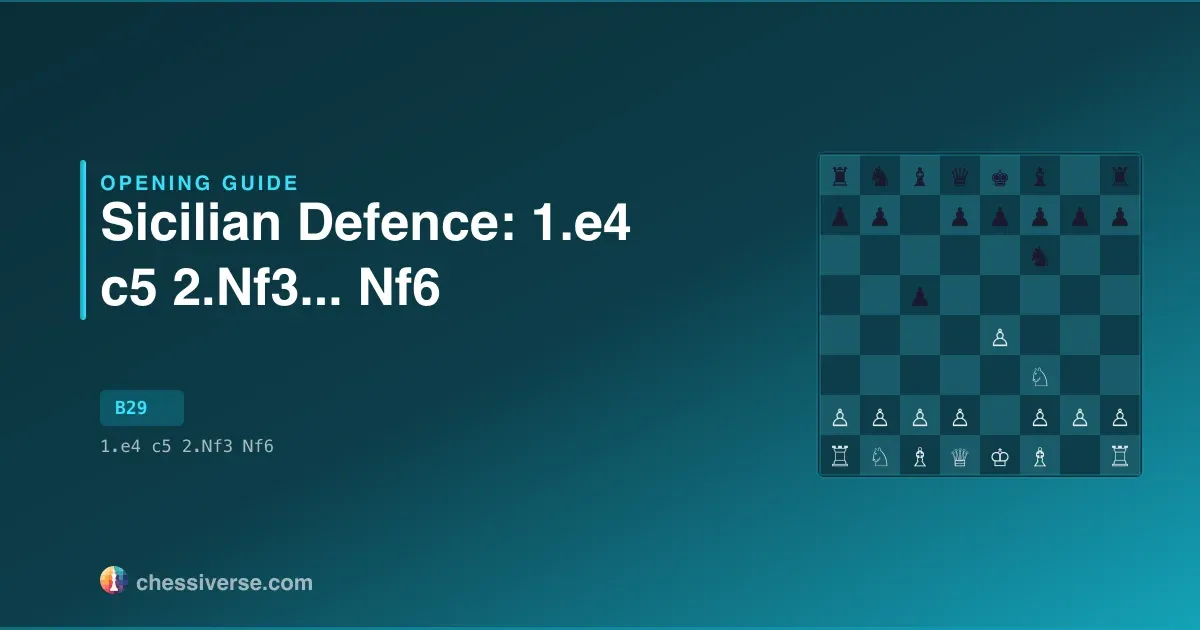
The Sicilian Defense: Nimzowitsch Variation begins with 1.e4 c5 2.Nf3 Nf6 (ECO B29). Black hits the e4 pawn immediately, daring White to push e5 and chase the knight. It's the Sicilian by way of Alekhine logic.
Strategic Overview
The Nimzowitsch Sicilian is an off-beat but principled line where Black provokes White into pushing pawns before completing development. After 2...Nf6, White almost always plays 3.e5, kicking the knight, and the game now revolves around whether White's central pawn pair is a strength or a target. The knight typically goes to d5, where it's well placed and not easy to dislodge — and now Black has the same kind of position as in the Alekhine Defense, except with the extra ...c5 already played. That extra move is significant: ...c5 attacks any d4 pawn White wants to push, and Black has counterplay on the queenside built right in. The strategic battle is over whether White can use his advanced e5 pawn to support a kingside attack or whether Black can chip away at it with ...d6, ...Nc6, and timely piece pressure. The line is rare at the top level because White has good resources, but it remains a perfectly playable surprise weapon and shares a lot of structural DNA with Alekhine Defense positions.
Key Ideas
When players succeed in this line, they usually do so by leaning on the following themes:
- Black provokes e5 — The whole point of 2...Nf6 is to bait White into pushing e5 and overcommitting the center. Black then plays Alekhine-style chess, treating the e5-pawn as a target to attack.
- The knight is happy on d5 — After being kicked, the knight typically lands on d5 — a strong central square. From there it influences both sides of the board and is hard to dislodge without making structural concessions.
- ...c5 is a built-in queenside resource — Unlike the standard Alekhine, the c-pawn is already on c5. That means queenside counterplay against d4 or with ...Nc6 is part of the position from the start, not something Black has to organize later.
- Surprise weapon, not main line — This isn't a serious top-level try anymore — White has good replies. But as a sideline against unprepared opponents, the structural ideas are perfectly sound and the game tends to favor whoever knows the themes better.
History and Notable Players
It arises from the Sicilian Defense (2.Nf3). On the White side, Vlastimil Jansa (11 games), Stefan Kindermann (10 games), Ratmir Kholmov (9 games) top the database. Notable Black exponents: Aleksandr Rakhmanov (78 games), Yochanan Afek (64 games), Jacob Murey (50 games).
Performance Across Rating Levels
Popularity and results vary sharply by rating level. The 1200 bracket has 403,317 games (0.06% of all games at that level); White wins 53.1%, Black 43.3%, 3.5% are drawn. At 1800 the opening surfaces in 0.05% of games; White wins 45.6%, Black 49.9%, draws 4.5%. Among 2500-rated players the line appears in 0.18% of games and draws spike to 9.9%, indicating tight preparation. White's edge erodes by 10.8pp from 1200 to 2500 Elo, suggesting Black's counterplay is easier to find with experience.
Time Control Patterns
Time control matters here: rapid players reach for this opening more than others. In bullet, it appears in 0.05% of games (1,350,070); White wins 47%. Blitz shows 0.06% adoption across 2,055,287 games, White scoring 48.1%. In rapid, the share rises to 0.06% — 691,685 games, White 52.6%. White's score swings 5.6pp across formats, so time control isn't just a stylistic choice here — it shifts the actual results.
Move Diversity and Theory Depth
Move choice is far from uniform in the Sicilian Defense: Nimzowitsch Variation. At 1200 Elo (403,317 games), the top reply is Nc3, played 43.6% of the time. Four other moves each take at least 5% of games, and the top three moves account for 78.7% of games. Entropy: 2.33. By 2500 (24,807 games), e5 takes over as the top reply at 54.8%; only two other moves still reach 5% and the top three moves account for 95.9% of games. Entropy drops to 1.53. The narrowing is significant — strong players consolidate around a small set of best moves, while amateurs scatter across many plausible-looking options.
Historical Trends
Tracking the Sicilian Defense: Nimzowitsch Variation year over year shows a clear story. Adoption peaked in 2020 at 0.08% (447,149 games). By 2025 it sits at 0.05%, 42% below the peak but still 11% above its 2013 level, so the line is up over the full period despite easing from the high.
Common Mistakes
- Drifting away from main theory — At 400 Elo, the three most-played moves cover 71.5% of games, against 88.5% at 2000. The most popular deviation is Bc4 (played 20.9% of the time at 400, much less so up top). It looks fine but quietly hands the better-prepared side an edge.
- Neglecting development — Extra pawn moves in the opening are tempting, especially when you "know the moves". Developing a piece each turn is the simple correction.
- Ignoring the kingside attack — In sharp Sicilian lines, White typically castles long and pushes the h-pawn. Without your own counterplay on the queenside or in the centre, White's attack lands first.
Practice on Chessiverse
Ready to try the Sicilian Defense: Nimzowitsch Variation against a bot? Pick an opponent at your level and play a game.