



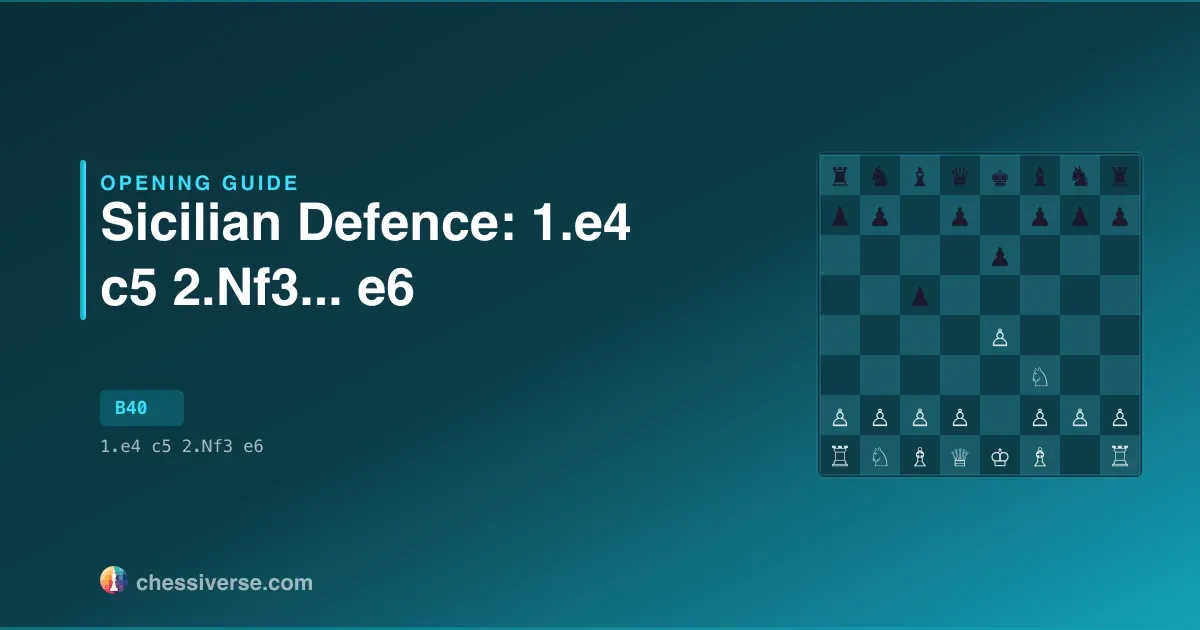
The Sicilian Defense: French Variation arises after 1.e4 c5 2.Nf3 e6 and falls under ECO code B40. This is one of the classical approaches in the Sicilian, where Black's 2...e6 activates the dark-squared bishop and lays the groundwork for a later ...d5 with pawn recapture. The position is highly flexible, frequently transposing into other major Sicilian systems depending on whether Black follows up with ...d6, ...Nc6, or other moves. Well-known variations that can arise from this position include the Kan, the Scheveningen, and the Taimanov. With 51 million Lichess games across all rating levels, it is one of the most popular openings.
History and Notable Players
It arises from the Sicilian Defense (2.Nf3). Among the most prolific practitioners on the White side are Heikki MJ Westerinen (163 games), Gyula Sax (134 games), Vlastimil Jansa (133 games). On the Black side, notable exponents include Pia Cramling (351 games), Normunds Miezis (349 games), Vlastimil Jansa (319 games).
Statistics
Based on 51 million Lichess games across all rating levels:
- White wins: 46.8%
- Black wins: 48.7%
- Draws: 4.5%
The statistics show a roughly balanced opening where both sides have equal chances.
Main Lines and Variations
After 1.e4 c5 2.Nf3 e6, the main continuations include:
Each of these lines leads to distinct types of positions and requires its own understanding of the resulting pawn structures and piece placements.
Common Mistakes to Avoid
- Ignoring the opponent's kingside attack: In many Sicilian lines, White will castle queenside and push pawns toward your king. If you don't create counterplay on the queenside or in the center, White's attack will arrive first.
Practice on Chessiverse
The best way to learn the Sicilian Defense: French Variation is through practice. On Chessiverse, you can play chess against computer opponents that specialize in this opening. Our AI bots range from beginner to grandmaster level, each with unique playing styles — from aggressive attackers to solid defenders. Choose a bot that matches your rating and work your way up as you master the opening's key ideas.
Performance Across Rating Levels
Popularity and results vary sharply by rating level. At 1200 Elo, the opening shows up in 0.56% of games (3,780,056 samples). White scores 47.4%, Black 49.1%, draws 3.4%. Move up to 1800 Elo and the share shifts to 1.52%, with White winning 46.5% versus Black's 49%. At 2500, 2.80% of games go into this opening; draws sit at 9% — the line is well-mapped at this level.
Time Control Patterns
The Sicilian Defense: French Variation skews toward blitz chess. In bullet, it appears in 1.08% of games (28,635,779); White wins 46.9%. Blitz shows 1.18% adoption across 42,351,073 games, White scoring 46.8%. In rapid, the share rises to 0.78% — 8,612,015 games, White 46.3%.
Move Diversity and Theory Depth
Looking at move selection shows how forcing — or not — the position really is. At 1200 Elo (3,780,056 games), the top reply is d4, played 36.4% of the time. Three other moves each take at least 5% of games, and the top three moves account for 78.6% of games. Entropy: 2.52. By 2500 (381,993 games), d4 dominates at 60.8% of replies; three other moves reach 5% and the top three moves account for 80.5% of games. Entropy drops to 2.03.
Historical Trends
Year-over-year data tells you whether this opening is a contemporary fixture or a fading one. Adoption peaked in 2015 at 1.28% (284,981 games). By 2025 it sits at 1.03%, 19% below the peak and roughly back to its 2013 level, leaving the line flat over the full period.