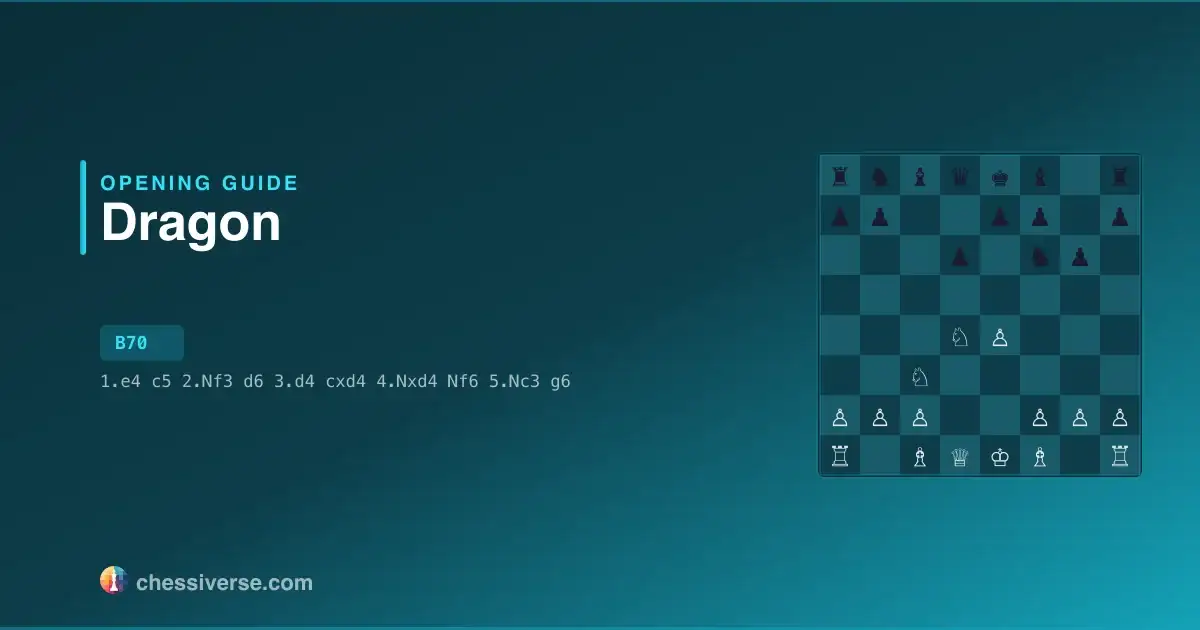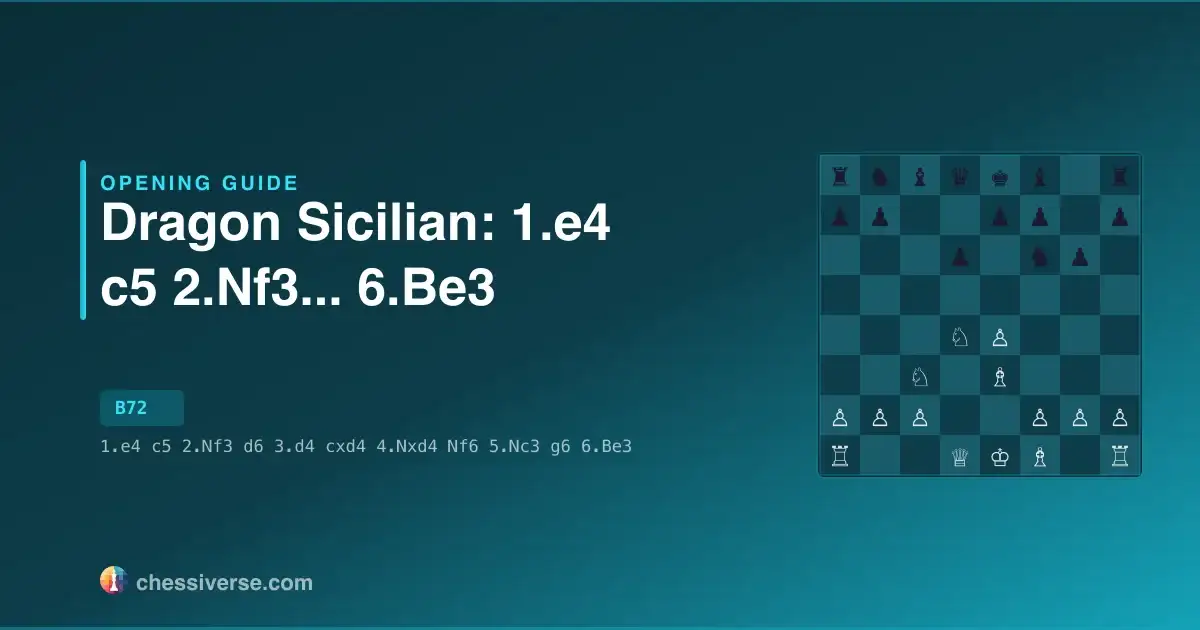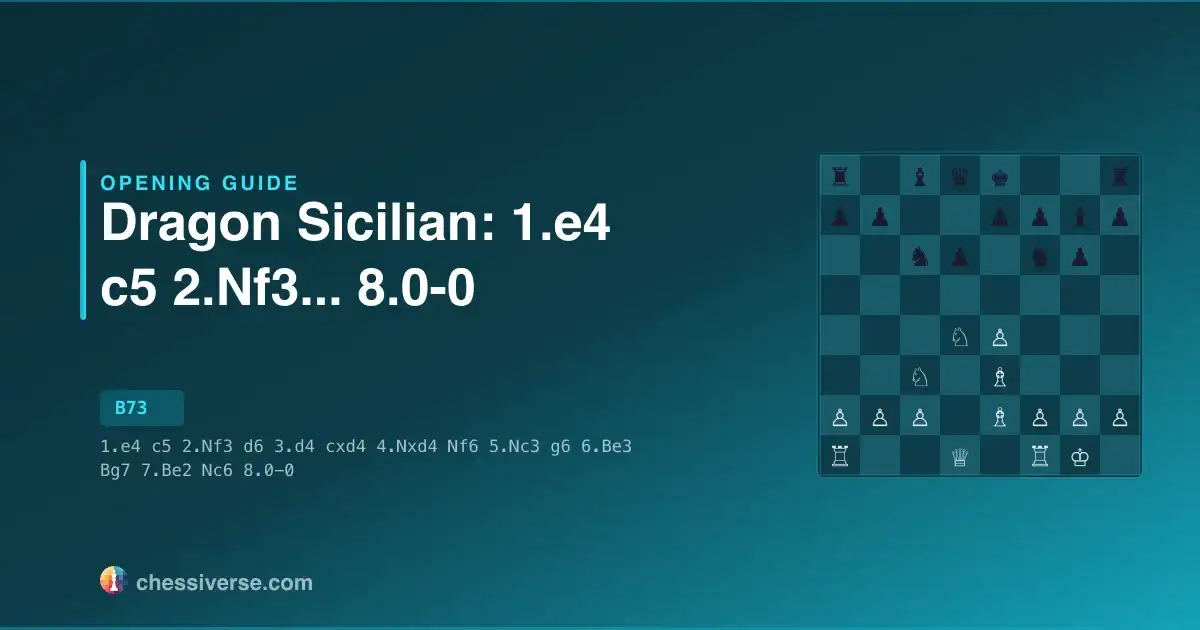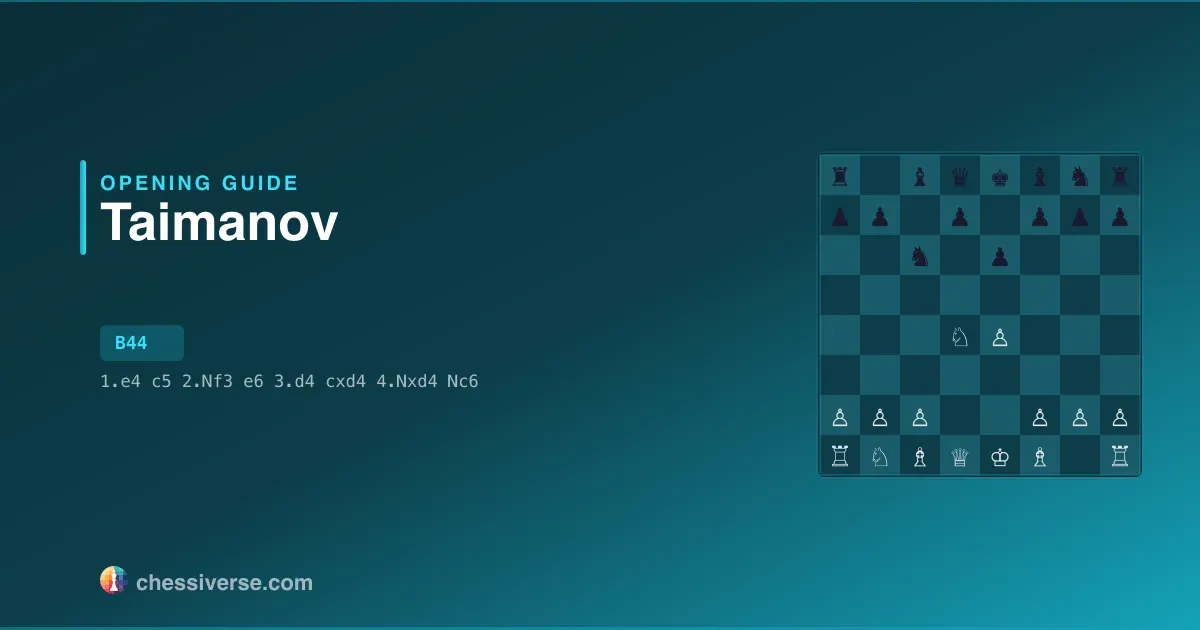
The Sicilian Defense: Taimanov Variation arises after 1.e4 c5 2.Nf3 e6 3.d4 cxd4 4.Nxd4 Nc6 and falls under ECO code B44. Named after Russian GM Mark Taimanov, who championed it during the 1960s, this system develops the knight to c6 within the e6 Sicilian framework. Although 4...Nc6 does not directly threaten e4, White typically responds with 5. Nc3 regardless. Black then faces a key branching point: 5...Nf6 leads to the Four Knights Sicilian, while 5...Qc7 enters the Bastrikov Variation, where Black prioritizes queenside development with ...a6, ...b5, ...Bb7, and ...Rc8, placing the dark-squared bishop on e7 or b4. White can counter with the English Attack setup (Nc3, Be3, Qd2, and O-O-O) or a quieter approach with Nc3, Be2, and O-O. The main alternative to 5. Nc3 is 5. Nb5, targeting the weakness on d6 created by Black's early 2...e6. With two pieces bearing down on d6 and only the bishop defending it, the hasty 5...a6? walks into 6. Nd6+ Bxd6 7. Qxd6 with a clear advantage for White. Black's best way to address the d6 threat is 5...d6, after which White usually continues with 6. c4 or 6. Bf4. With 11.4 million Lichess games across all rating levels, it is a well-established opening choice.
- Black delays kingside development, focusing first on the queenside with ...a6, ...b5, ...Bb7 and ...Rc8.
- After 5.Nc3 Qc7, White can choose the English Attack with Be3, Qd2 and long castling, or a setup with Be2 and short castling.
- White can test Black immediately with 5.Nb5, eyeing the d6-square weakened by ...e6; Black usually answers 5...d6.
History and Notable Players
It arises from the Sicilian Defense (2.Nf3). Among the most prolific practitioners on the White side are Alexei Shirov (65 games), Michael Adams (62 games), Alexander Motylev (57 games). On the Black side, notable exponents include Mark E Taimanov (232 games), Vlastimil Jansa (172 games), Pia Cramling (150 games).
The variation grew out of the older Paulsen setup and was popularised by Mark Taimanov in the 1960s. Taimanov himself saw ...Nge7, delaying ...Qc7, as the real signature move of his system, regarding 4...Nc6 as just one of several possible Paulsen move orders.
Named after: Mark Taimanov (1926-2016), the Soviet grandmaster and concert pianist who popularised this ...e6 and ...Nc6 system in the 1960s.
Notable players: Mark Taimanov
Taimanov was a world-class concert pianist whose duo recordings appeared in the Great Pianists of the 20th Century series; he beat six world champions, and is remembered for his 6-0 loss to Bobby Fischer in 1971.
Statistics
Based on 11.4 million Lichess games across all rating levels:
- White wins: 47.7%
- Black wins: 47.7%
- Draws: 4.7%
The statistics show a roughly balanced opening where both sides have equal chances.
Main Lines and Variations
After 1.e4 c5 2.Nf3 e6 3.d4 cxd4 4.Nxd4 Nc6, the main continuations include:
Each of these lines leads to distinct types of positions and requires its own understanding of the resulting pawn structures and piece placements.
Practice on Chessiverse
The best way to learn the Sicilian Defense: Taimanov Variation is through practice. On Chessiverse, you can play chess against computer opponents that specialize in this opening. Our AI bots range from beginner to grandmaster level, each with unique playing styles — from aggressive attackers to solid defenders. Choose a bot that matches your rating and work your way up as you master the opening's key ideas.
Performance Across Rating Levels
The picture changes a lot as you climb the rating ladder. Among 1200-rated players, it appears in 0.07% of games — 501,713 of them on record — with White winning 47.4% and Black 49.1%. By 1800, popularity is 0.41% and White's score is 47.8% to Black's 47.5%. Among 2500-rated players the line appears in 0.52% of games and draws spike to 9.2%, indicating tight preparation.
Time Control Patterns
Time control matters here: blitz players reach for this opening more than others. In bullet, it appears in 0.23% of games (6,066,925); White wins 47.3%. Blitz shows 0.27% adoption across 9,622,425 games, White scoring 47.7%. In rapid, the share rises to 0.16% — 1,802,714 games, White 47.3%.
Move Diversity and Theory Depth
What players actually play after the opening moves depends heavily on rating. At 1200 Elo (501,713 games), the top reply is Nxc6, played 40.3% of the time. Three other moves each take at least 5% of games, and the top three moves account for 82.1% of games. Entropy: 2.28. By 2500 (70,946 games), Nc3 takes over as the top reply at 79.6%; only two other moves still reach 5% and the top three moves account for 92.5% of games. Entropy drops to 1.25. That entropy collapse is the signature of a line where preparation pays off: at the top, players know the best move and play it.
Historical Trends
Long-term, the trajectory of this opening is informative. Adoption peaked in 2015 at 0.31% (67,742 games). By 2025 it sits at 0.22%, 27% below the peak and 19% under its 2013 level, leaving the line in decline.