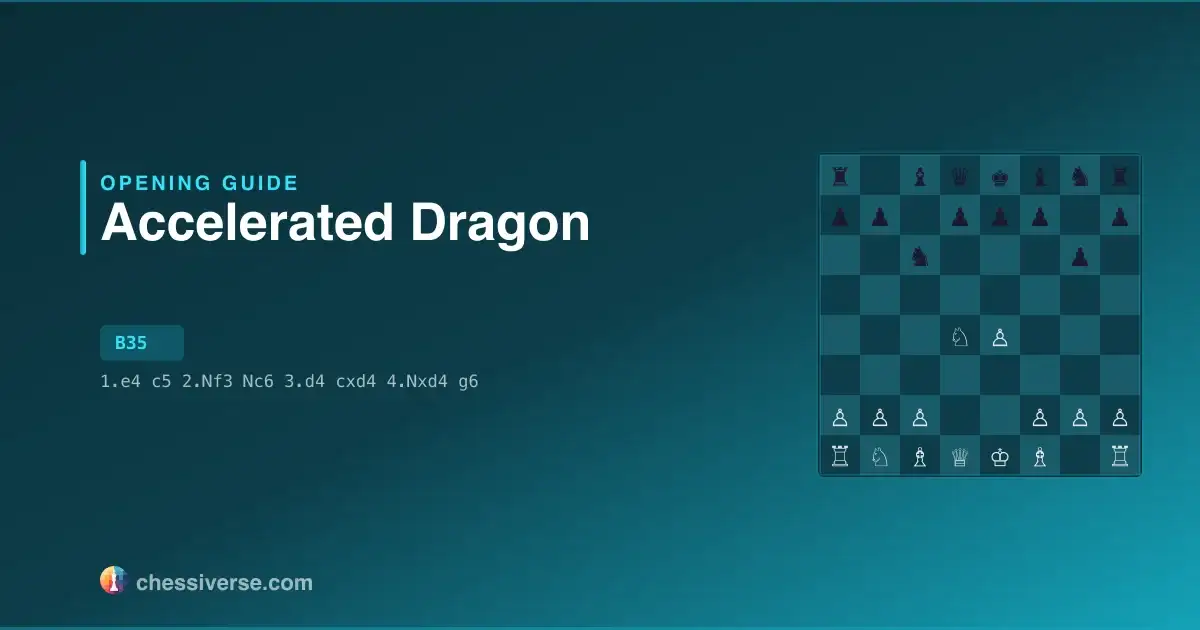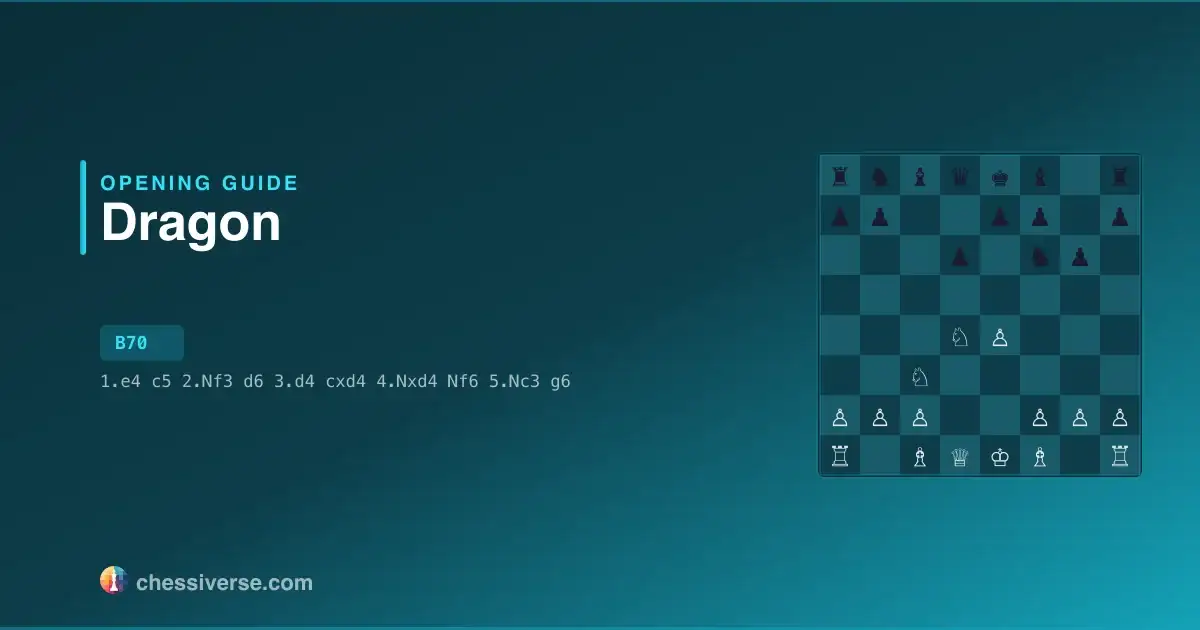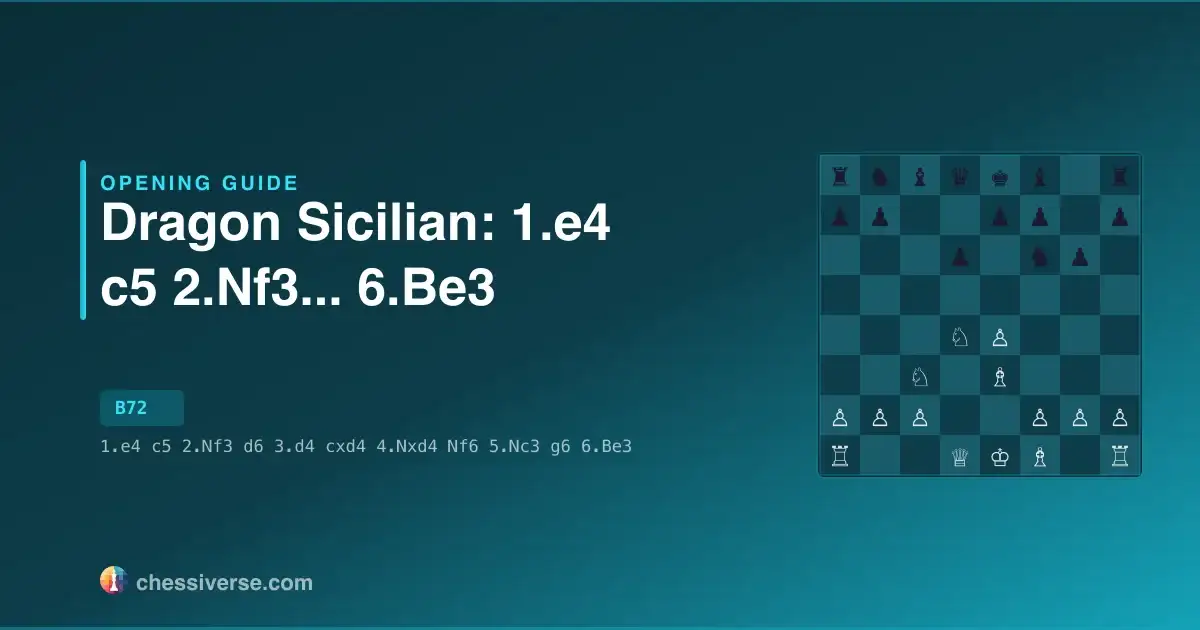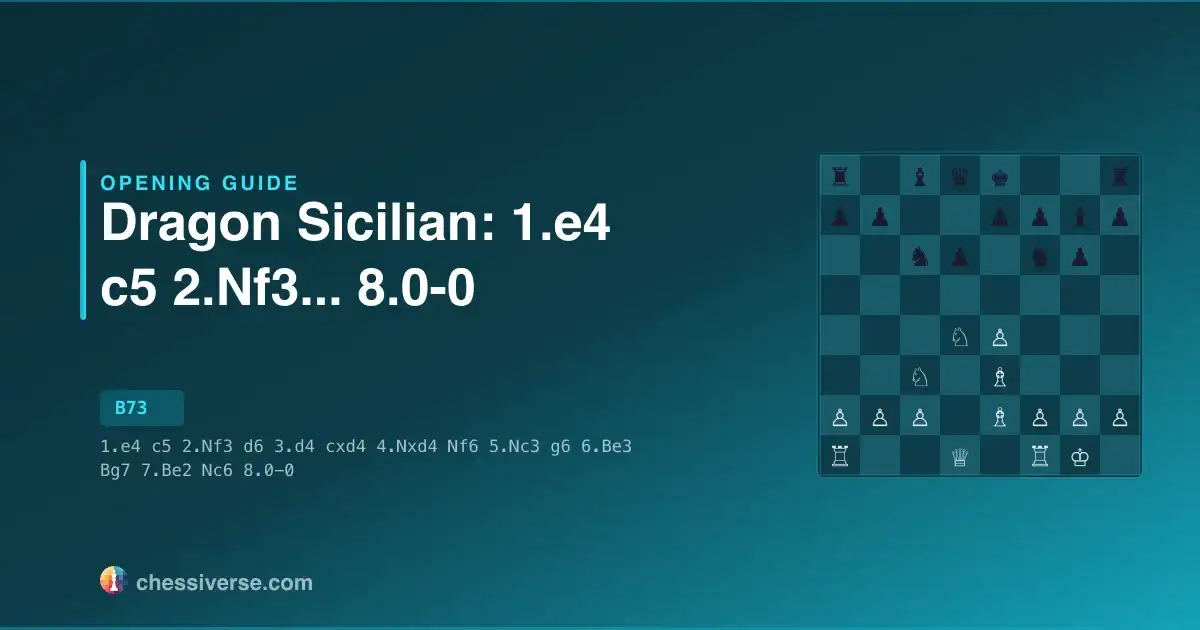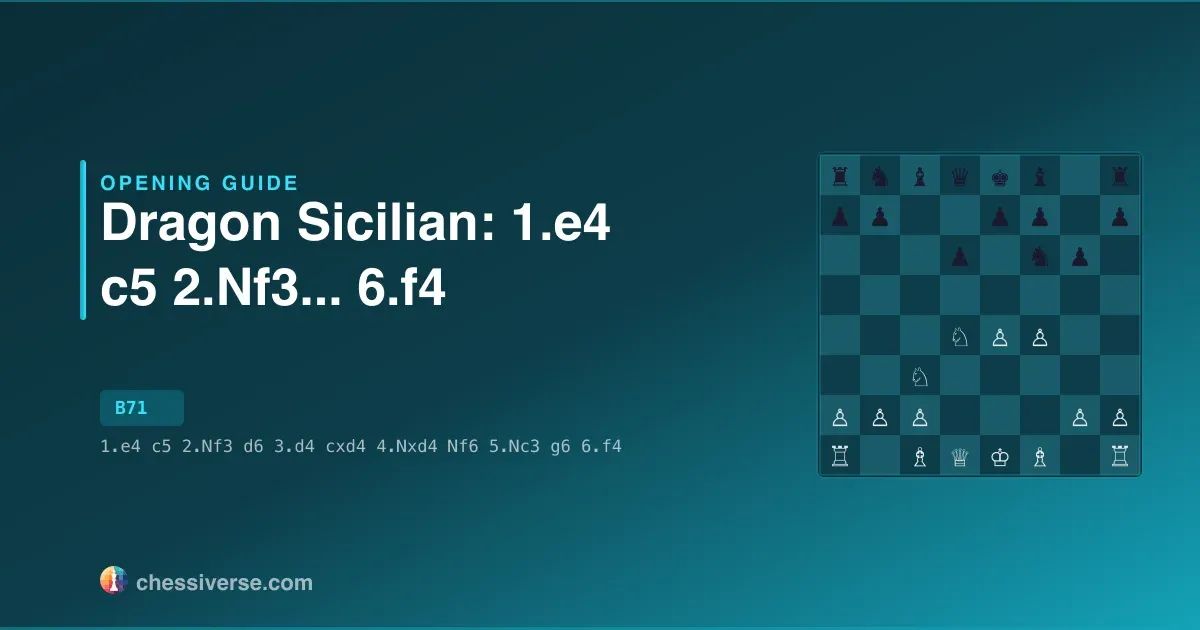
1.e4 c5 2.Nf3 d6 3.d4 cxd4 4.Nxd4 Nf6 5.Nc3 g6 6.f4 opens the Sicilian Defense: Dragon Variation, Levenfish Variation, ECO B71. White pushes f4 to set up the e5 break before Black can finish the standard Dragon setup. Played carelessly, it's a tempo trap for Black.
Strategic Overview
The Levenfish Attack with 6.f4 is one of White's more aggressive answers to the Dragon. The point of f4 isn't immediate attack — it's preparing e5, which would kick Black's f6-knight and disrupt the entire kingside fianchetto plan. The line trades the calm development of the Yugoslav Attack for a quicker central confrontation, and Black has to know what he's doing or he loses a tempo and ends up worse for no reason. Black's correct response involves developing carefully, supporting the f6-knight, and either preventing e5 outright or making sure that when it lands, the structural cost is manageable. Quiet developing moves that ignore the e5 threat hand White exactly what he wants. The whole line is a litmus test of preparation — Black with theory does well, Black without theory often gets crushed by move fifteen. It's not the most popular weapon against the Dragon these days because Black's resources have been mapped out fairly thoroughly, but at club level it remains an effective practical try, especially against players who have prepared only for the Yugoslav.
Key Ideas
A few ideas come up again and again in this opening:
- f4 prepares e5 — The push to f4 isn't an attacking move on its own — it's setup. The real threat is e5, which would chase the f6-knight and disrupt Black's whole Dragon plan.
- Black must develop with care — Casual development walks into e5 and a lost tempo. Black needs to support the knight, prepare counter-tools, or contest the center directly — anything but pretend f4 doesn't matter.
- Theory matters in this line — The Levenfish punishes opponents who don't know the specific ideas. With preparation Black is fine; without it, the position can collapse fast. It's a strong surprise weapon at club level for that reason.
History and Notable Players
It arises from the Sicilian Defense: Dragon Variation. On the White side, Olga Gutmakher (7 games), Joaquim Durao (7 games), Theresa Reh (6 games) top the database. Notable Black exponents: A Jonathan Mestel (6 games), Andrew J Whiteley (6 games), Samuel Herman Reshevsky (5 games).
Performance Across Rating Levels
Popularity and results vary sharply by rating level. The 1200 bracket has 8,640 games (0.00% of all games at that level); White wins 47%, Black 49.5%, 3.5% are drawn. Move up to 1800 Elo and the share shifts to 0.01%, with White winning 54.6% versus Black's 41.7%. At the top end (2500+ Elo), popularity is 0.03% with 8.3% draws — a clear sign of how much theory rules the line at master level. White's score improves by 3.7pp from the 1200 bracket to the 2500 bracket — the line rewards preparation.
Move Diversity and Theory Depth
What players actually play after the opening moves depends heavily on rating. At 1200 Elo (8,640 games), the top reply is Bg7, played 71.7% of the time. Two other moves each take at least 5% of games, and the top three moves account for 88.4% of games. Entropy: 1.61. By 2500 (3,524 games), Nc6 takes over as the top reply at 55.4%; two other moves reach 5% and the top three moves account for 96.8% of games. Entropy drops to 1.54. Even elite players don't fully agree on the best continuation here, which keeps the position dynamic.
Common Mistakes
- Drifting away from main theory — At 400 Elo, the three most-played moves cover 87.4% of games, against 94.3% at 2000. The most popular deviation is e5 (played 7.7% of the time at 400, much less so up top). It looks fine but quietly hands the better-prepared side an edge.
- Neglecting development — Extra pawn moves in the opening are tempting, especially when you "know the moves". Developing a piece each turn is the simple correction.
- Ignoring the kingside attack — In sharp Sicilian lines, White typically castles long and pushes the h-pawn. Without your own counterplay on the queenside or in the centre, White's attack lands first.
Practice on Chessiverse
Ready to try the Sicilian Defense: Dragon Variation, Levenfish Variation against a bot? Pick an opponent at your level and play a game.