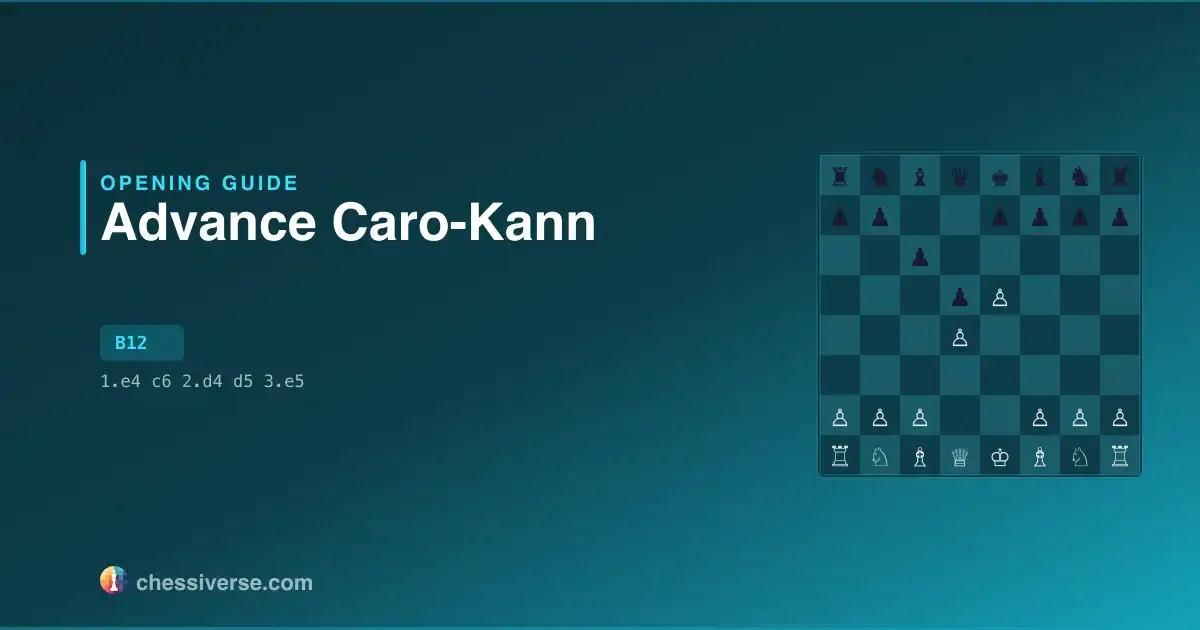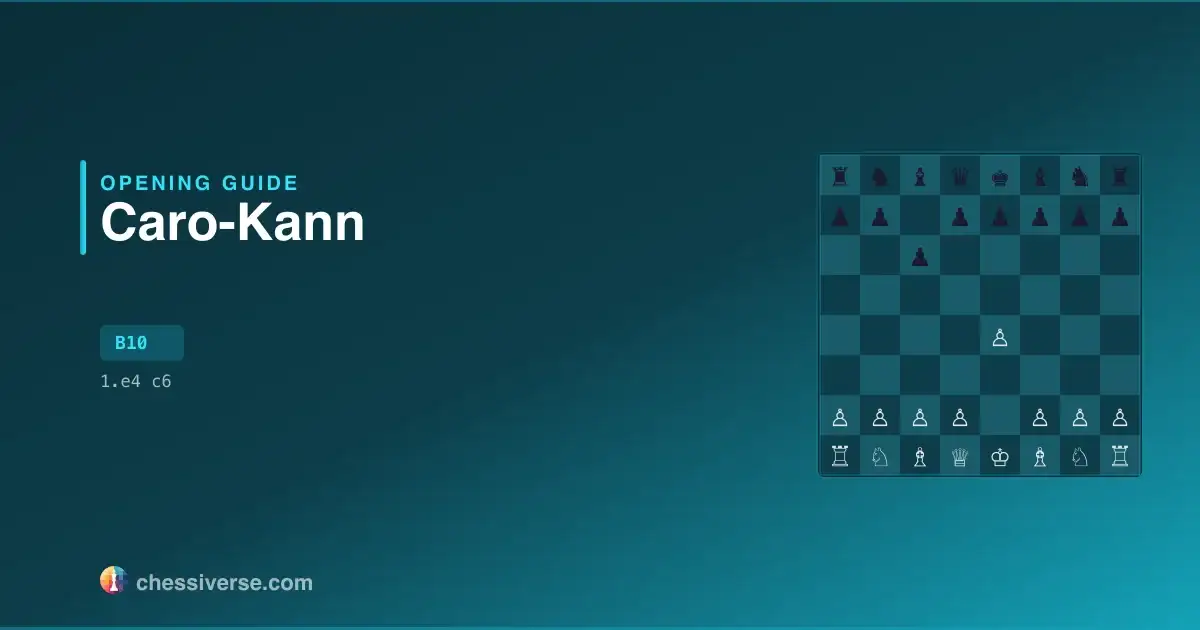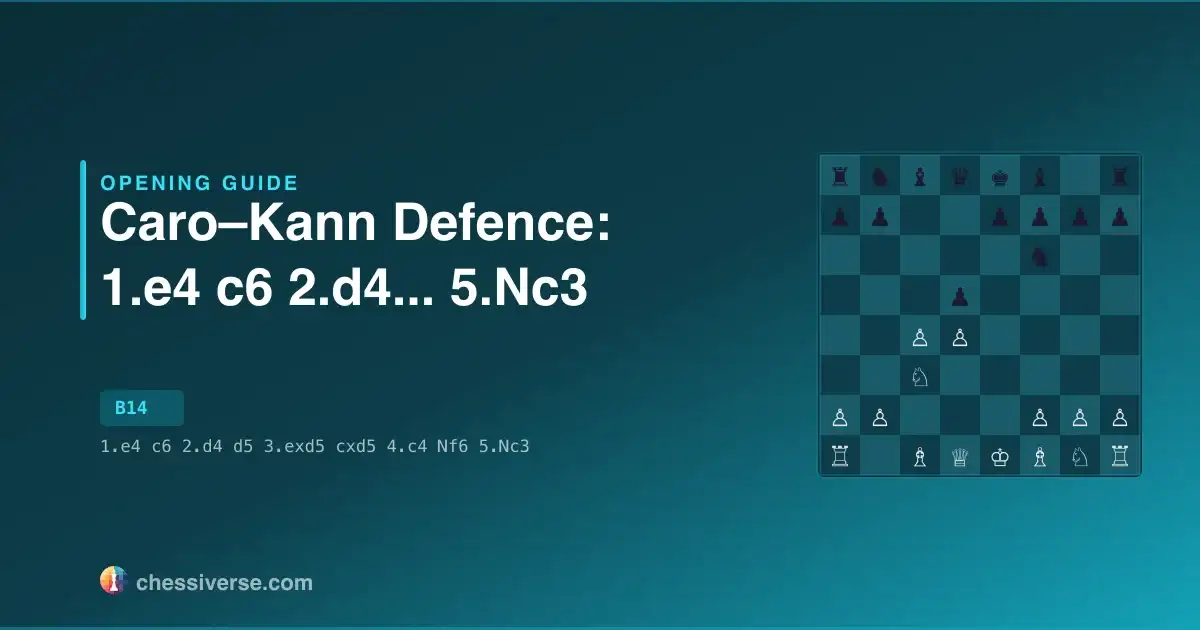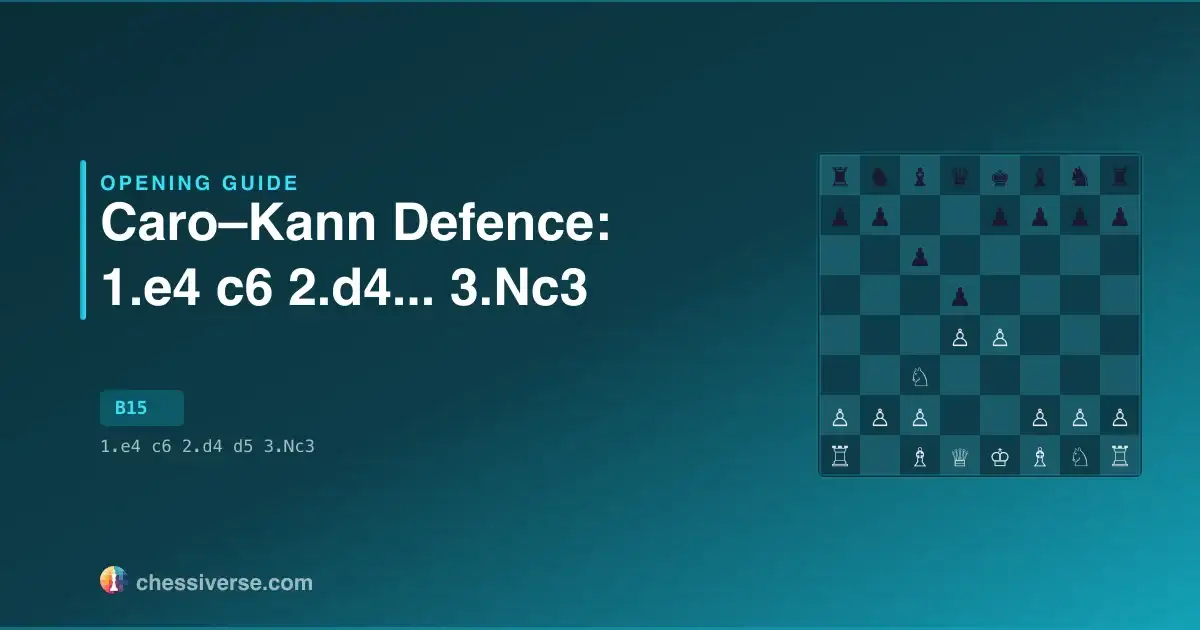


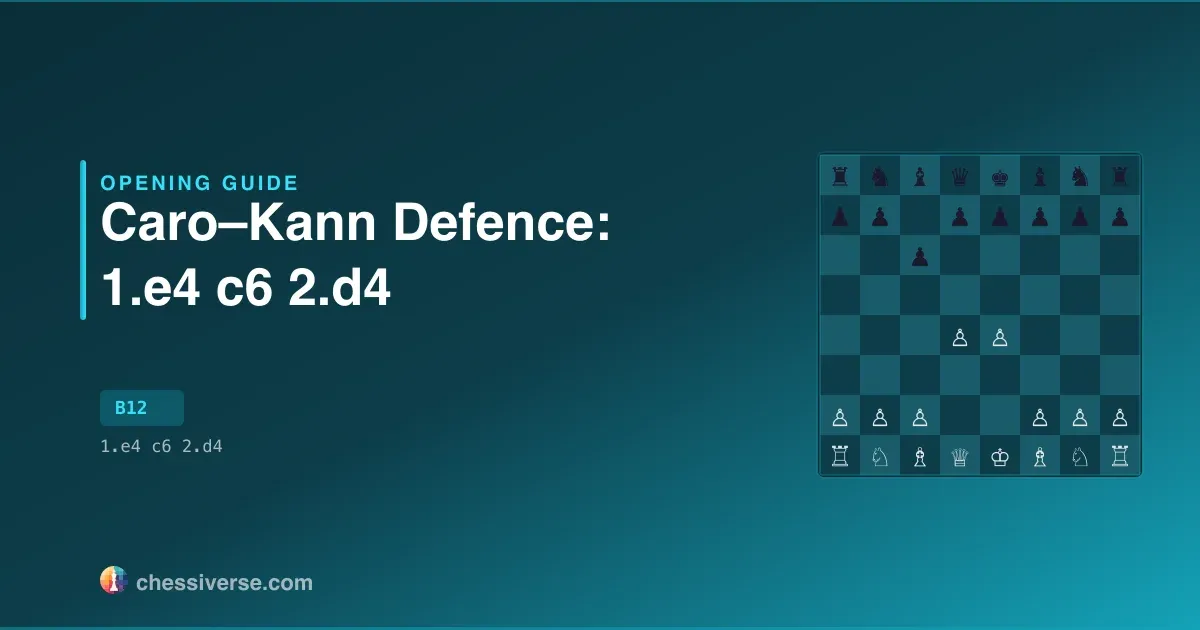
The Caro-Kann Defense: 1.e4 c6 2.d4 arises after 1.e4 c6 2.d4 and falls under ECO code B12. White follows the natural principle of occupying the center with two pawns when given the opportunity. Black's standard reply is 2...d5, carrying out the plan prepared by 1...c6. This move puts immediate pressure on e4, and since d5 is backed by the c-pawn, Black would welcome the exchange variation 3. exd5 cxd5, which effectively swaps White's central e-pawn for Black's less important c-pawn. To avoid this favorable trade for Black, White most often continues with either 3. e5, advancing the pawn out of danger, or 3. Nc3, preparing to recapture after an exchange on e4. The move 2...d5 is overwhelmingly the choice in practice, played in over 95% of serious games, though a few rare alternatives have been tried, often with ...d5 following shortly afterward. With 93.3 million Lichess games across all rating levels, it is one of the most popular openings.
History and Notable Players
It arises from the Caro-Kann Defense. Among the most prolific practitioners on the White side are Alexei Shirov (106 games), Evgeny Sveshnikov (105 games), Viswanathan Anand (93 games). On the Black side, notable exponents include Vladimir Burmakin (348 games), Aleksey Dreev (309 games), Eduard Meduna (297 games).
Statistics
Based on 93.3 million Lichess games across all rating levels:
- White wins: 48.6%
- Black wins: 46.5%
- Draws: 4.8%
The statistics show a roughly balanced opening where both sides have equal chances.
Main Lines and Variations
After 1.e4 c6 2.d4, the main continuations include:
Each of these lines leads to distinct types of positions and requires its own understanding of the resulting pawn structures and piece placements.
Common Mistakes to Avoid
- Being too passive: While this opening is solid, playing without a plan can lead to a cramped position. Look for the right moment to break with a central pawn advance and free your pieces.
Practice on Chessiverse
The best way to learn the Caro-Kann Defense is through practice. On Chessiverse, you can play chess against computer opponents that specialize in this opening. Our AI bots range from beginner to grandmaster level, each with unique playing styles — from aggressive attackers to solid defenders. Choose a bot that matches your rating and work your way up as you master the opening's key ideas.
Performance Across Rating Levels
The picture changes a lot as you climb the rating ladder. At 1200 Elo, the opening shows up in 1.26% of games (8,494,144 samples). White scores 49.2%, Black 47.1%, draws 3.7%. By 1800, popularity is 2.67% and White's score is 48.4% to Black's 46.5%. At the top end (2500+ Elo), popularity is 3.78% with 9.6% draws — a clear sign of how much theory rules the line at master level.
Time Control Patterns
The Caro-Kann Defense (2.d4) skews toward blitz chess. In bullet, it appears in 1.64% of games (43,717,488); White wins 49.1%. Blitz shows 2.04% adoption across 73,308,976 games, White scoring 48.6%. In rapid, the share rises to 1.80% — 19,948,915 games, White 48.6%.
Move Diversity and Theory Depth
Move choice is far from uniform in the Caro-Kann Defense (2.d4). At 1200 Elo (8,494,144 games), the top reply is d5, played 90.7% of the time. No other move reaches 5% of games, and the top three moves account for 95.5% of games. Entropy: 0.72. By 2500 (515,184 games), d5 dominates at 96.1% of replies; no other move reaches 5% and the top three moves account for 99% of games. Entropy drops to 0.32.
Historical Trends
Year-over-year data tells you whether this opening is a contemporary fixture or a fading one. Adoption peaked in 2025 at 2.38% (17,671,273 games). 2025 marks the high — the opening is rising, currently at 2.38%.