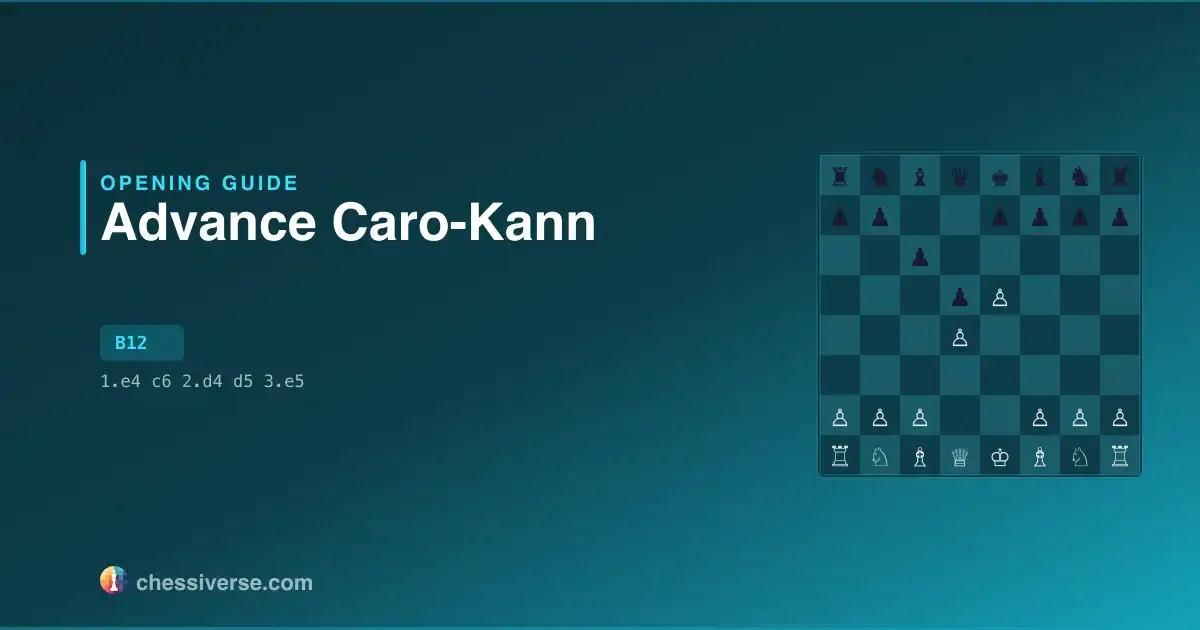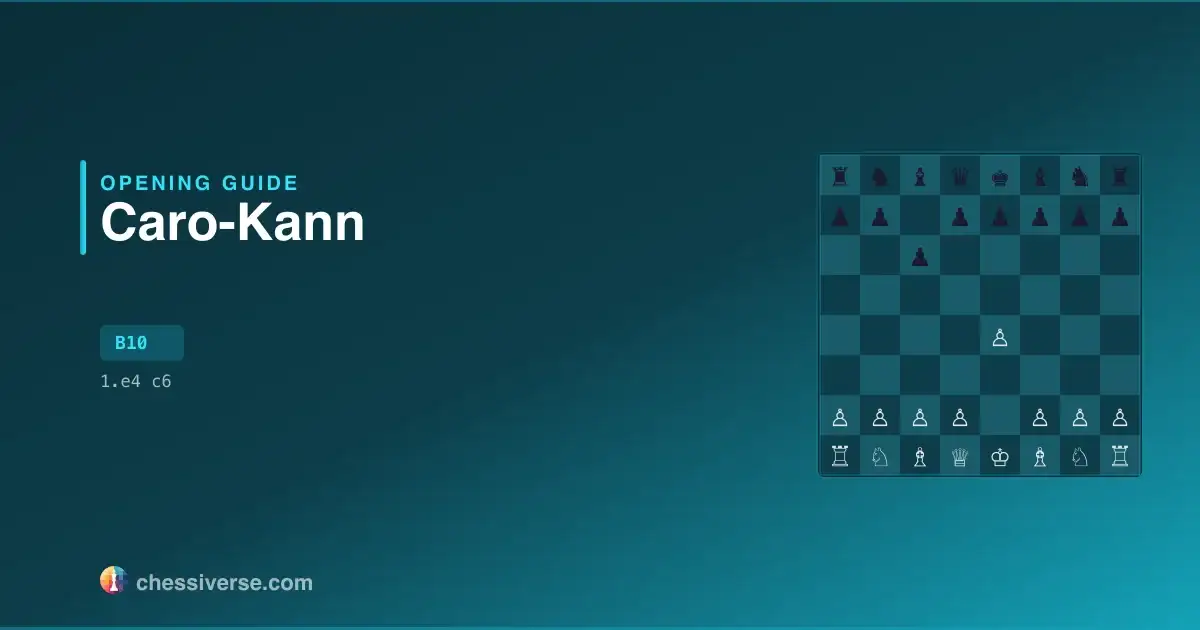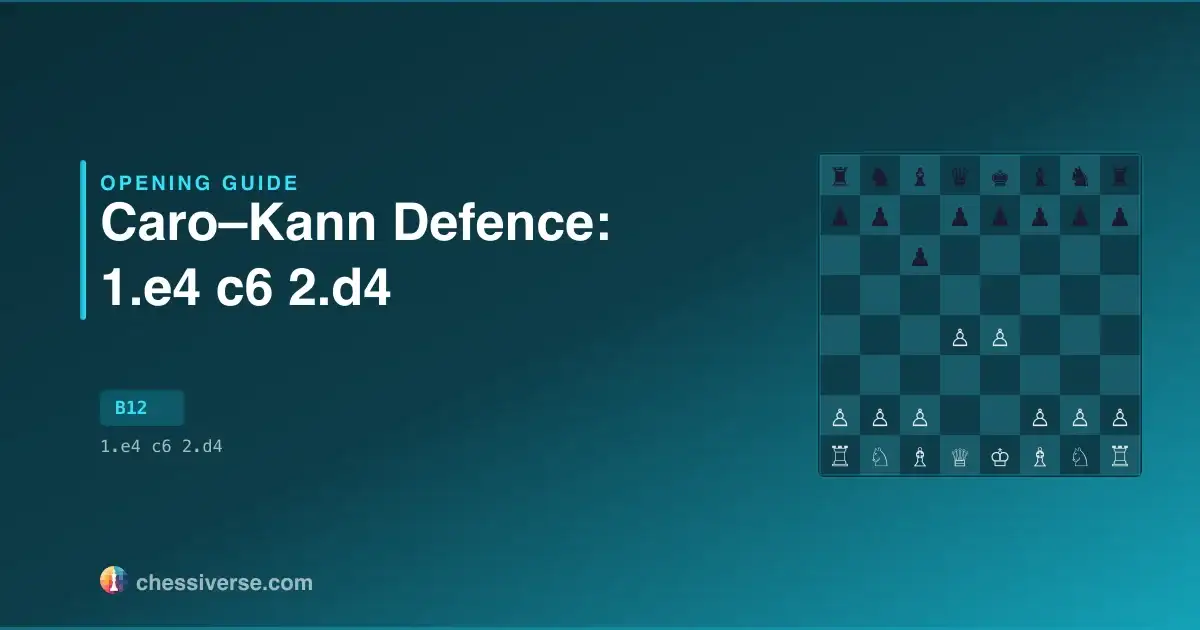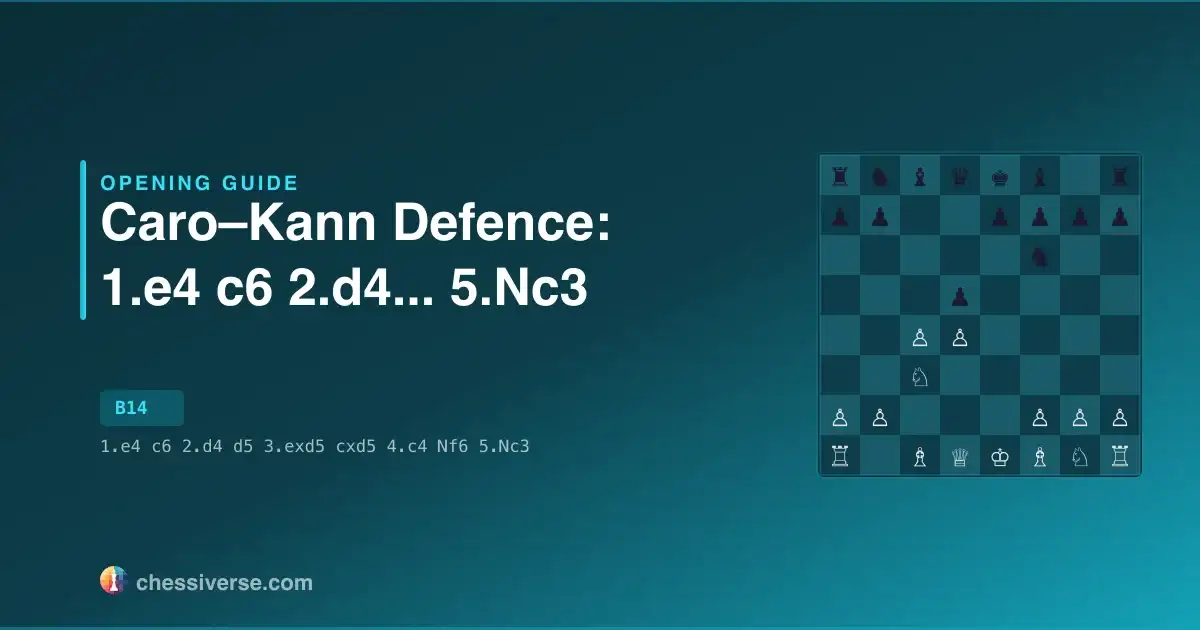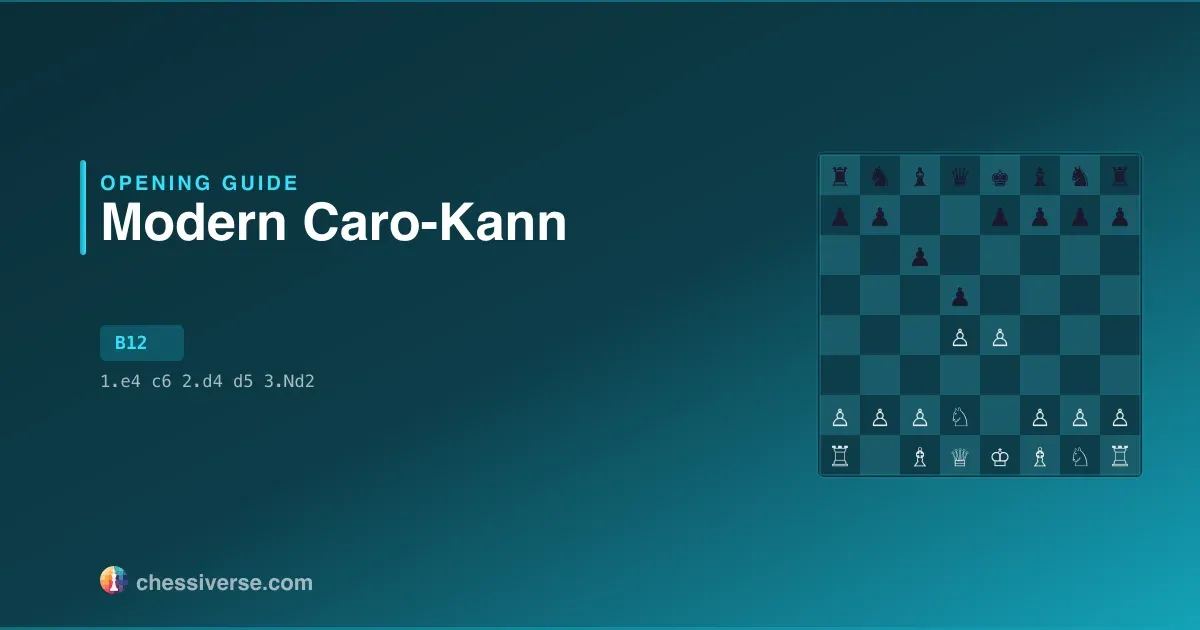
The Caro-Kann Defense: Modern Variation arises after 1.e4 c6 2.d4 d5 3.Nd2 and falls under ECO code B12. In the Caro-Kann, Black prepares ...d5 with 1...c6, ensuring the c-pawn can recapture if White takes on d5. Compared to the French Defense, where 1...e6 serves a similar purpose, the Caro-Kann avoids locking in the light-squared bishop, though the trade-off is that Black cannot develop the knight to c6 as easily and may lose a tempo if ...c5 is later desired. After 2.d4 d5, White chooses 3.Nd2 rather than the more common 3.Nc3, keeping the c-pawn free to advance to c3 or c4 and sidestepping any ...Bb4 pin. The drawback is reduced activity compared to a knight on c3, which would bear directly on e4 and d5. The resulting play tends to be quieter and more positional, with Black's most common response being 3...dxe4 4.Nxe4, leading to positions where piece placement and long-term strategy take precedence. With 196.9 million Lichess games across all rating levels, it is one of the most popular openings.
History and Notable Players
Among the most prolific practitioners on the White side are Sergei Tiviakov (121 games), Vlastimil Jansa (115 games), Nigel D Short (114 games). On the Black side, notable exponents include Vladimir Burmakin (410 games), Aleksey Dreev (389 games), Eduard Meduna (357 games).
Statistics
Based on 3.2 million Lichess games across all rating levels:
- White wins: 50.9%
- Black wins: 43.3%
- Draws: 5.9%
White holds a moderate edge statistically, though Black has good practical chances.
Common Mistakes to Avoid
- Being too passive: While this opening is solid, playing without a plan can lead to a cramped position. Look for the right moment to break with a central pawn advance and free your pieces.
- Allowing White to build an overwhelming center: Hypermodern openings allow White space in the center, but you need to strike back at the right moment. Delaying the counterattack too long can leave you without active play.
Practice on Chessiverse
The best way to learn the Caro-Kann Defense: Modern Variation is through practice. On Chessiverse, you can play chess against computer opponents that specialize in this opening. Our AI bots range from beginner to grandmaster level, each with unique playing styles — from aggressive attackers to solid defenders. Choose a bot that matches your rating and work your way up as you master the opening's key ideas.
Performance Across Rating Levels
The picture changes a lot as you climb the rating ladder. Among 1200-rated players, it appears in 0.01% of games — 64,423 of them on record — with White winning 54.6% and Black 42.4%. Move up to 1800 Elo and the share shifts to 0.11%, with White winning 51.4% versus Black's 43.5%. At the top end (2500+ Elo), popularity is 0.33% with 11.5% draws — a clear sign of how much theory rules the line at master level. White's edge erodes by 8.2pp from 1200 to 2500 Elo, suggesting Black's counterplay is easier to find with experience.
Time Control Patterns
The Caro-Kann Defense: Modern Variation skews toward bullet chess. In bullet, it appears in 4.41% of games (117,115,939); White wins 47.8%. Blitz shows 4.30% adoption across 154,428,757 games, White scoring 47.4%. In rapid, the share rises to 3.84% — 42,442,709 games, White 46.8%.
Move Diversity and Theory Depth
Looking at move selection shows how forcing — or not — the position really is. At 1200 Elo (22,491,792 games), the top reply is d4, played 34.9% of the time. Three other moves each take at least 5% of games, and the top three moves account for 81.5% of games. Entropy: 2.38. By 2500 (765,806 games), d4 dominates at 66.5% of replies; only two other moves still reach 5% and the top three moves account for 90.8% of games. Entropy drops to 1.63. The narrowing is significant — strong players consolidate around a small set of best moves, while amateurs scatter across many plausible-looking options.
Historical Trends
Year-over-year data tells you whether this opening is a contemporary fixture or a fading one. Adoption peaked in 2025 at 5.00% (37,054,066 games). 2025 marks the high — the opening is rising, currently at 5.00%.