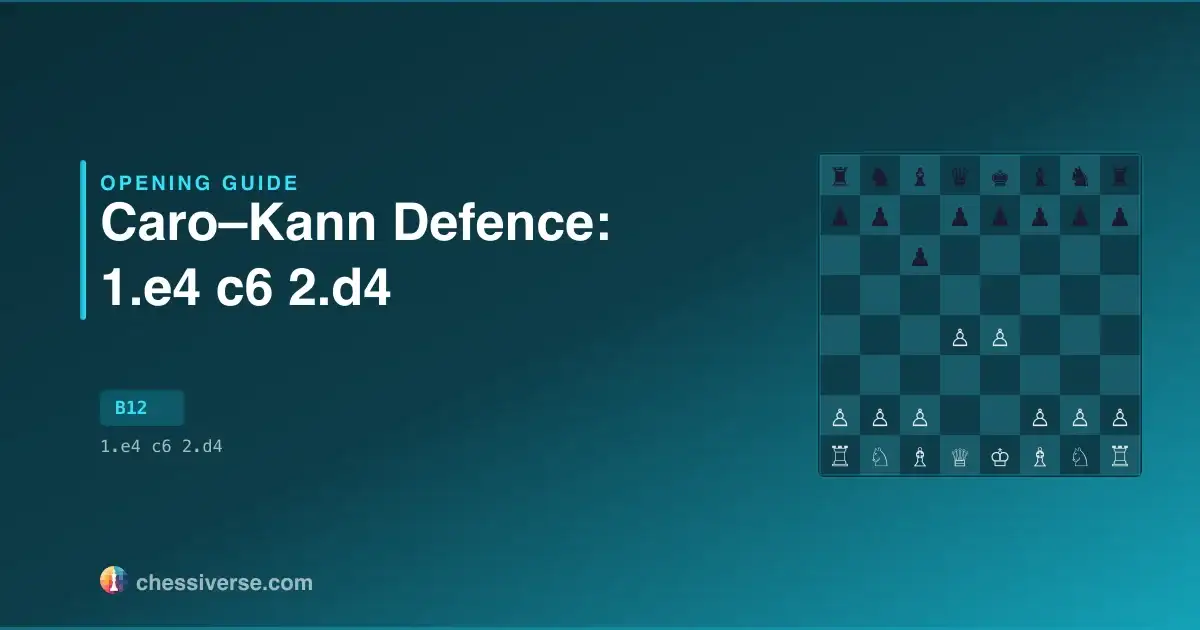




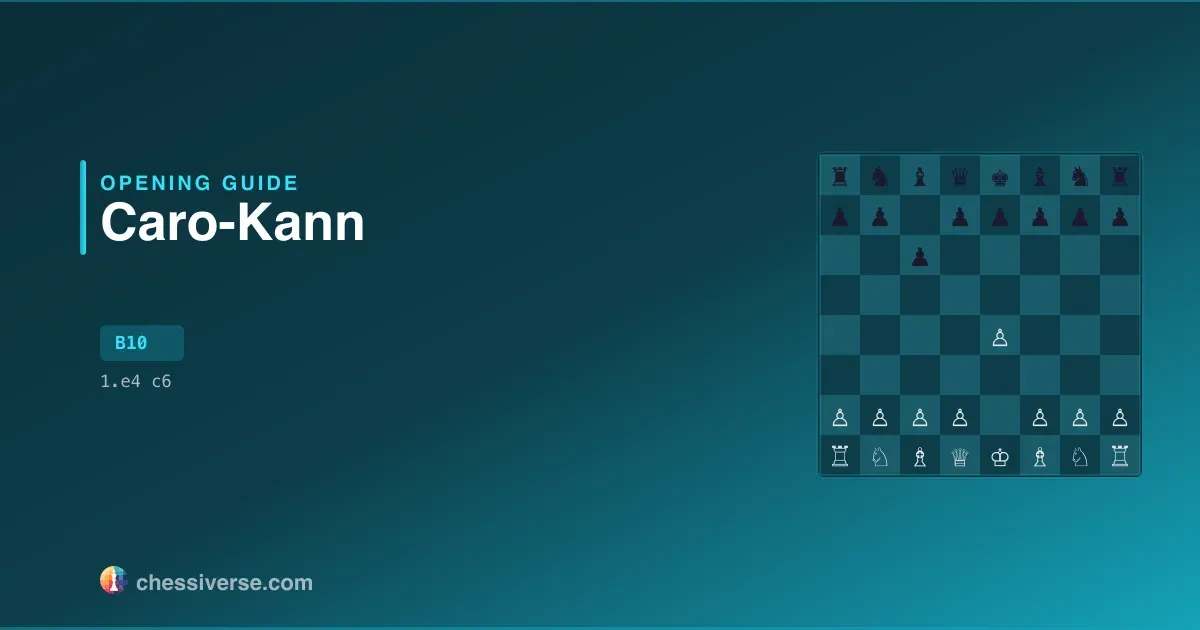
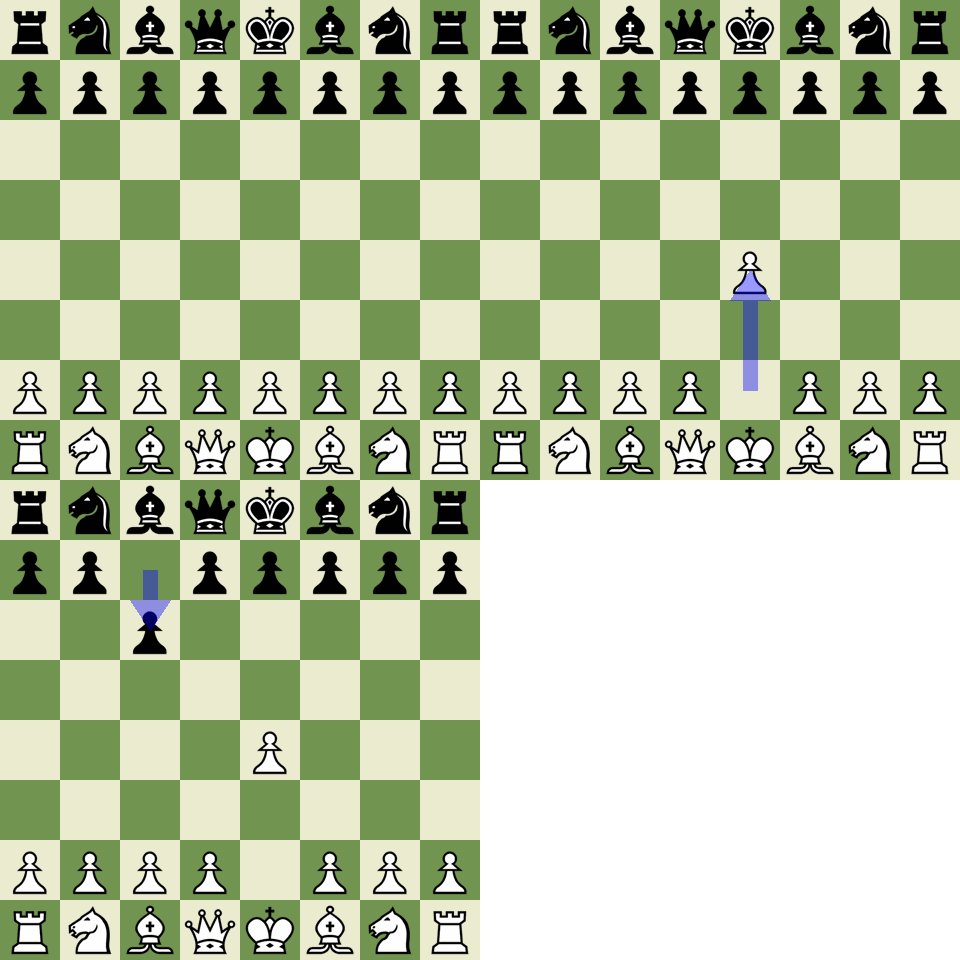
The Caro-Kann Defense arises after 1.e4 c6 and falls under ECO code B10. With 1...c6, Black lays the groundwork for 2...d5, ensuring the c-pawn can recapture if White takes on d5. Achieving a pawn on d5 is strategically valuable because it controls c4, neutralizing one of the most common attacking setups in the Open Game where White's bishop on c4 targets the vulnerable f7 square. The advantage of the Caro-Kann over the French Defense (which also prepares ...d5, but with 1...e6) is that the light-squared bishop on c8 remains unobstructed; the trade-off is that the c-pawn can no longer support a knight on c6, and if Black later wants to push ...c5 to challenge White's centre, a tempo will have been lost. After 1...c6, White typically responds with 2. d4, establishing a broad two-pawn centre, since Black has neither created a threat nor contested d4. Black then plays 2...d5, and the game branches depending on White's approach: exchanging pawns on d5, advancing with e5, or defending e4 with a piece or pawn. With 196.9 million Lichess games across all rating levels, it is one of the most popular openings.
- Black stakes a claim in the centre with 2...d5, in line with the opening's emphasis on central control.
- Unlike in the French Defence, Black's light-squared bishop is not locked behind the pawn chain and can develop freely, at the cost of a tempo.
- Play is usually positional and solid rather than sharp, though modern lines with kingside castling for Black can become dynamic.
History and Notable Players
Among the most prolific practitioners on the White side are Sergei Tiviakov (121 games), Vlastimil Jansa (115 games), Nigel D Short (114 games). On the Black side, notable exponents include Vladimir Burmakin (410 games), Aleksey Dreev (389 games), Eduard Meduna (357 games).
Caro and Kann analysed the defence in 1886, a year after Kann had beaten Jacques Mieses with it in just 24 moves at Hamburg 1885. Viktor Korchnoi played it many times, including in his first world championship match against Anatoly Karpov, and it appeared in the famous last game of Kasparov's rematch against Deep Blue.
Named after: Named for Horatio Caro of England and Marcus Kann of Austria, who both analysed the defence in 1886.
Notable players: José Capablanca, Viktor Korchnoi, Ding Liren, Alireza Firouzja
The last game of the Kasparov vs Deep Blue rematch was a Caro-Kann: in the Steinitz Variation, Kasparov committed a blunder that was already known to theory and lost.
Statistics
Based on 196.9 million Lichess games across all rating levels:
- White wins: 47.3%
- Black wins: 48%
- Draws: 4.7%
The statistics show a roughly balanced opening where both sides have equal chances.
Main Lines and Variations
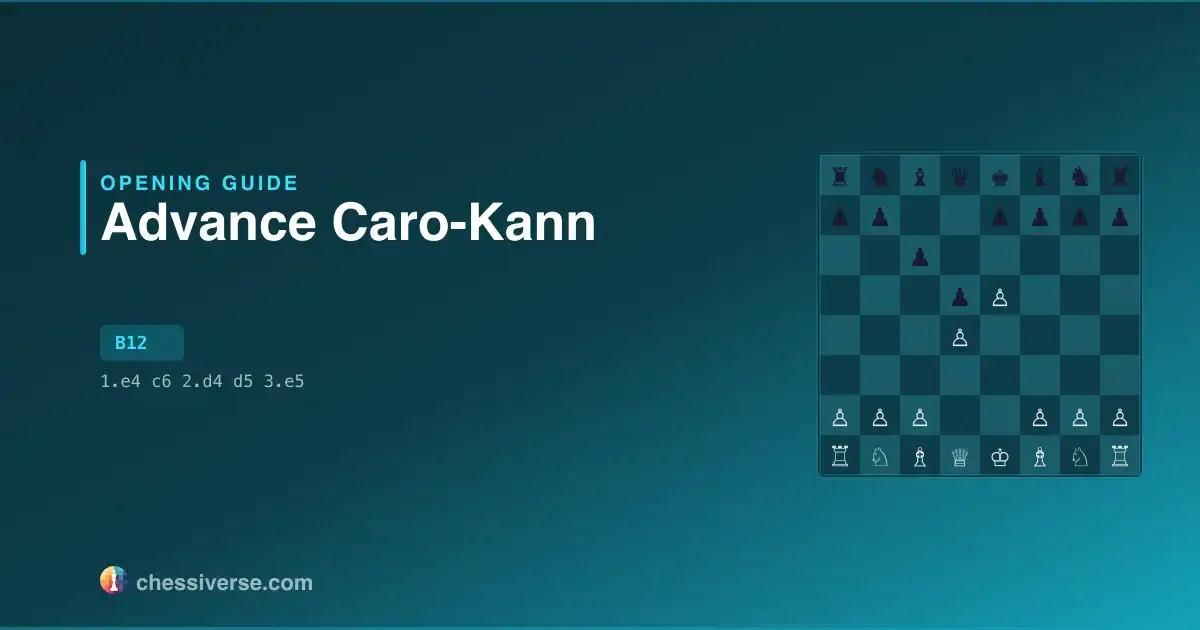
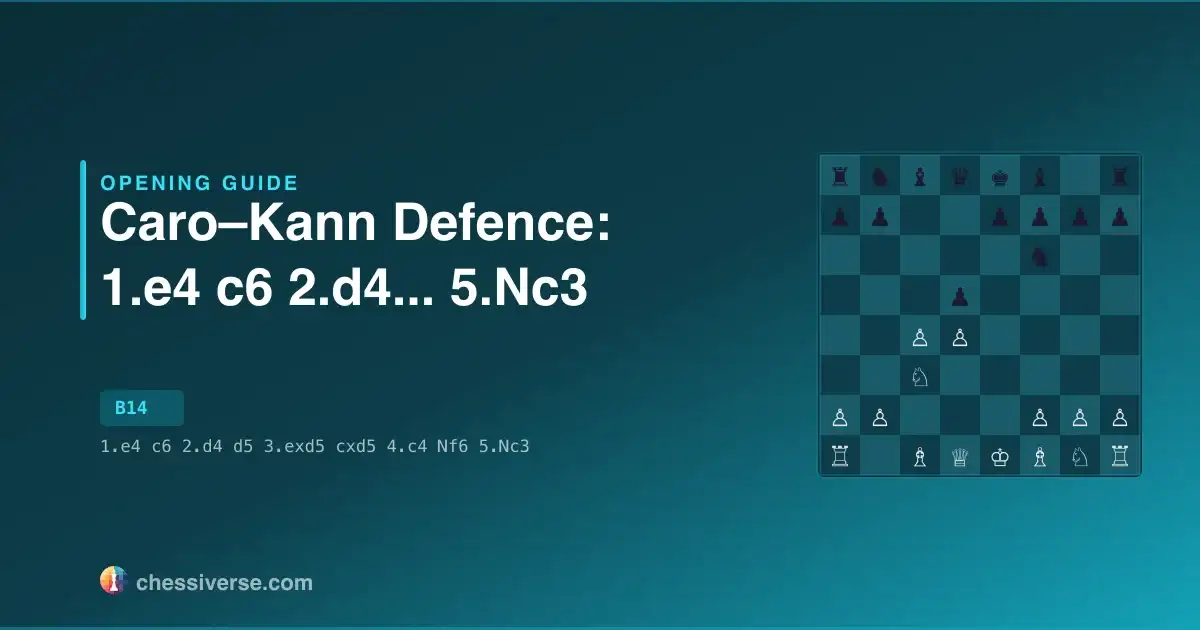
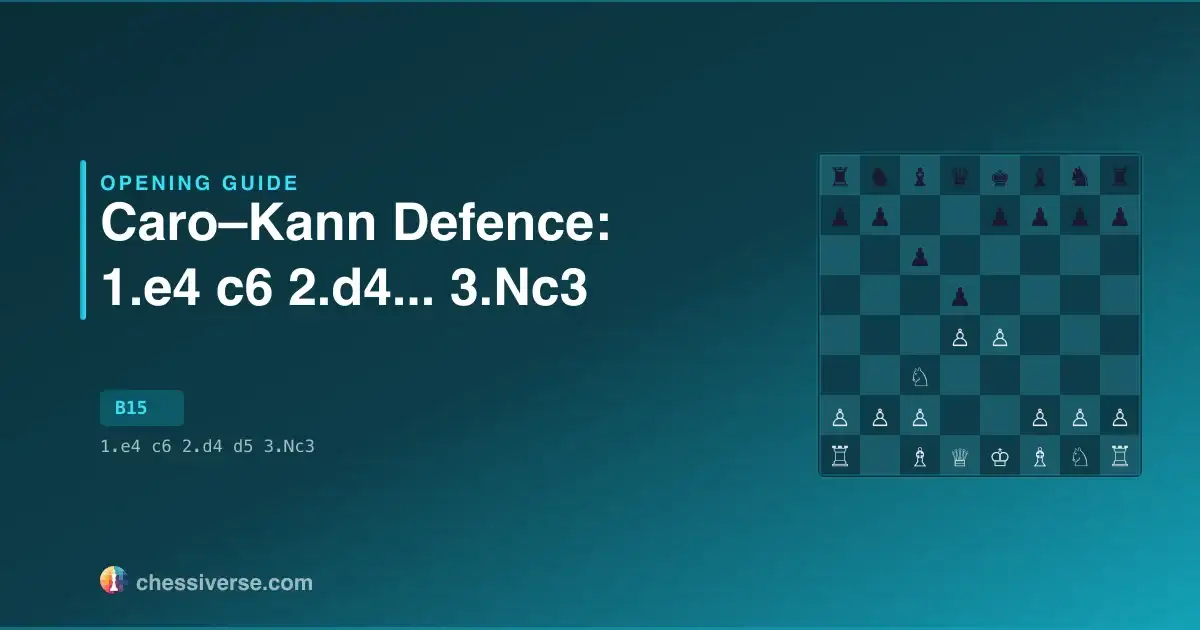
After 1.e4 c6, the main continuations include:
Each of these lines leads to distinct types of positions and requires its own understanding of the resulting pawn structures and piece placements.
Common Mistakes to Avoid
- Being too passive: While this opening is solid, playing without a plan can lead to a cramped position. Look for the right moment to break with a central pawn advance and free your pieces.
Practice on Chessiverse
The best way to learn the Caro-Kann Defense is through practice. On Chessiverse, you can play chess against computer opponents that specialize in this opening. Our AI bots range from beginner to grandmaster level, each with unique playing styles — from aggressive attackers to solid defenders. Choose a bot that matches your rating and work your way up as you master the opening's key ideas.
Performance Across Rating Levels
How well the Caro-Kann Defense works depends on what level you're playing at. Among 1200-rated players, it appears in 3.33% of games — 22,491,792 of them on record — with White winning 47.5% and Black 48.7%. At 1800 the opening surfaces in 5.10% of games; White wins 47.2%, Black 47.8%, draws 5%. At the top end (2500+ Elo), popularity is 5.62% with 9.9% draws — a clear sign of how much theory rules the line at master level.
Time Control Patterns
Look at the same opening across time controls and bullet stands out. In bullet, it appears in 4.41% of games (117,115,939); White wins 47.8%. Blitz shows 4.30% adoption across 154,428,757 games, White scoring 47.4%. In rapid, the share rises to 3.84% — 42,442,709 games, White 46.8%.
Move Diversity and Theory Depth
Looking at move selection shows how forcing — or not — the position really is. At 1200 Elo (22,491,792 games), the top reply is d4, played 34.9% of the time. Three other moves each take at least 5% of games, and the top three moves account for 81.5% of games. Entropy: 2.38. By 2500 (765,806 games), d4 dominates at 66.5% of replies; only two other moves still reach 5% and the top three moves account for 90.8% of games. Entropy drops to 1.63. The narrowing is significant — strong players consolidate around a small set of best moves, while amateurs scatter across many plausible-looking options.
Historical Trends
Long-term, the trajectory of this opening is informative. Adoption peaked in 2025 at 5.00% (37,054,066 games). 2025 marks the high — the opening is rising, currently at 5.00%.