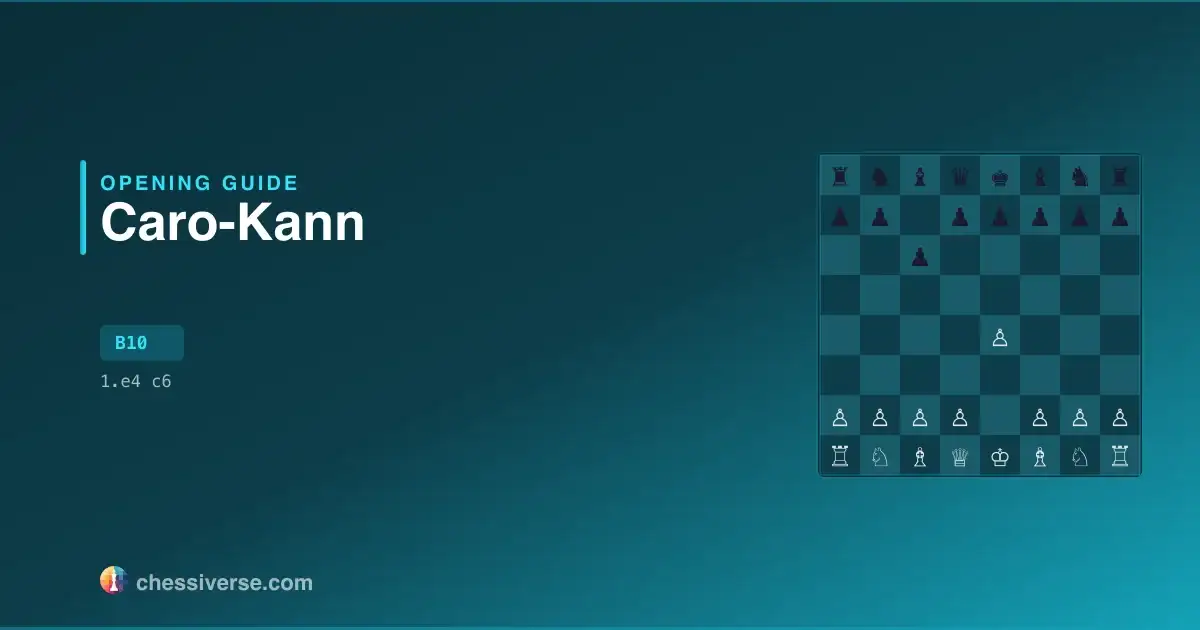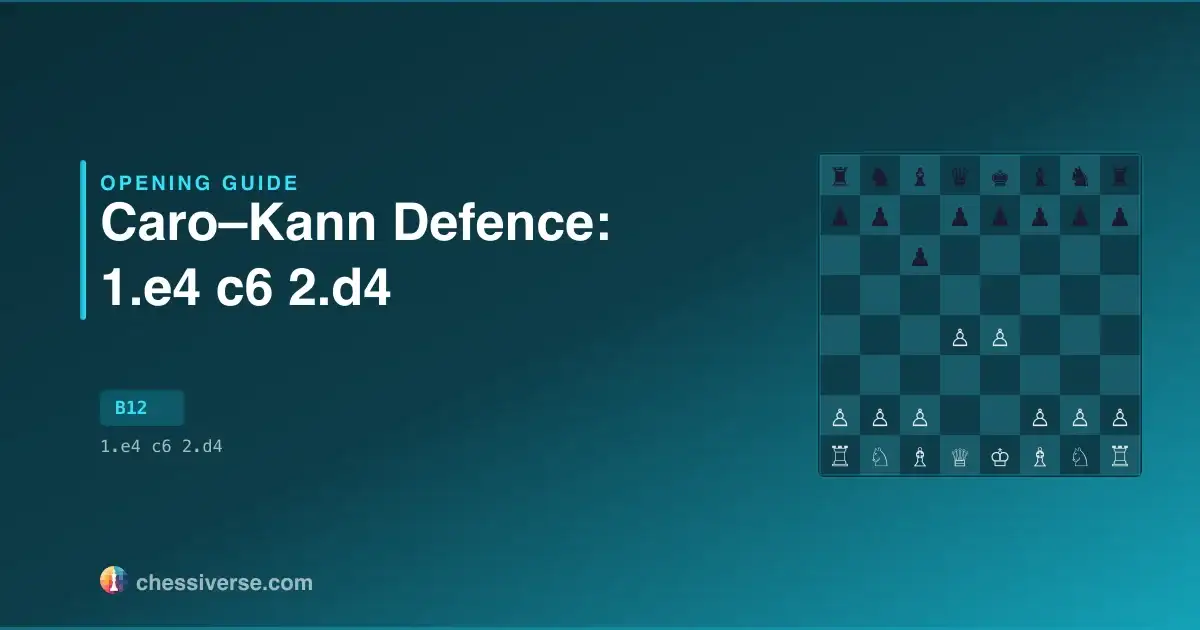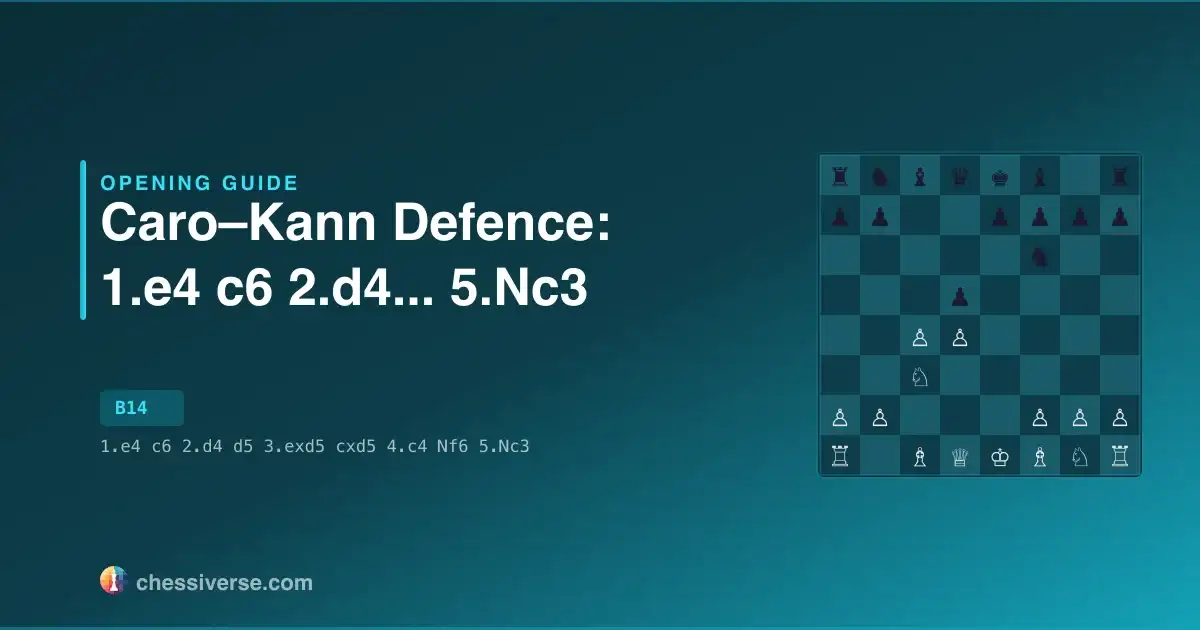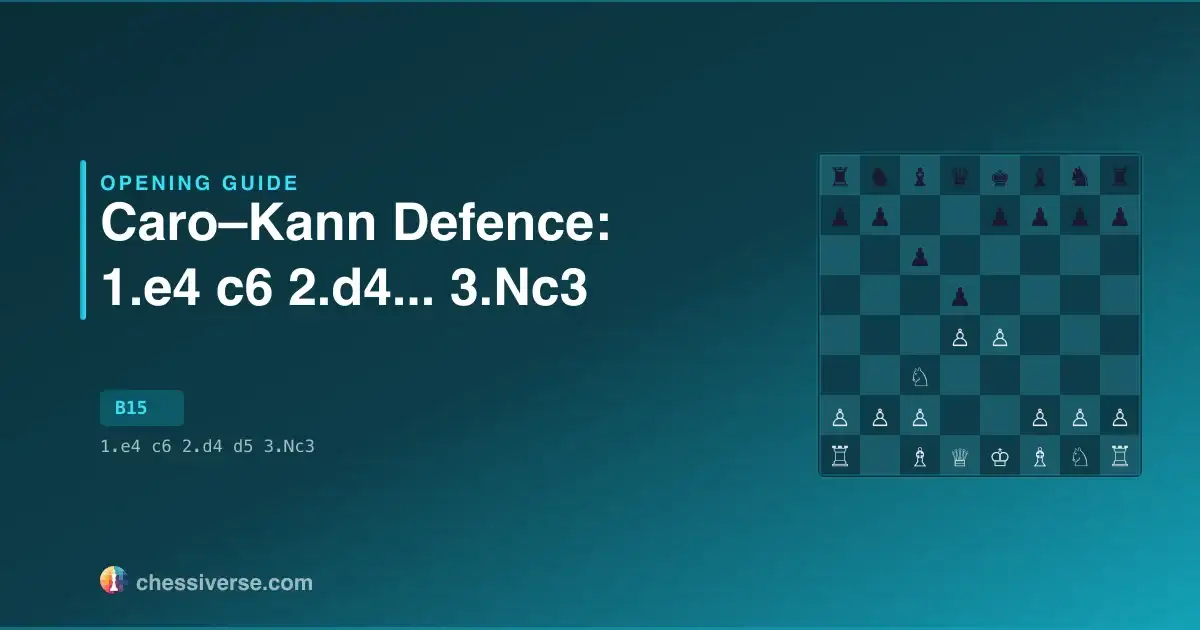




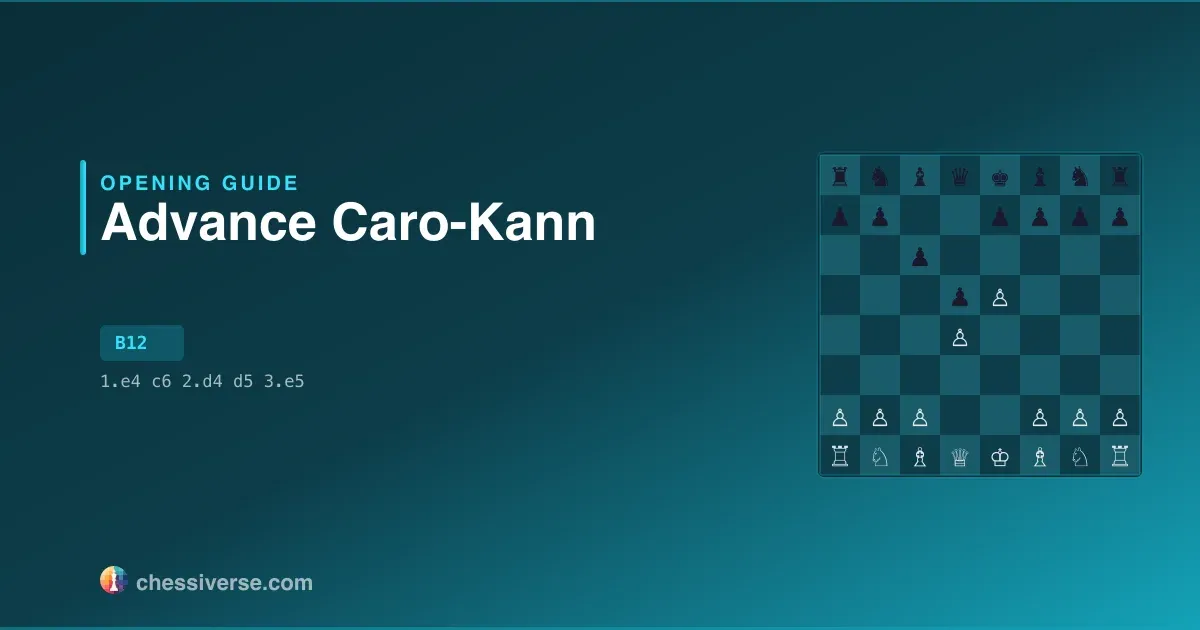
The Caro-Kann Defense: Advance Variation arises after 1.e4 c6 2.d4 d5 3.e5 and falls under ECO code B12. White pushes the e-pawn to secure a spatial advantage in the centre. For a long time this line was considered dubious, largely due to the instructive defeat Aron Nimzowitsch suffered against Jose Capablanca at the New York 1927 tournament. Since then, however, it has been rehabilitated through a range of ideas spanning quiet positional play to sharp, aggressive lines. Black has two principal responses. The most popular approach involves developing the light-squared bishop outside the pawn chain before playing ...e6, aiming for an improved version of the Advance French structure. The drawback is that this delays a direct counter-blow in the centre, and the bishop can become a target of advances like g4 and h4. The key alternative is to challenge White's centre immediately with ...c5. Unlike in the French Defense, Black has spent two moves on the c-pawn rather than one, and with the e-pawn still on e7, the c5 pawn is undefended, giving White the option to capture it. Black can often recover the pawn and end up with two central pawns against one, but may also choose to sacrifice the pawn for rapid piece development instead. With 37.1 million Lichess games across all rating levels, it is one of the most popular openings.
- The early e5 push immediately grabs White an advantage in space.
- White's sharpest tries throw the kingside pawns forward, with g4 in the Bayonet and Van der Wiel lines or the h4 lunge named after Tal.
History and Notable Players
It arises from the Caro-Kann Defense. Among the most prolific practitioners on the White side are Alexei Shirov (106 games), Evgeny Sveshnikov (105 games), Viswanathan Anand (93 games). On the Black side, notable exponents include Vladimir Burmakin (348 games), Aleksey Dreev (309 games), Eduard Meduna (297 games).
For decades 3.e5 was written off as harmless, a reputation cemented by Nimzowitsch's strategic loss to Capablanca at New York 1927. New ideas changed that: the sharp 4.Nc3 and g4 line was popular in the 1980s and later a Shirov favourite, while Nigel Short popularized a calmer system in the 1990s. In the 21st century the Advance has become White's most popular weapon against the Caro-Kann.
Named after: The Caro-Kann carries the names of Horatio Caro of England and Marcus Kann of Austria, who both analysed the defence in 1886.
Notable players: Alexei Shirov, Nigel Short, Mikhail Tal
A year before Caro and Kann's 1886 analysis, Marcus Kann showed the defence's bite by defeating Jacques Mieses at the German Chess Congress in Hamburg in May 1885.
Statistics
Based on 37.1 million Lichess games across all rating levels:
- White wins: 47.8%
- Black wins: 47.8%
- Draws: 4.4%
The statistics show a roughly balanced opening where both sides have equal chances.
Common Mistakes to Avoid
- Being too passive: While this opening is solid, playing without a plan can lead to a cramped position. Look for the right moment to break with a central pawn advance and free your pieces.
Practice on Chessiverse
The best way to learn the Caro-Kann Defense: Advance Variation is through practice. On Chessiverse, you can play chess against computer opponents that specialize in this opening. Our AI bots range from beginner to grandmaster level, each with unique playing styles — from aggressive attackers to solid defenders. Choose a bot that matches your rating and work your way up as you master the opening's key ideas.
Performance Across Rating Levels
How well the Caro-Kann Defense: Advance Variation works depends on what level you're playing at. At 1200 Elo, the opening shows up in 0.66% of games (4,468,248 samples). White scores 48.8%, Black 47.5%, draws 3.7%. By 1800, popularity is 0.92% and White's score is 46.9% to Black's 48.4%. Among 2500-rated players the line appears in 1.43% of games and draws spike to 8.4%, indicating tight preparation.
Time Control Patterns
Time control matters here: rapid players reach for this opening more than others. In bullet, it appears in 0.52% of games (13,766,237); White wins 49%. Blitz shows 0.79% adoption across 28,311,347 games, White scoring 47.8%. In rapid, the share rises to 0.79% — 8,789,699 games, White 47.6%.
Move Diversity and Theory Depth
What players actually play after the opening moves depends heavily on rating. At 1200 Elo (4,468,248 games), the top reply is Bf5, played 57.7% of the time. Two other moves each take at least 5% of games, and the top three moves account for 92% of games. Entropy: 1.75. By 2500 (194,367 games), Bf5 dominates at 70% of replies; only one other move still reaches 5% and the top three moves account for 97.8% of games. Entropy drops to 1.10. That entropy collapse is the signature of a line where preparation pays off: at the top, players know the best move and play it.
Historical Trends
Year-over-year data tells you whether this opening is a contemporary fixture or a fading one. Adoption peaked in 2025 at 0.94% (7,008,074 games). 2025 marks the high — the opening is rising, currently at 0.94%.