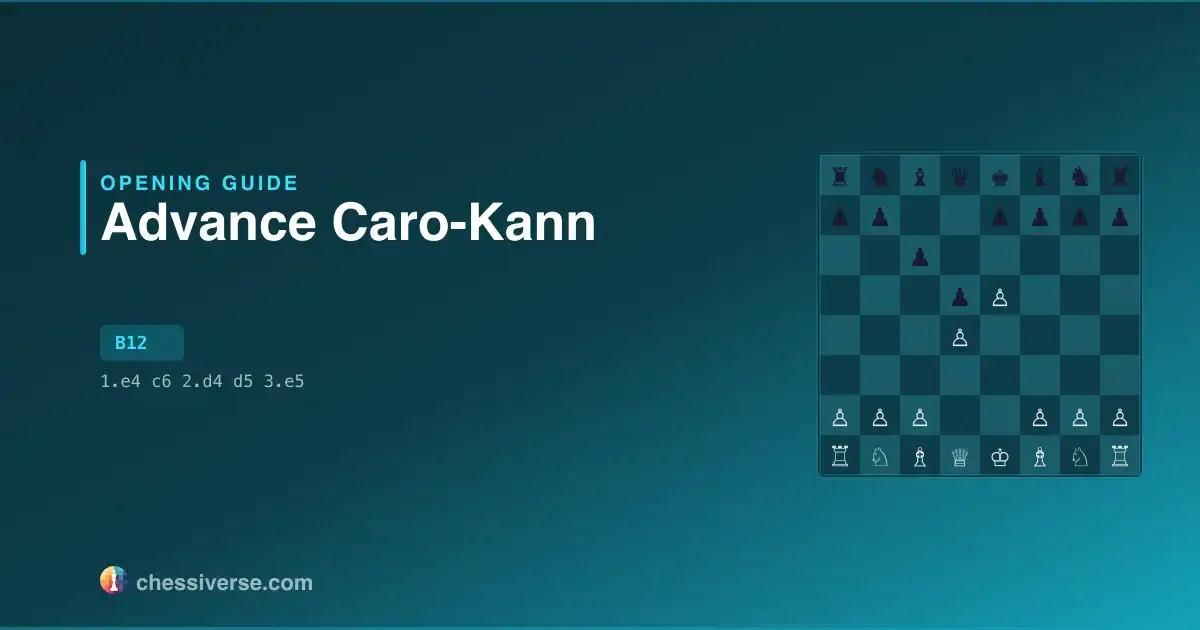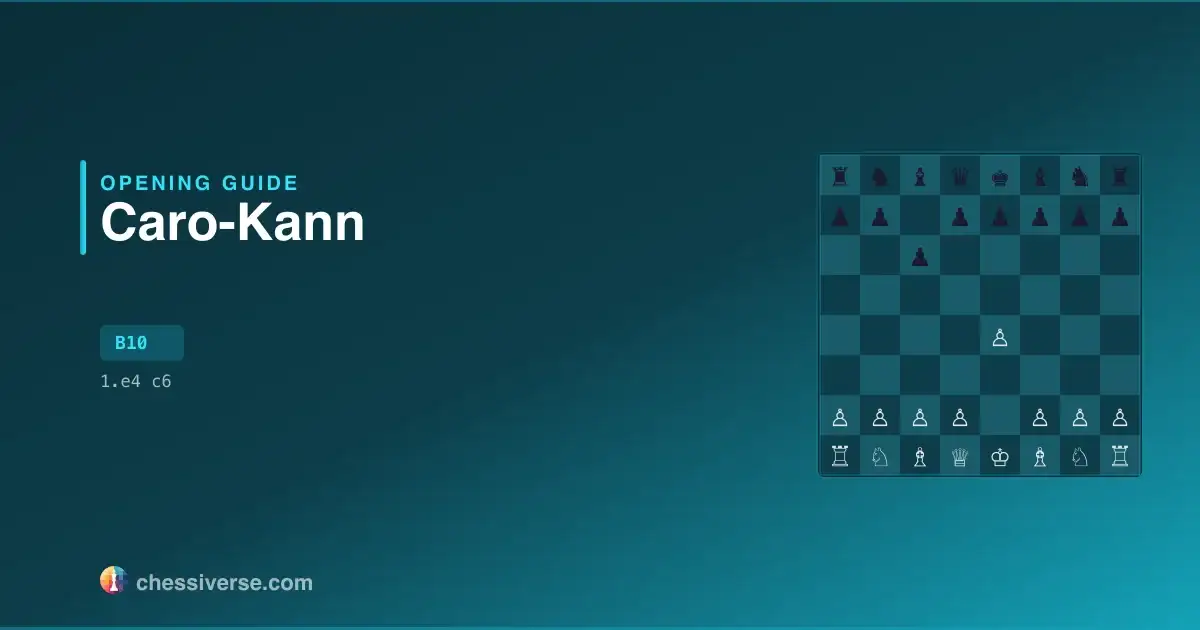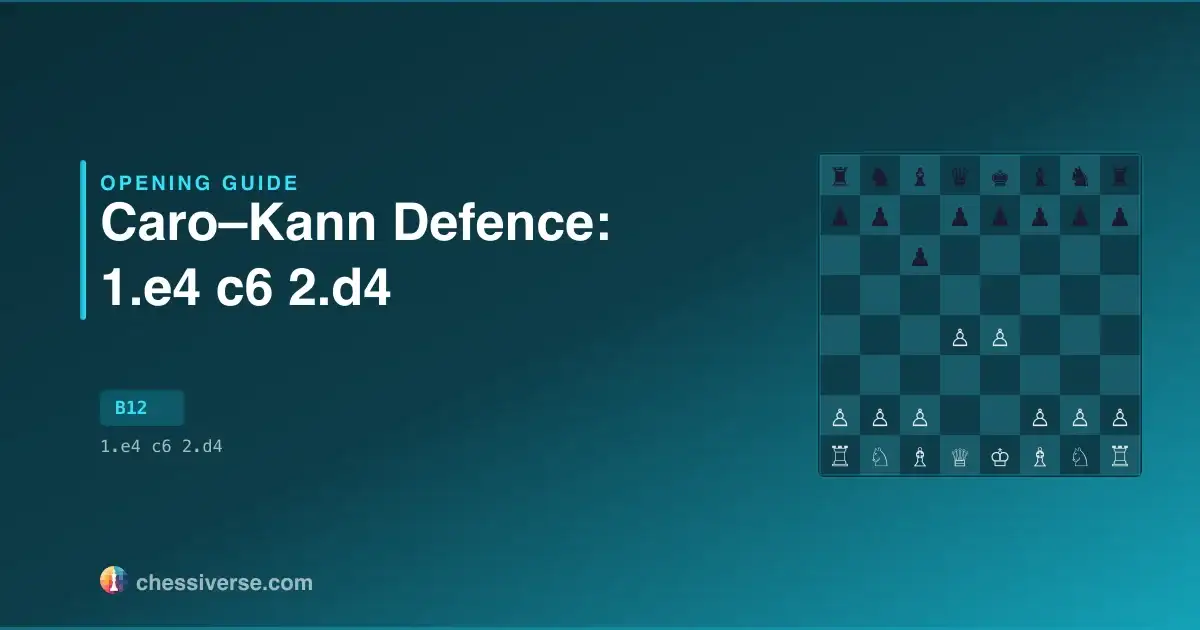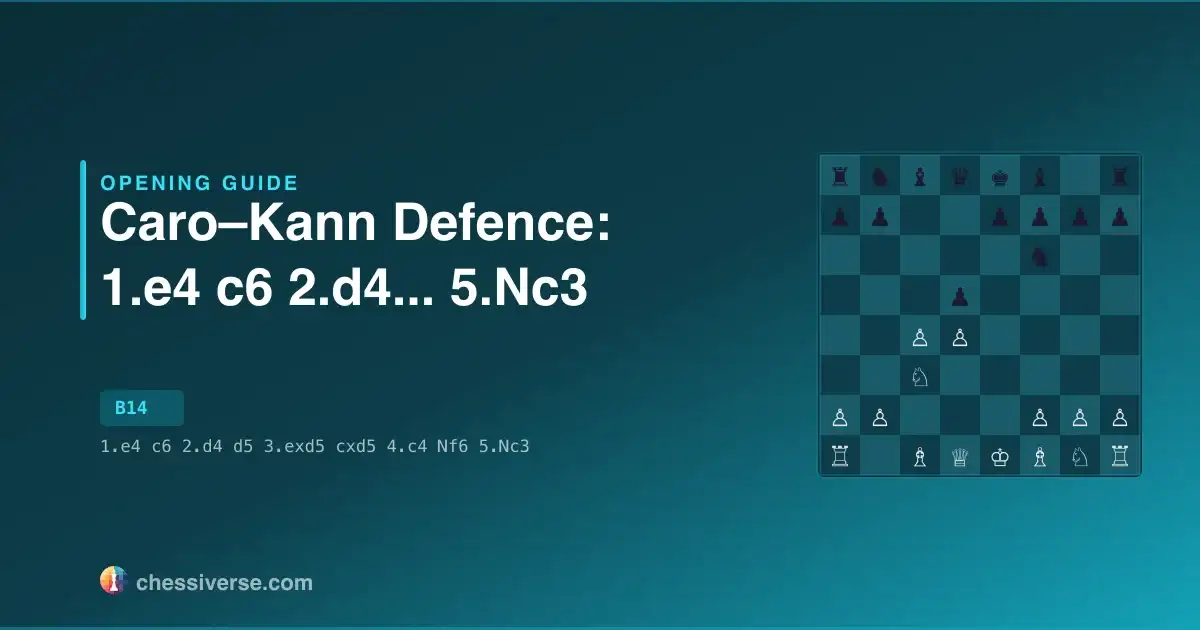


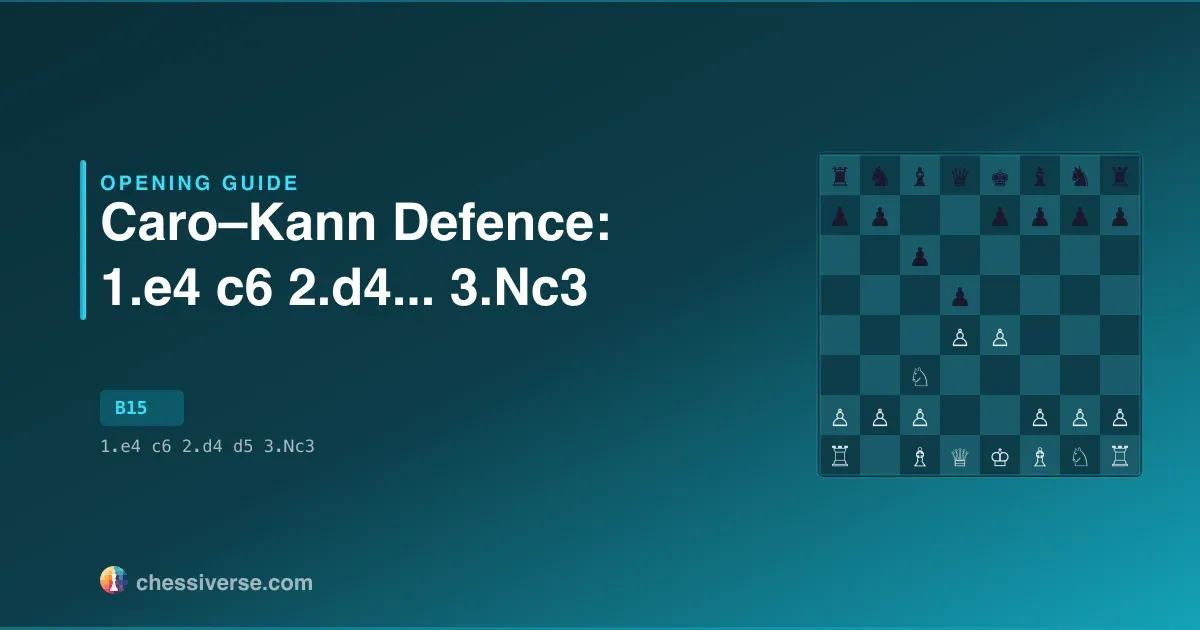
The Caro-Kann Defense (3.Nc3) arises after 1.e4 c6 2.d4 d5 3.Nc3 and falls under ECO code B15. White brings the knight into play, preparing to recapture on e4. The principal continuation is 3...dxe4, which eliminates White's two-pawn center, and White typically responds with 4. Nxe4, though certain gambit approaches involving declining the recapture also exist. Black has a few sideline options to dodge mainstream theory, but 3...e6?!, which reinforces d5 a second time, is generally regarded as inferior since it combines the drawbacks of both the Caro-Kann and the French Defense without the benefits of either. With 20.4 million Lichess games across all rating levels, it is a well-established opening choice.
History and Notable Players
It arises from the Caro-Kann Defense (2.d4). Among the most prolific practitioners on the White side are Boris V Spassky (58 games), Alonso Zapata (49 games), Viktor D Kupreichik (48 games). On the Black side, notable exponents include Laszlo Eperjesi (96 games), Vladimir Burmakin (80 games), Eduard Meduna (74 games).
Statistics
Based on 20.4 million Lichess games across all rating levels:
- White wins: 50%
- Black wins: 45%
- Draws: 5.1%
The statistics show a roughly balanced opening where both sides have equal chances.
Main Lines and Variations
After 1.e4 c6 2.d4 d5 3.Nc3, the main continuations include:
- Classical Caro-Kann
- Caro-Kann Defense: Karpov Variation
- Tartakower Caro-Kann
- Caro-Kann Defense: Bronstein-Larsen Variation
Each of these lines leads to distinct types of positions and requires its own understanding of the resulting pawn structures and piece placements.
Common Mistakes to Avoid
- Being too passive: While this opening is solid, playing without a plan can lead to a cramped position. Look for the right moment to break with a central pawn advance and free your pieces.
Practice on Chessiverse
The best way to learn the Caro-Kann Defense (3.Nc3) is through practice. On Chessiverse, you can play chess against computer opponents that specialize in this opening. Our AI bots range from beginner to grandmaster level, each with unique playing styles — from aggressive attackers to solid defenders. Choose a bot that matches your rating and work your way up as you master the opening's key ideas.
Performance Across Rating Levels
How well the Caro-Kann Defense (3.Nc3) works depends on what level you're playing at. At 1200 Elo, the opening shows up in 0.24% of games (1,649,524 samples). White scores 50.6%, Black 45.7%, draws 3.7%. By 1800, popularity is 0.59% and White's score is 50.2% to Black's 44.7%. Among 2500-rated players the line appears in 0.86% of games and draws spike to 10.3%, indicating tight preparation. White's edge erodes by 4.2pp from 1200 to 2500 Elo, suggesting Black's counterplay is easier to find with experience.
Time Control Patterns
Time control matters here: blitz players reach for this opening more than others. In bullet, it appears in 0.42% of games (11,172,698); White wins 51%. Blitz shows 0.44% adoption across 15,838,971 games, White scoring 49.9%. In rapid, the share rises to 0.41% — 4,548,870 games, White 50.1%.
Move Diversity and Theory Depth
What players actually play after the opening moves depends heavily on rating. At 1200 Elo (1,649,524 games), the top reply is dxe4, played 57.3% of the time. Two other moves each take at least 5% of games, and the top three moves account for 88% of games. Entropy: 2.02. By 2500 (117,956 games), dxe4 dominates at 93.1% of replies; no other move reaches 5% and the top three moves account for 97.5% of games. Entropy drops to 0.53. The narrowing is significant — strong players consolidate around a small set of best moves, while amateurs scatter across many plausible-looking options.
Historical Trends
Tracking the Caro-Kann Defense (3.Nc3) year over year shows a clear story. Adoption peaked in 2025 at 0.53% (3,962,498 games). 2025 marks the high — the opening is rising, currently at 0.53%.