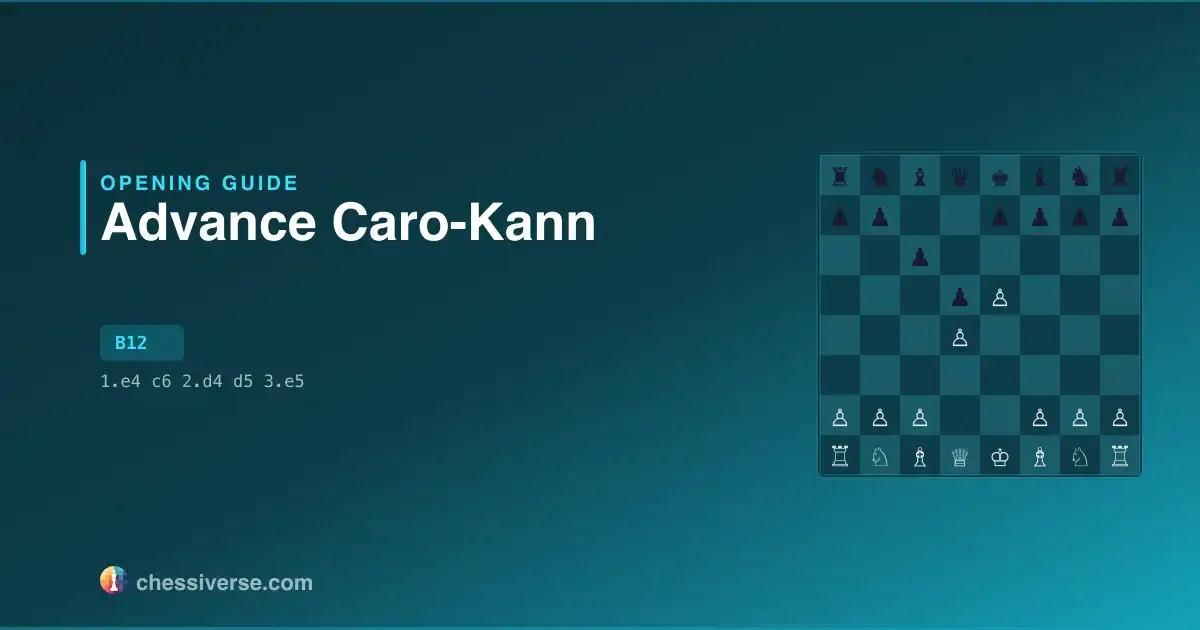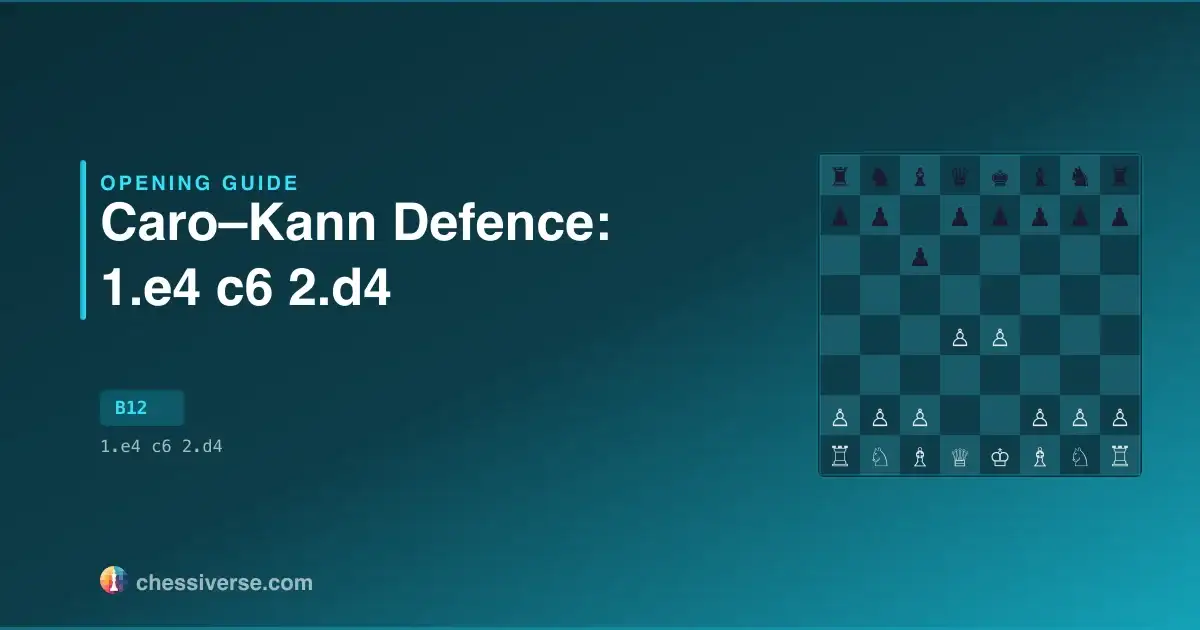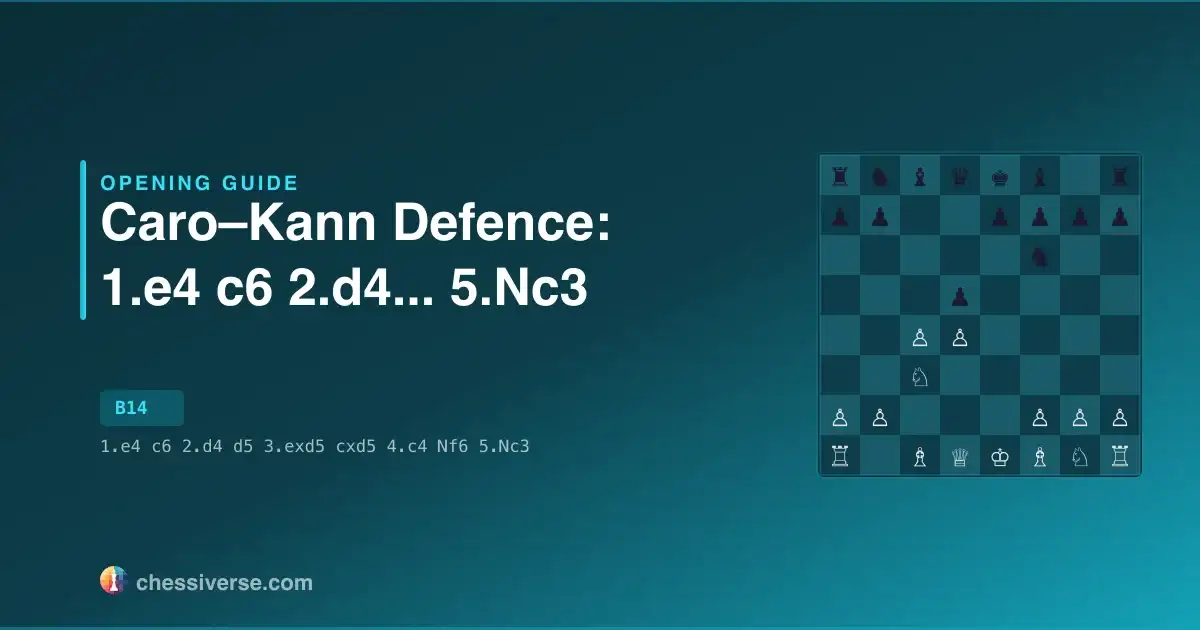




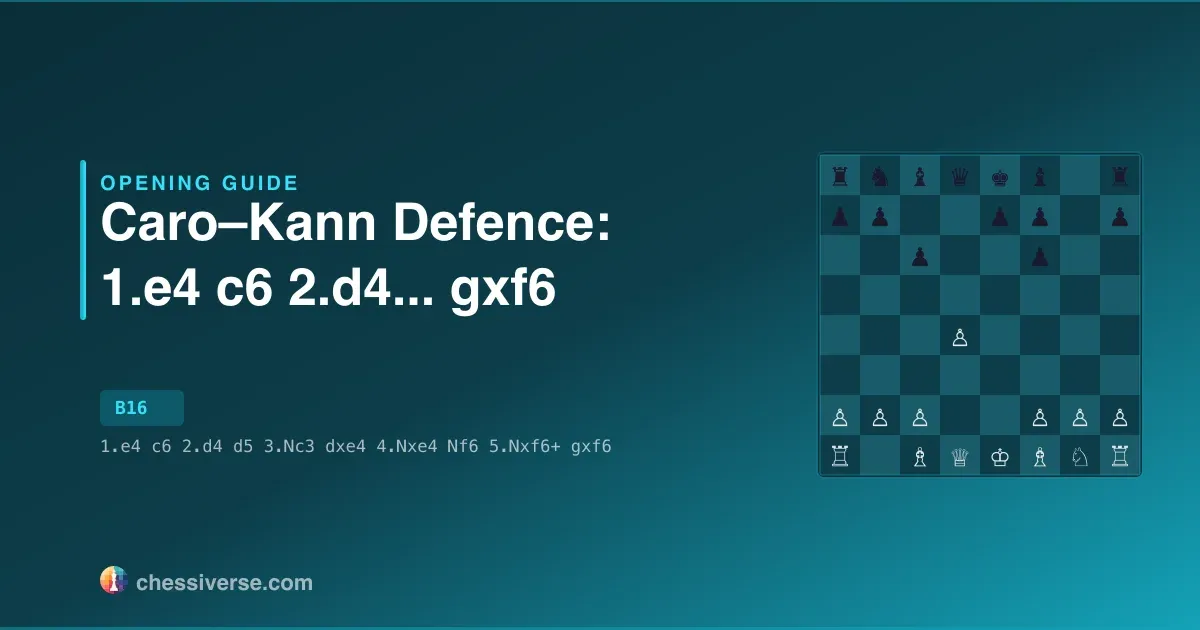
1.e4 c6 2.d4 d5 3.Nc3 dxe4 4.Nxe4 Nf6 5.Nxf6+ gxf6 opens the Caro-Kann Defense: Bronstein-Larsen Variation, ECO B16. Across rating levels it shows up in 519,385 recorded games — enough data to map exactly where it succeeds and where it stalls.
History and Notable Players
It arises from the Caro-Kann Defense (3.Nc3). Among the most prolific White practitioners are Jon L Arnason (7 games), Heikki MJ Westerinen (7 games), Thomas Luther (7 games). Black-side regulars include Dragoljub M Ciric (26 games), David Bronstein (20 games), Peter Petran (20 games).
Performance Across Rating Levels
Popularity and results vary sharply by rating level. The 1200 bracket has 13,283 games (0.00% of all games at that level); White wins 55.6%, Black 40.1%, 4.4% are drawn. At 1800 the opening surfaces in 0.01% of games; White wins 47.5%, Black 47%, draws 5.5%. At 2500, 0.04% of games go into this opening; draws sit at 11.4% — the line is well-mapped at this level. White's edge erodes by 8.0pp from 1200 to 2500 Elo, suggesting Black's counterplay is easier to find with experience.
Time Control Patterns
Time control matters here: bullet players reach for this opening more than others. In bullet, it appears in 0.01% of games (383,569); White wins 49.4%. Blitz shows 0.01% adoption across 464,518 games, White scoring 48.4%. In rapid, the share rises to 0.01% — 54,867 games, White 49.4%.
Move Diversity and Theory Depth
Move choice is far from uniform in the Caro-Kann Defense: Bronstein-Larsen Variation. At 1200 Elo (13,283 games), the top reply is Nf3, played 58.7% of the time. Two other moves each take at least 5% of games, and the top three moves account for 82.7% of games. Entropy: 2.07. By 2500 (4,973 games), c3 takes over as the top reply at 50.5%; three other moves reach 5% and the top three moves account for 82.2% of games. Entropy rises to 2.17. Even elite players don't fully agree on the best continuation here, which keeps the position dynamic.
Historical Trends
Tracking the Caro-Kann Defense: Bronstein-Larsen Variation year over year shows a clear story. Adoption peaked in 2017 at 0.015% (16,916 games). By 2025 it sits at 0.009%, 36% below the peak but still 92% above its 2013 level, so the line is up over the full period despite easing from the high.
Common Mistakes
- Neglecting development — It can feel productive to make extra pawn moves early, but falling behind in piece development is what loses most amateur games — especially in open positions where active pieces find squares fast.
- Drifting into passivity — These openings are solid, but solid is not synonymous with passive. Look for the right moment to break with a central pawn advance — without it, your pieces stay cramped.
Practice on Chessiverse
Ready to try the Caro-Kann Defense: Bronstein-Larsen Variation against a bot? Pick an opponent at your level and play a game.