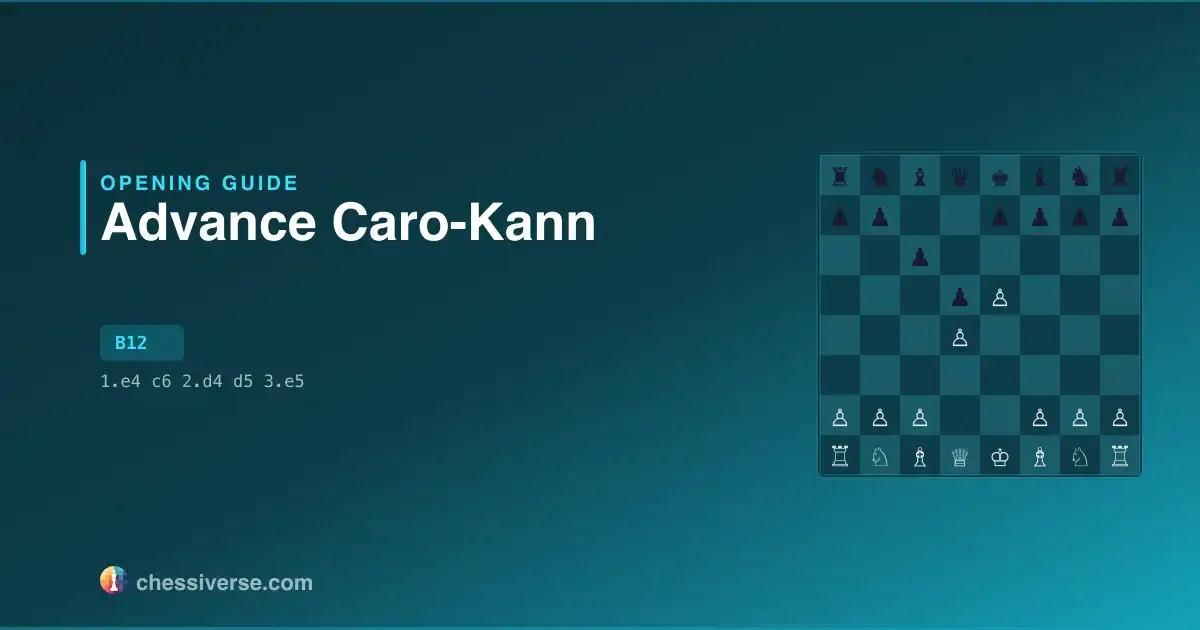




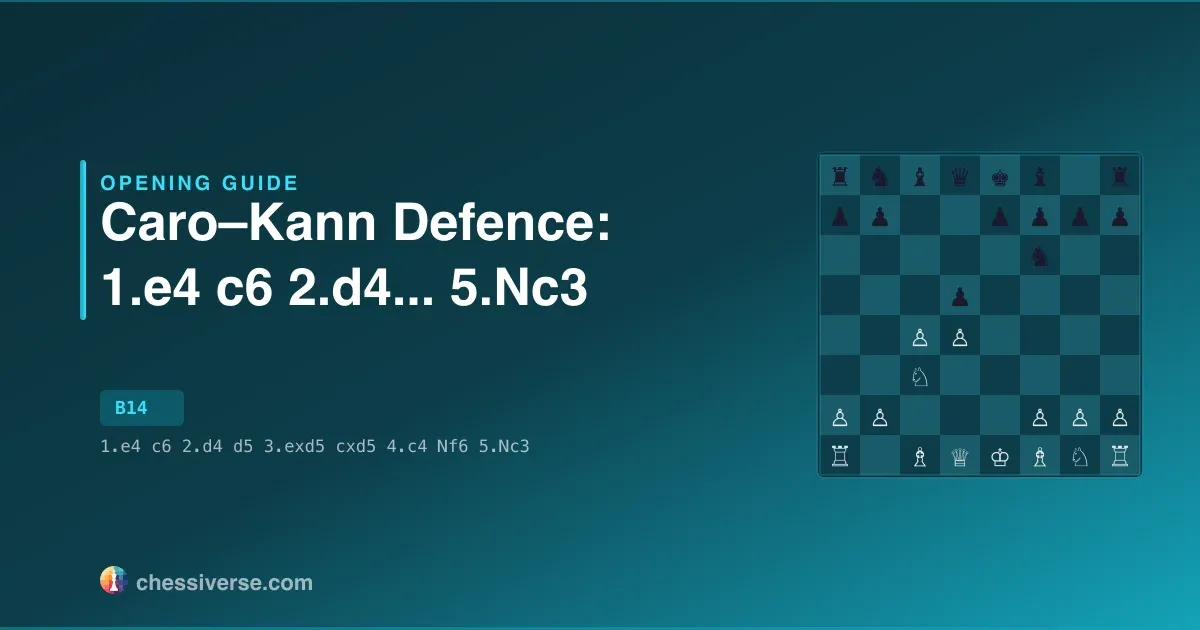
1.e4 c6 2.d4 d5 3.exd5 cxd5 4.c4 Nf6 5.Nc3 opens the Caro-Kann Defense: Panov Attack, ECO B14. Lichess records 2,815,607 games in this line, which gives us a reliable view of how it actually performs in practice.
History and Notable Players
It arises from the Caro-Kann Defense: Exchange Variation. On the White side, Evgeny Sveshnikov (43 games), Judit Polgar (33 games), Inna Gaponenko (32 games) top the database. Notable Black exponents: Eduard Meduna (64 games), Laszlo Eperjesi (48 games), Anatoly Karpov (36 games).
Performance Across Rating Levels
The picture changes a lot as you climb the rating ladder. The 1200 bracket has 44,829 games (0.01% of all games at that level); White wins 52.3%, Black 44%, 3.7% are drawn. By 1800, popularity is 0.09% and White's score is 49.8% to Black's 44.6%. At 2500, 0.34% of games go into this opening; draws sit at 11.3% — the line is well-mapped at this level. White's edge erodes by 6.1pp from 1200 to 2500 Elo, suggesting Black's counterplay is easier to find with experience.
Time Control Patterns
The Caro-Kann Defense: Panov Attack skews toward blitz chess. In bullet, it appears in 0.06% of games (1,657,235); White wins 49.9%. Blitz shows 0.07% adoption across 2,441,893 games, White scoring 49.5%. In rapid, the share rises to 0.03% — 373,714 games, White 49.6%.
Move Diversity and Theory Depth
Move choice is far from uniform in the Caro-Kann Defense: Panov Attack. At 1200 Elo (44,829 games), the top reply is e6, played 31.6% of the time. Four other moves each take at least 5% of games, and the top three moves account for 69.9% of games. Entropy: 2.62. By 2500 (45,806 games), Nc6 takes over as the top reply at 43.8%; only two other moves still reach 5% and the top three moves account for 97.6% of games. Entropy drops to 1.71. The narrowing is significant — strong players consolidate around a small set of best moves, while amateurs scatter across many plausible-looking options.
Historical Trends
Long-term, the trajectory of this opening is informative. Adoption peaked in 2017 at 0.064% (72,507 games). By 2025 it sits at 0.061%, 4% below the peak but still 64% above its 2013 level, so the line is up over the full period despite easing from the high.
Common Mistakes
- Drifting away from main theory — At 400 Elo, the three most-played moves cover 67.9% of games, against 84.5% at 2000. The most popular deviation is dxc4 (played 20.8% of the time at 400, much less so up top). It looks fine but quietly hands the better-prepared side an edge.
- Neglecting development — Extra pawn moves in the opening are tempting, especially when you "know the moves". Developing a piece each turn is the simple correction.
- Drifting into passivity — These openings are solid, but solid is not synonymous with passive. Look for the right moment to break with a central pawn advance — without it, your pieces stay cramped.
Practice on Chessiverse
Ready to try the Caro-Kann Defense: Panov Attack against a bot? Pick an opponent at your level and play a game.