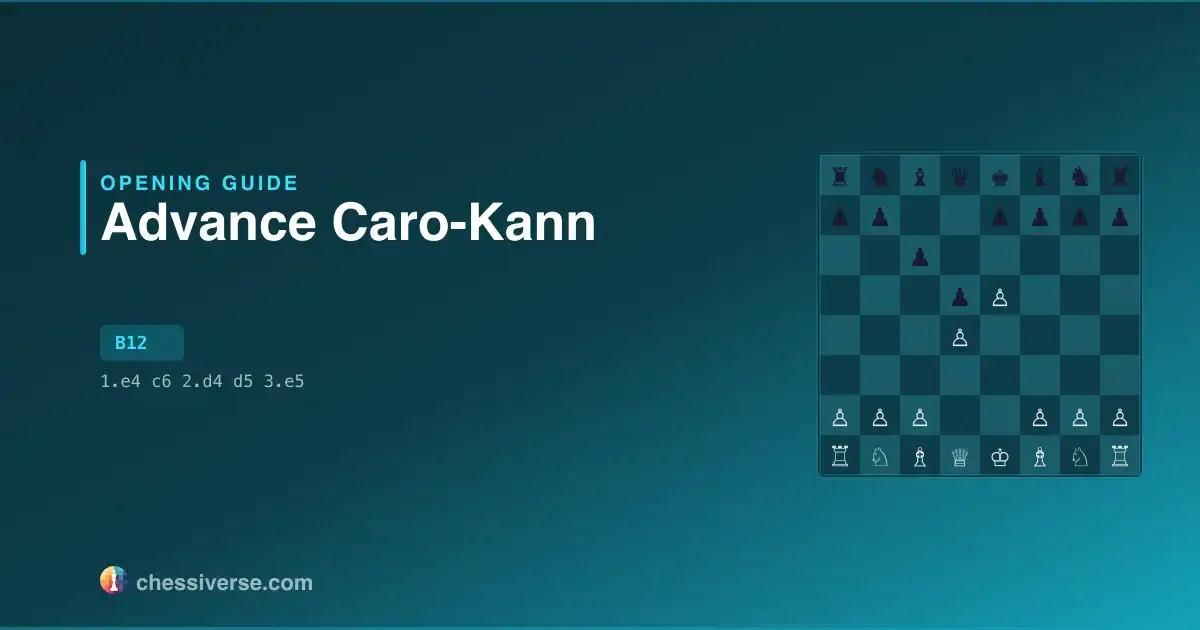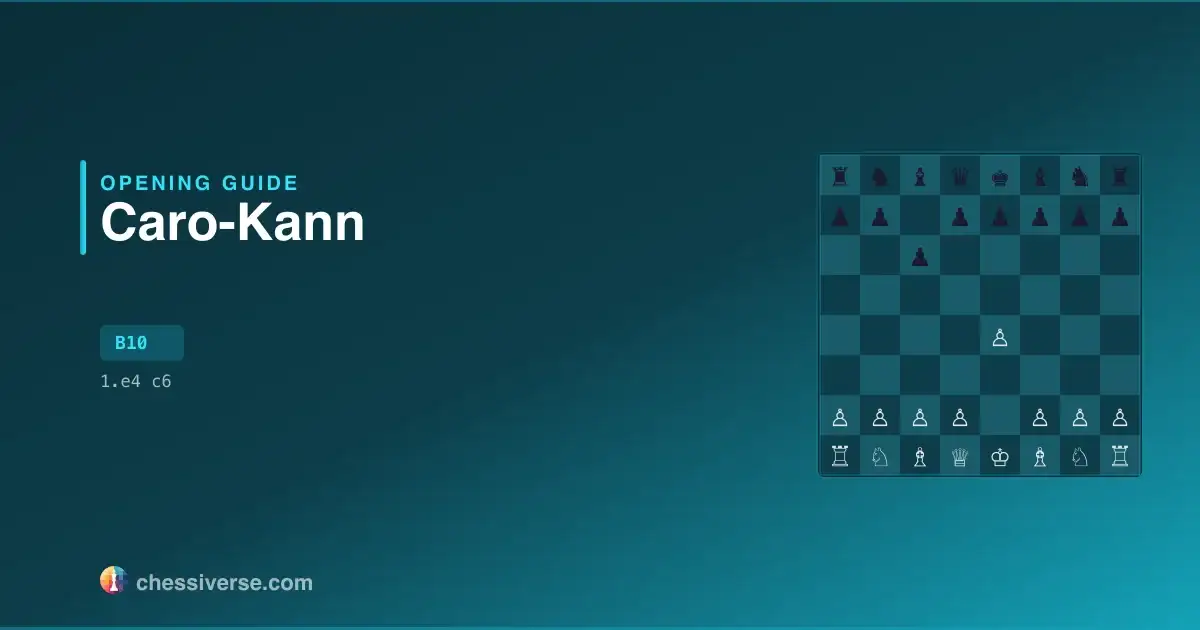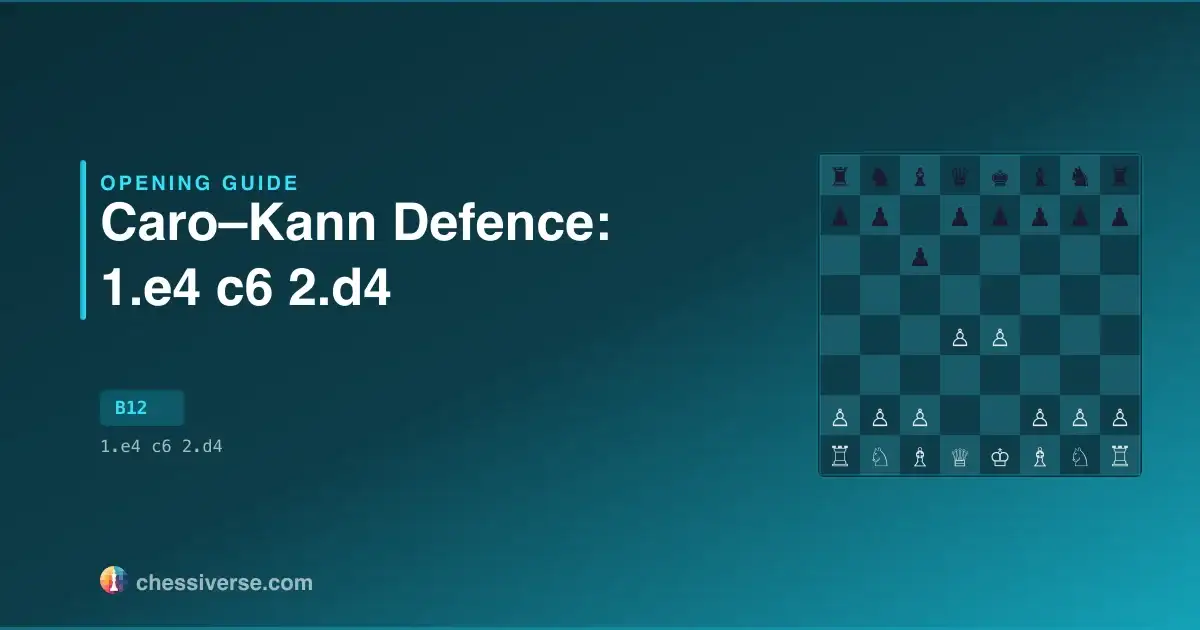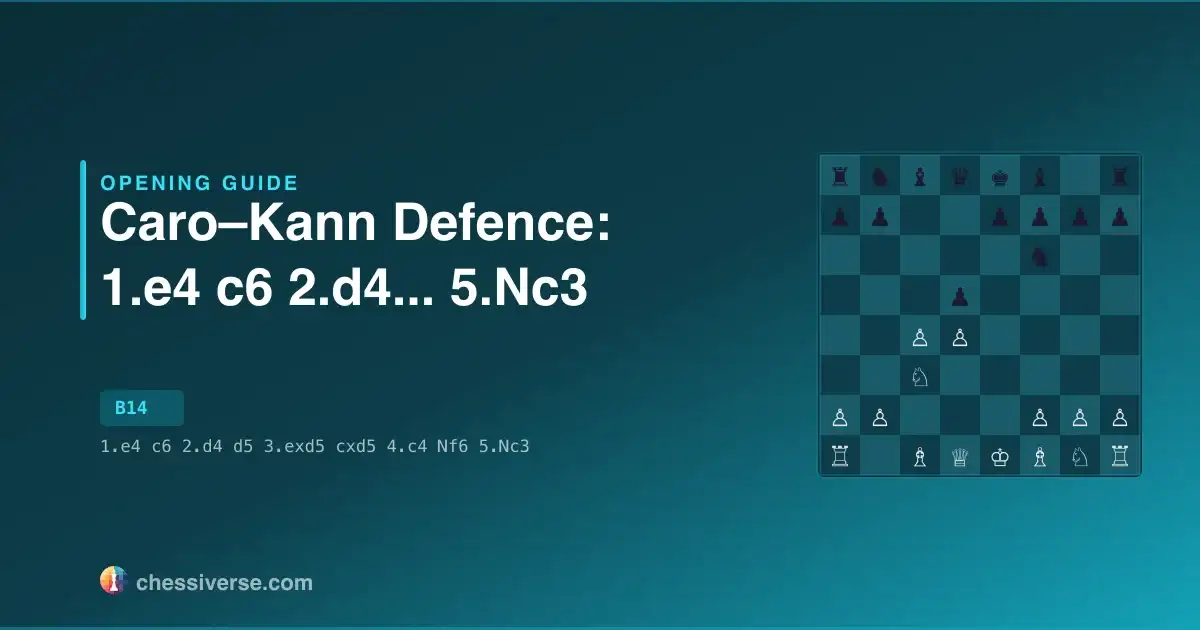




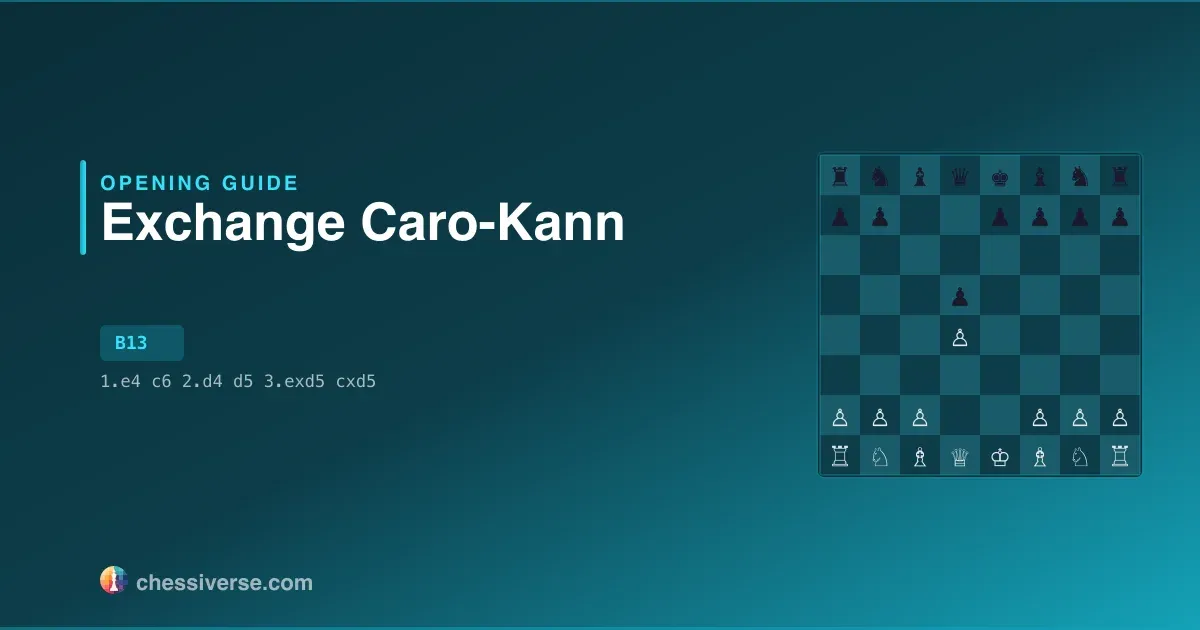
The Caro-Kann Defense: Exchange Variation arises after 1.e4 c6 2.d4 d5 3.exd5 cxd5 and falls under ECO code B13. In practice, this position almost invariably transitions into the Panov-Botvinnik Attack via 4. c4, unless White opts for the quieter 4. Bd3. The seemingly natural 4. Nc3?! is considered inaccurate because the knight accomplishes little on that square: occupying e4 would be premature, and after ...e6 the d5 pawn becomes firmly entrenched. Playing c4 first, followed by Nc3, is far more effective since it creates genuine pressure against d5. With 25.3 million Lichess games across all rating levels, it is a well-established opening choice.
- White's main plan starts with 4.Bd3, developing while stopping Black's bishop from reaching f5, most often continuing with c3, Bf4 and Qb3
- The trade on d5 leaves each side with a pawn majority on a different wing
- The structure is a reversed Carlsbad, so some strategic ideas from the Queen's Gambit Declined Exchange carry over
History and Notable Players
It arises from the Caro-Kann Defense. Among the most prolific practitioners on the White side are Evgeny Sveshnikov (90 games), Zigurds Lanka (47 games), Judit Polgar (45 games). On the Black side, notable exponents include Eduard Meduna (93 games), Laszlo Eperjesi (76 games), Vladimir Burmakin (75 games).
After 3.exd5, Black nearly always recaptures with the c-pawn, and the resulting structure has been understood through its kinship with the Queen's Gambit Declined: it is a Carlsbad formation with colours reversed. Bobby Fischer was a notable adopter of the main line with 4.Bd3.
Named after: The parent defence honours Horatio Caro and Marcus Kann, who both analysed it in 1886; 'Exchange' describes White's trade of pawns with 3.exd5.
Notable players: Bobby Fischer
Recapturing with the c-pawn gives a Carlsbad pawn structure with the colours reversed, so this 1.e4 line shares some of its strategic ideas with the Queen's Gambit Declined Exchange Variation.
Statistics
Based on 25.3 million Lichess games across all rating levels:
- White wins: 47.6%
- Black wins: 46.9%
- Draws: 5.5%
The statistics show a roughly balanced opening where both sides have equal chances.
Main Lines and Variations
After 1.e4 c6 2.d4 d5 3.exd5 cxd5, the main continuations include:
Each of these lines leads to distinct types of positions and requires its own understanding of the resulting pawn structures and piece placements.
Common Mistakes to Avoid
- Being too passive: While this opening is solid, playing without a plan can lead to a cramped position. Look for the right moment to break with a central pawn advance and free your pieces.
Practice on Chessiverse
The best way to learn the Caro-Kann Defense: Exchange Variation is through practice. On Chessiverse, you can play chess against computer opponents that specialize in this opening. Our AI bots range from beginner to grandmaster level, each with unique playing styles — from aggressive attackers to solid defenders. Choose a bot that matches your rating and work your way up as you master the opening's key ideas.
Performance Across Rating Levels
The picture changes a lot as you climb the rating ladder. The 1200 bracket has 1,712,336 games (0.25% of all games at that level); White wins 47.4%, Black 48.6%, 4% are drawn. By 1800, popularity is 0.83% and White's score is 47.7% to Black's 46.7%. At 2500, 0.92% of games go into this opening; draws sit at 11% — the line is well-mapped at this level.
Time Control Patterns
Look at the same opening across time controls and bullet stands out. In bullet, it appears in 0.61% of games (16,277,191); White wins 48.2%. Blitz shows 0.57% adoption across 20,619,500 games, White scoring 47.7%. In rapid, the share rises to 0.42% — 4,697,474 games, White 47.2%.
Move Diversity and Theory Depth
Looking at move selection shows how forcing — or not — the position really is. At 1200 Elo (1,712,336 games), the top reply is Nc3, played 41.3% of the time. Four other moves each take at least 5% of games, and the top three moves account for 79.6% of games. Entropy: 2.32. By 2500 (126,073 games), Bd3 takes over as the top reply at 48.7%; only two other moves still reach 5% and the top three moves account for 95.5% of games. Entropy drops to 1.64. The narrowing is significant — strong players consolidate around a small set of best moves, while amateurs scatter across many plausible-looking options.
Historical Trends
Long-term, the trajectory of this opening is informative. Adoption peaked in 2025 at 0.65% (4,835,638 games). 2025 marks the high — the opening is rising, currently at 0.65%.