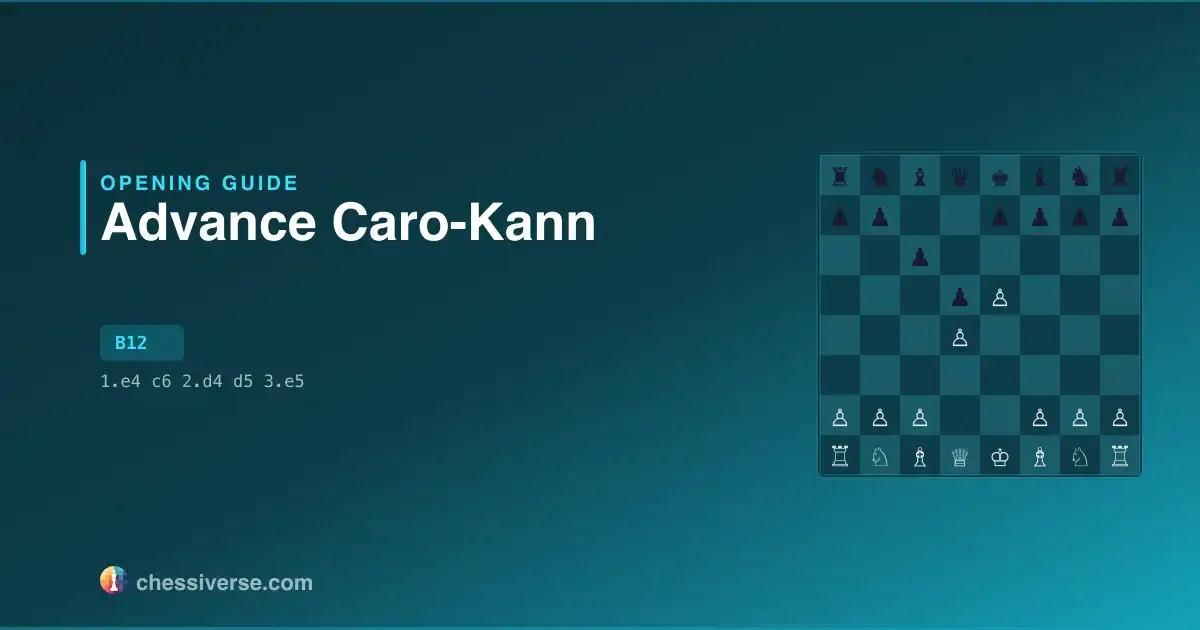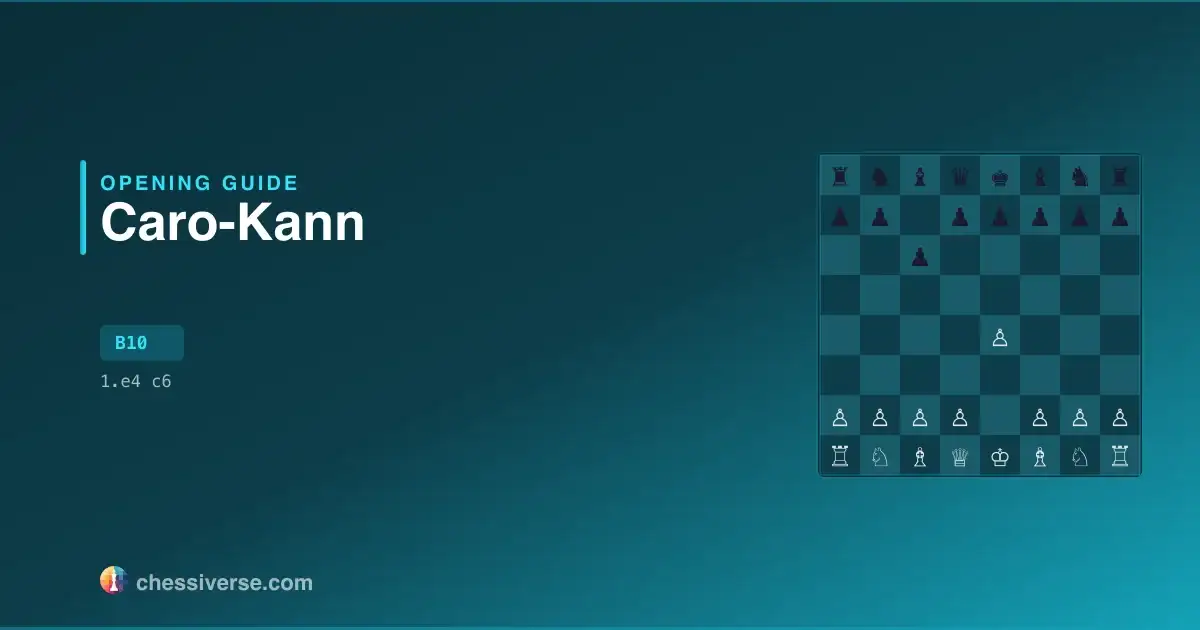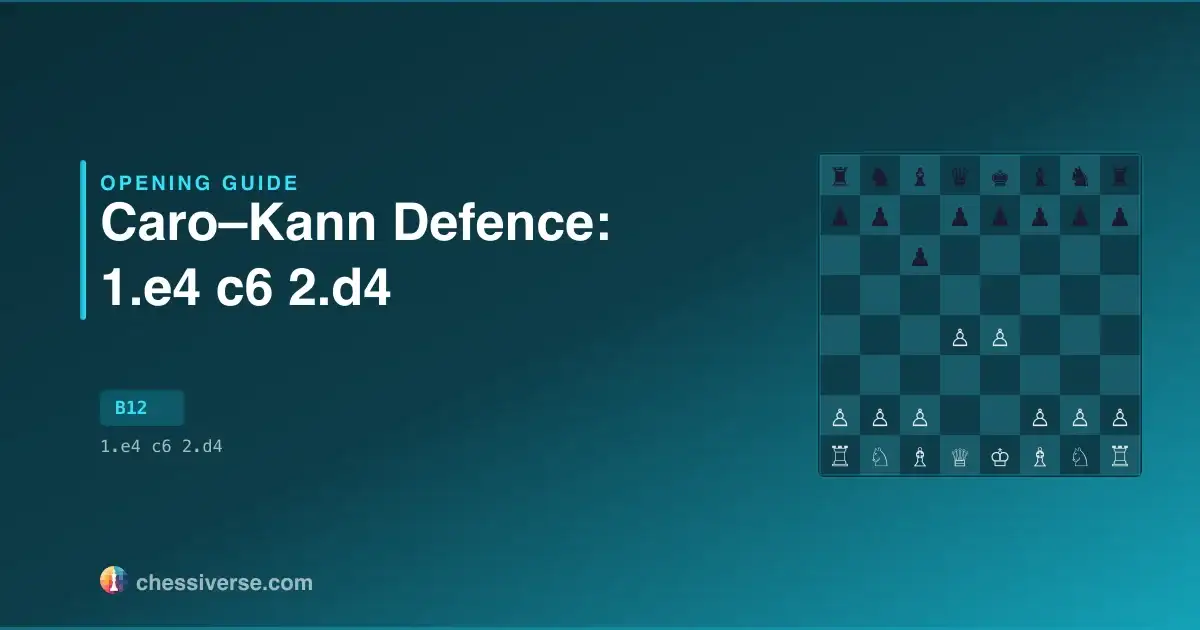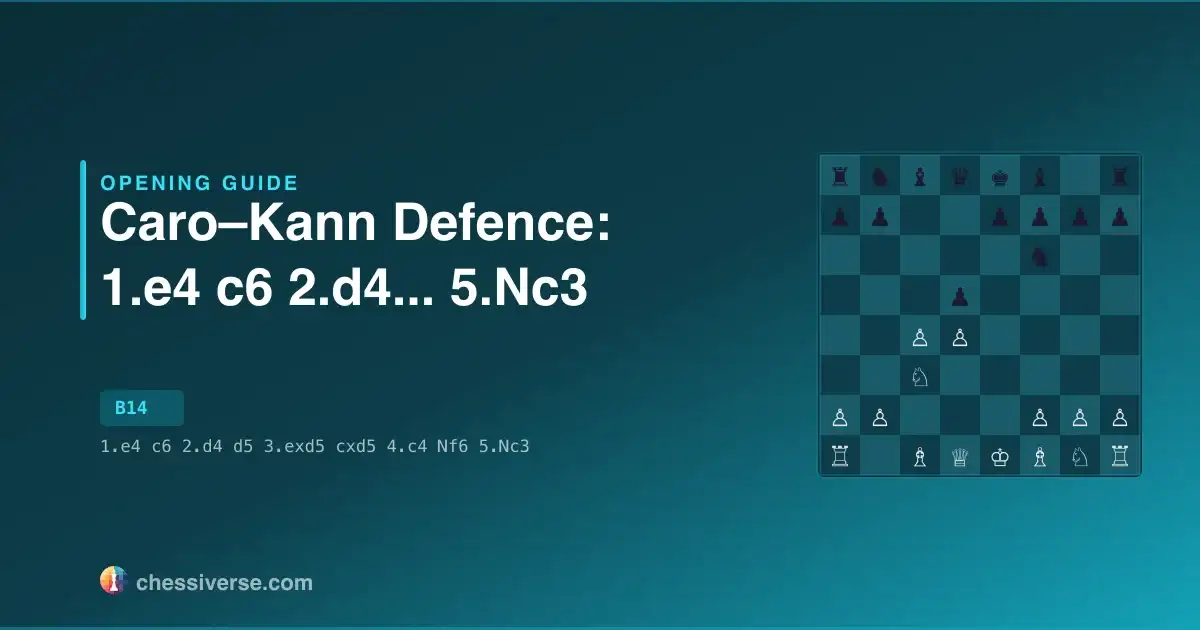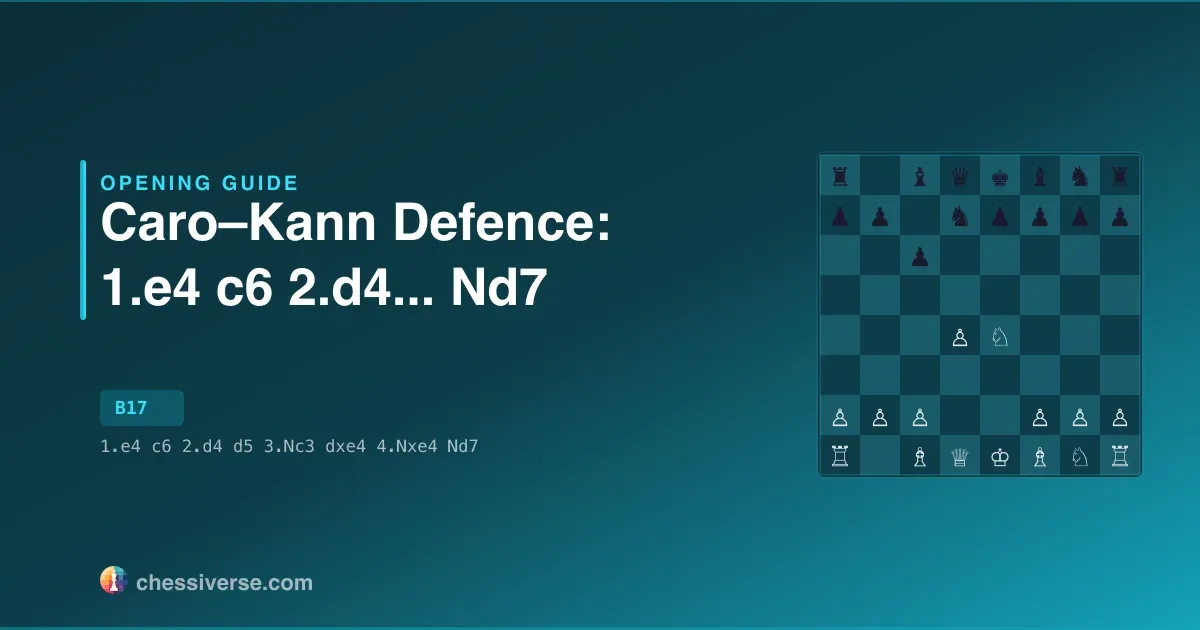
The Caro-Kann Defense: Karpov Variation begins with 1.e4 c6 2.d4 d5 3.Nc3 dxe4 4.Nxe4 Nd7 (ECO B17). Black develops the queen's knight first, preparing to challenge the e4-knight without ever exposing the c8-bishop on g6. It's the variation that turned the Caro-Kann into a world championship workhorse.
Strategic Overview
The Smyslov-Karpov Variation is the most flexible Caro-Kann line. By bringing the b8-knight to d7 first, Black plans to trade the e4-knight on f6 without committing the light-squared bishop to its standard g6 square. The point is structural integrity: Black keeps the pawn front intact and reserves the option to develop the c8-bishop more actively later — sometimes to b7 after ...b6, sometimes back to its original diagonal once the center is settled. The trade-off is freedom for a slight space disadvantage, and White often tries to exploit Black's delayed development with the aggressive 5.Ng5 idea, hitting f7 and forcing immediate decisions. Black must answer accurately or the position falls apart fast. With careful play Black emerges with a solid, slightly cramped position where the typical plan is ...Ngf6, ...e6, ...Be7, ...0-0, ...c5 at the right moment, and gradual equalization. This is the Caro-Kann line that Karpov turned into a wall for years and that Kasparov famously fell into a tactical trap in against Deep Blue. It's solid, theoretically deep, and forgiving of style — exactly why it stays popular at every level.
Key Ideas
A few ideas come up again and again in this opening:
- Develop the knight first, keep options for the bishop — By playing ...Nd7 before ...Bf5, Black keeps the light-squared bishop flexible. It can come out to b7, stay home temporarily, or develop normally once the center is resolved — far more options than the Classical.
- Watch out for 5.Ng5 — White's most aggressive try jumps to g5, threatening f7 and forcing Black to defend precisely. Black has to know the theory here or the position can collapse quickly under tactical pressure.
- Solid structure, slight cramp — Black accepts a marginal space disadvantage in exchange for a structurally clean position with no permanent weaknesses. The whole line is built on the idea that solid structure outlasts White's slight space edge.
- World champion approved — This was Karpov's preferred Caro-Kann line and a standard at the top level for decades. It's not flashy, but its theoretical depth and resilience make it one of the hardest defenses for White to crack.
History and Notable Players
It arises from the Caro-Kann Defense (3.Nc3). Among the most prolific White practitioners are Sergei Tiviakov (27 games), Vlastimil Jansa (27 games), Boris V Spassky (23 games). Black-side regulars include Eduard Meduna (145 games), Anatoly Karpov (109 games), Jonathan S Speelman (95 games).
Performance Across Rating Levels
How well the Caro-Kann Defense: Karpov Variation works depends on what level you're playing at. The 1200 bracket has 28,701 games (0.00% of all games at that level); White wins 47.4%, Black 48.9%, 3.7% are drawn. By 1800, popularity is 0.06% and White's score is 48.2% to Black's 45.9%. At the top end (2500+ Elo), popularity is 0.11% with 10.7% draws — a clear sign of how much theory rules the line at master level. Positions also become less sharp as level rises (sharpness 0.96 → 0.89).
Time Control Patterns
Time control matters here: blitz players reach for this opening more than others. In bullet, it appears in 0.03% of games (921,939); White wins 49.5%. Blitz shows 0.04% adoption across 1,536,364 games, White scoring 48.4%. In rapid, the share rises to 0.02% — 256,694 games, White 47.2%. White's score swings 2.3pp across formats, so time control isn't just a stylistic choice here — it shifts the actual results.
Move Diversity and Theory Depth
Move choice is far from uniform in the Caro-Kann Defense: Karpov Variation. At 1200 Elo (28,701 games), the top reply is Nf3, played 53.7% of the time. One other move takes at least 5% of games, and the top three moves account for 75.8% of games. Entropy: 2.36. By 2500 (15,272 games), Nf3 is still the top reply, at 42.4%; four other moves reach 5% and the top three moves account for 78% of games. Entropy drops to 2.34. Move diversity stays high even at master level, suggesting the opening doesn't force one specific response.
Historical Trends
Long-term, the trajectory of this opening is informative. Adoption peaked in 2017 at 0.06% (65,943 games). By 2025 it sits at 0.03%, 41% below the peak but still 17% above its 2013 level, so the line is up over the full period despite easing from the high.
Common Mistakes
- Drifting away from main theory — At 400 Elo, the three most-played moves cover 67.5% of games, against 74.3% at 2000. The most popular deviation is Bc4 (played 19.8% of the time at 400, less so up top). It looks fine but quietly hands the better-prepared side an edge.
- Neglecting development — It can feel productive to make extra pawn moves early, but falling behind in piece development is what loses most amateur games — especially in open positions where active pieces find squares fast.
- Drifting into passivity — These openings are solid, but solid is not synonymous with passive. Look for the right moment to break with a central pawn advance — without it, your pieces stay cramped.
Practice on Chessiverse
Ready to try the Caro-Kann Defense: Karpov Variation against a bot? Pick an opponent at your level and play a game.