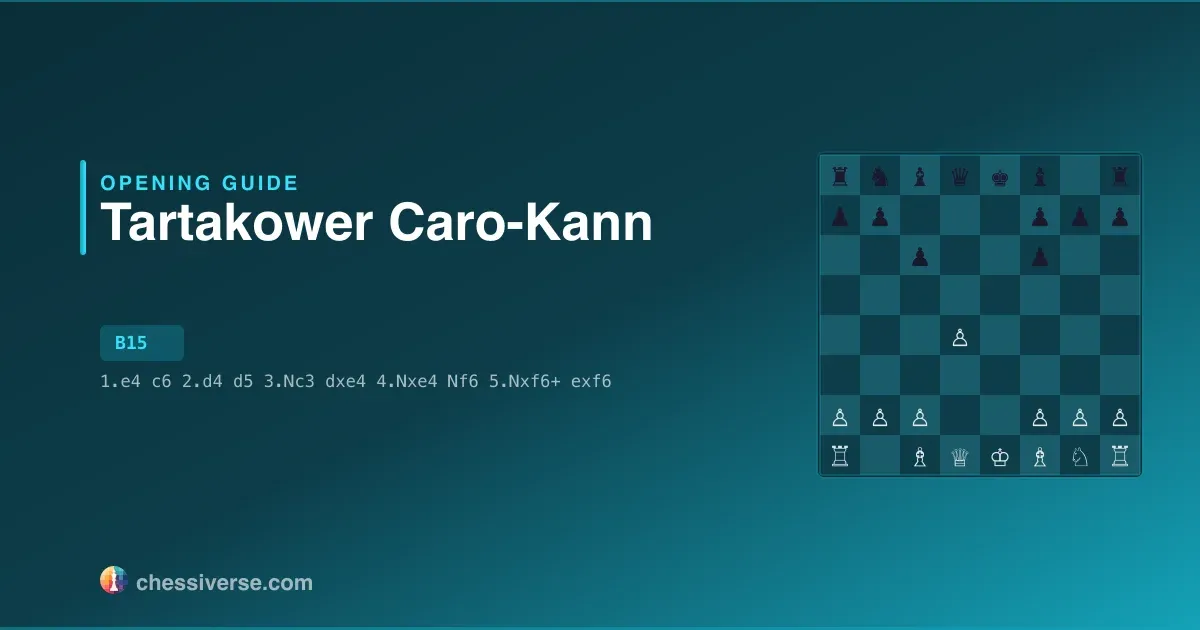
The Caro-Kann Defense: Tartakower Variation arises after 1.e4 c6 2.d4 d5 3.Nc3 dxe4 4.Nxe4 Nf6 5.Nxf6+ exf6 and falls under ECO code B15. With 3.5 million Lichess games across all rating levels, it is a well-established opening choice.
- Recapturing with the e-pawn gets Black's pieces out fast and is considered sounder than the double-edged 5...gxf6 of the Bronstein-Larsen line
- White keeps the healthier pawn structure, so Black plays for piece activity rather than the endgame
- Black must stay alert in endings, where White's d-pawn is a potential passed pawn
History and Notable Players
It arises from the Caro-Kann Defense. Among the most prolific practitioners on the White side are Boris V Spassky (58 games), Alonso Zapata (49 games), Viktor D Kupreichik (48 games). On the Black side, notable exponents include Laszlo Eperjesi (96 games), Vladimir Burmakin (80 games), Eduard Meduna (74 games).
The parent Caro-Kann was analyzed in 1886 by Horatio Caro and Marcus Kann. The 5...exf6 recapture became a Korchnoi trademark: he trusted it enough to bring it to his first world championship match against Anatoly Karpov, and Ulf Andersson has also taken it up.
Named after: Known as both the Tartakower and the Korchnoi Variation, the latter for Viktor Korchnoi, who recaptured with 5...exf6 many times at the highest level.
Notable players: Viktor Korchnoi, Ulf Andersson
Korchnoi backed this structurally inferior line to the hilt, taking it into his first world championship match against Anatoly Karpov.
Statistics
Based on 3.5 million Lichess games across all rating levels:
- White wins: 47.4%
- Black wins: 46.1%
- Draws: 6.5%
The statistics show a roughly balanced opening where both sides have equal chances.
Common Mistakes to Avoid
- Being too passive: While this opening is solid, playing without a plan can lead to a cramped position. Look for the right moment to break with a central pawn advance and free your pieces.
Practice on Chessiverse
The best way to learn the Caro-Kann Defense: Tartakower Variation is through practice. On Chessiverse, you can play chess against computer opponents that specialize in this opening. Our AI bots range from beginner to grandmaster level, each with unique playing styles — from aggressive attackers to solid defenders. Choose a bot that matches your rating and work your way up as you master the opening's key ideas.
Performance Across Rating Levels
How well the Caro-Kann Defense: Tartakower Variation works depends on what level you're playing at. The 1200 bracket has 145,277 games (0.02% of all games at that level); White wins 47.9%, Black 48.1%, 4% are drawn. At 1800 the opening surfaces in 0.10% of games; White wins 47.3%, Black 46.6%, draws 6.1%. At the top end (2500+ Elo), popularity is 0.47% with 10.8% draws — a clear sign of how much theory rules the line at master level.
Time Control Patterns
Time control matters here: bullet players reach for this opening more than others. In bullet, it appears in 0.08% of games (2,221,241); White wins 48.7%. Blitz shows 0.08% adoption across 2,924,252 games, White scoring 47.4%. In rapid, the share rises to 0.06% — 622,193 games, White 47.3%.
Move Diversity and Theory Depth
Move choice is far from uniform in the Caro-Kann Defense: Tartakower Variation. At 1200 Elo (145,277 games), the top reply is Nf3, played 49% of the time. Two other moves each take at least 5% of games, and the top three moves account for 81.2% of games. Entropy: 2.31. By 2500 (64,135 games), c3 takes over as the top reply at 61.2%; four other moves reach 5% and the top three moves account for 85.9% of games. Entropy drops to 1.86.
Historical Trends
Long-term, the trajectory of this opening is informative. Adoption peaked in 2025 at 0.11% (801,576 games). 2025 marks the high — the opening is rising, currently at 0.11%.