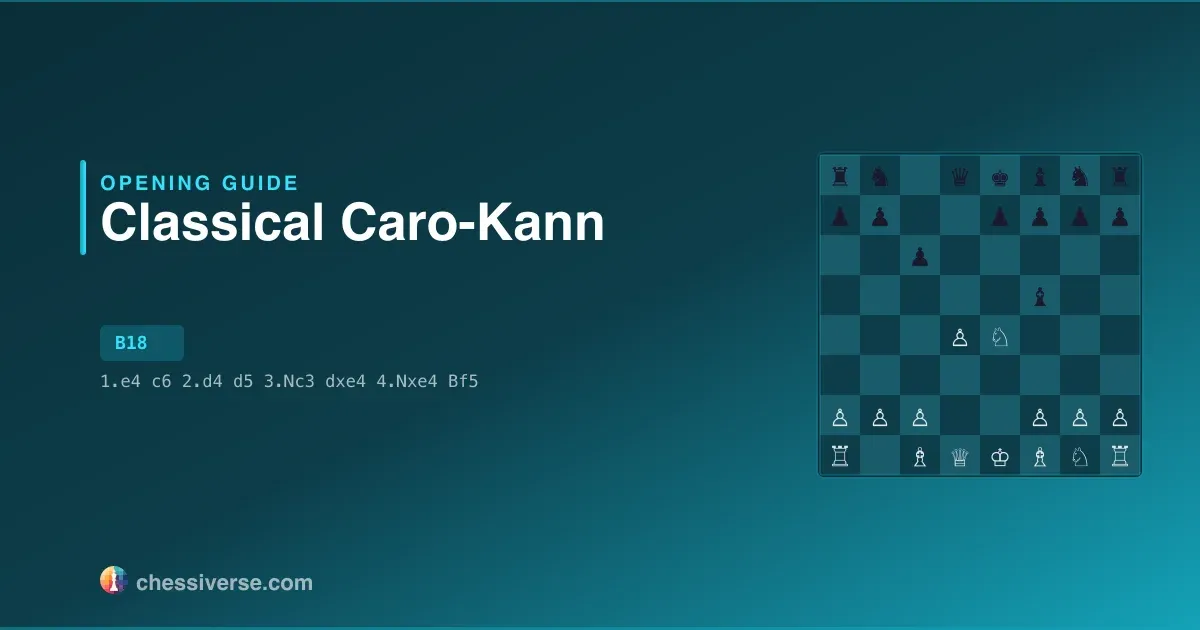
The Caro-Kann Defense: Classical Variation arises after 1.e4 c6 2.d4 d5 3.Nc3 dxe4 4.Nxe4 Bf5 and falls under ECO code B18. In the vast majority of games, White continues with Ng3, driving the bishop back from its active post. However, the ambitious Nc5 and the aggressive Burris Gambit are noteworthy alternatives that have produced surprisingly strong results for White. With 7.5 million Lichess games across all rating levels, it is a well-established opening choice.
- White grabs kingside space with h4-h5 and chases Black's bishop, but that far-advanced h-pawn can turn into a weakness in the endgame
- Black keeps a healthy, compromise-free pawn structure and strikes back with a well-timed ...c5 to challenge the d4 pawn
- Modern treatments get sharp: Black sometimes castles kingside or even leaves the king in the centre
History and Notable Players
It arises from the Caro-Kann Defense. Among the most prolific practitioners on the White side are Michele Godena (54 games), Sergei Tiviakov (52 games), Thomas Luther (34 games). On the Black side, notable exponents include Igor Khenkin (124 games), Aleksey Dreev (118 games), Alexander Riazantsev (88 games).
Caro and Kann worked out the parent defence in 1886, and the Classical line with 4...Bf5 was long regarded as best play for both sides. The Caro-Kann's reputation as a rock-solid defence rests largely on this variation, and it still appears regularly in top-level games.
Named after: The Caro-Kann honours Horatio Caro and Marcus Kann, who analysed it in 1886; this line is also called the Capablanca Variation after Jose Raul Capablanca.
Notable players: José Raúl Capablanca
This one variation carries most of the Caro-Kann's fame for solidity: 4...Bf5 was long considered the best play for both sides in the entire opening.
Statistics
Based on 7.5 million Lichess games across all rating levels:
- White wins: 49.5%
- Black wins: 45.1%
- Draws: 5.4%
The statistics show a roughly balanced opening where both sides have equal chances.
Main Lines and Variations
After 1.e4 c6 2.d4 d5 3.Nc3 dxe4 4.Nxe4 Bf5, the main continuations include:
Each of these lines leads to distinct types of positions and requires its own understanding of the resulting pawn structures and piece placements.
Common Mistakes to Avoid
- Being too passive: While this opening is solid, playing without a plan can lead to a cramped position. Look for the right moment to break with a central pawn advance and free your pieces.
Practice on Chessiverse
The best way to learn the Caro-Kann Defense: Classical Variation is through practice. On Chessiverse, you can play chess against computer opponents that specialize in this opening. Our AI bots range from beginner to grandmaster level, each with unique playing styles — from aggressive attackers to solid defenders. Choose a bot that matches your rating and work your way up as you master the opening's key ideas.
Performance Across Rating Levels
Popularity and results vary sharply by rating level. The 1200 bracket has 520,023 games (0.08% of all games at that level); White wins 48%, Black 48.2%, 3.8% are drawn. At 1800 the opening surfaces in 0.24% of games; White wins 50.4%, Black 44.1%, draws 5.5%. At the top end (2500+ Elo), popularity is 0.35% with 11.4% draws — a clear sign of how much theory rules the line at master level.
Time Control Patterns
Look at the same opening across time controls and blitz stands out. In bullet, it appears in 0.12% of games (3,164,783); White wins 50.8%. Blitz shows 0.16% adoption across 5,857,402 games, White scoring 49.7%. In rapid, the share rises to 0.15% — 1,644,645 games, White 48.7%. White's score swings 2.1pp across formats, so time control isn't just a stylistic choice here — it shifts the actual results.
Move Diversity and Theory Depth
Looking at move selection shows how forcing — or not — the position really is. At 1200 Elo (520,023 games), the top reply is Bd3, played 29.7% of the time. Five other moves each take at least 5% of games, and the top three moves account for 71.7% of games. Entropy: 2.66. By 2500 (47,251 games), Ng3 takes over as the top reply at 92.1%; no other move reaches 5% and the top three moves account for 97.5% of games. Entropy drops to 0.56. The narrowing is significant — strong players consolidate around a small set of best moves, while amateurs scatter across many plausible-looking options.
Historical Trends
Year-over-year data tells you whether this opening is a contemporary fixture or a fading one. Adoption peaked in 2017 at 0.18% (209,185 games). By 2025 it sits at 0.16%, 11% below the peak but still 33% above its 2013 level, so the line is up over the full period despite easing from the high.