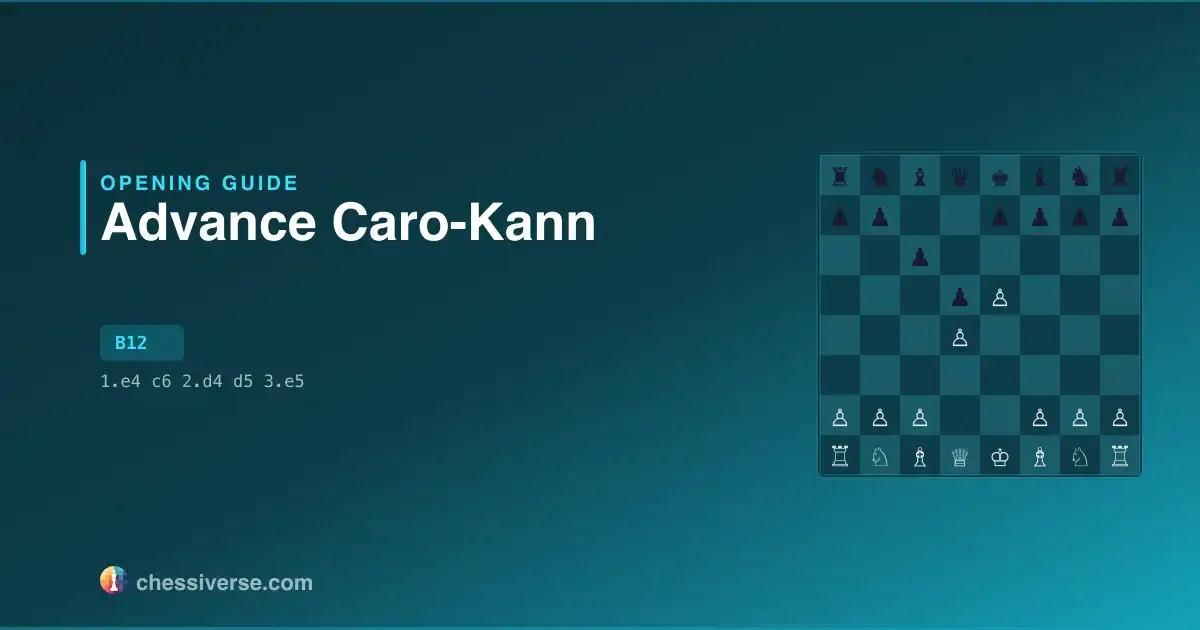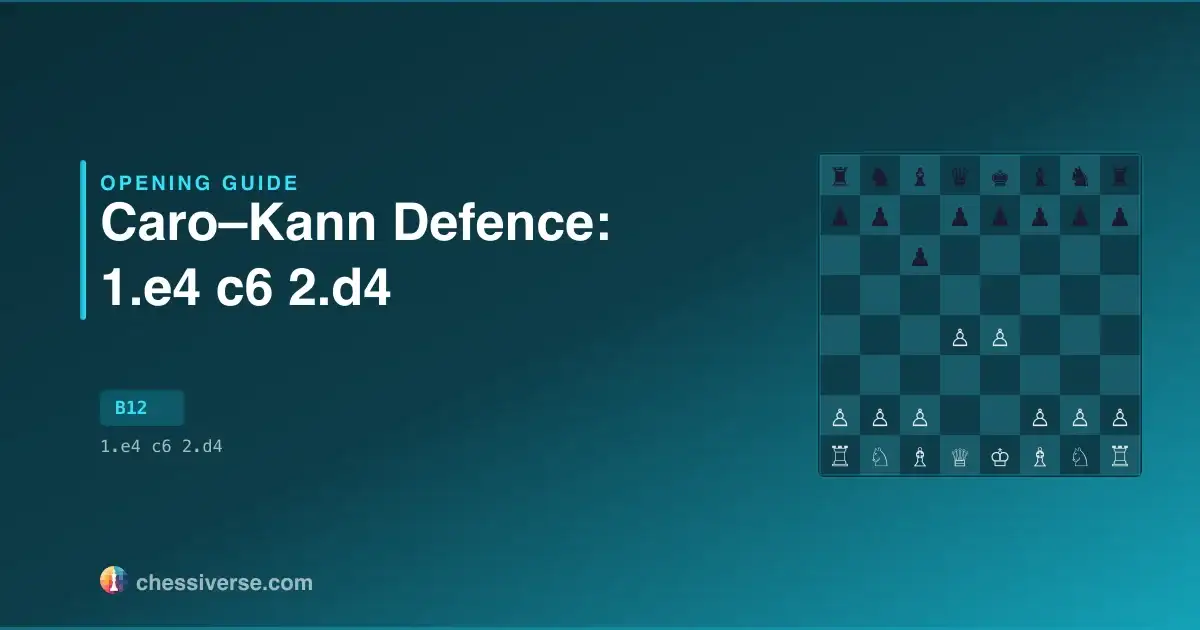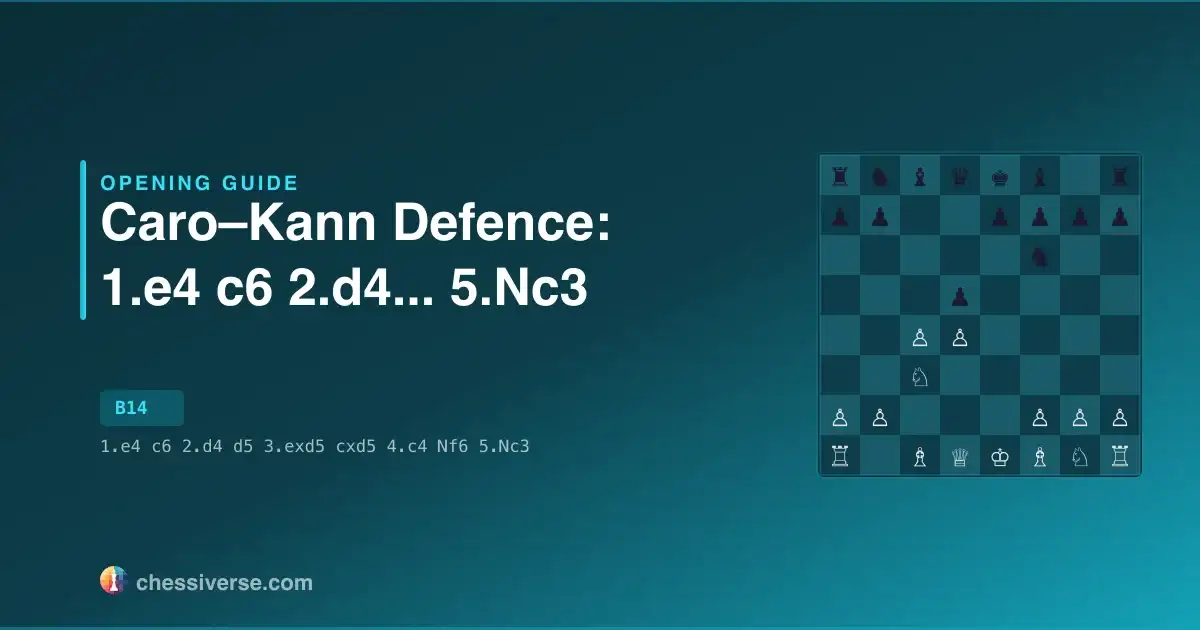


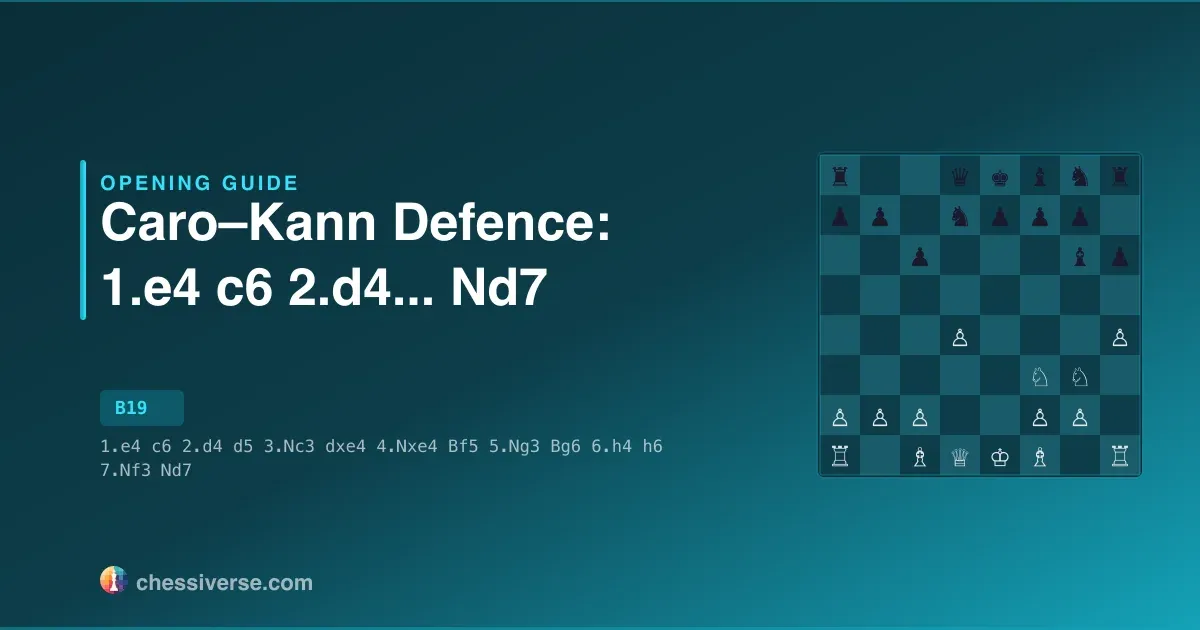
The Caro-Kann Defense: Classical Variation, Main Line begins with 1.e4 c6 2.d4 d5 3.Nc3 dxe4 4.Nxe4 Bf5 5.Ng3 Bg6 6.h4 h6 7.Nf3 Nd7 (ECO B19). Both sides have committed to the deep Classical main line and the pawn on h4 is loaded. Once h5 lands, the g6-bishop is permanently fenced in for the rest of the game.
Strategic Overview
This is the heart of the Classical Caro-Kann main line. White's h2-h4-h5 idea is the central strategic theme: by pushing h5, White boxes in the g6-bishop and the h-pawn becomes a permanent thorn in Black's kingside. The catch is that the h5 pawn isn't a free attacker — it needs protection from the g3-knight, which means that knight is tied down to defense and arguably becomes a bad piece. So both sides are locked into a long-term structural trade: White gets a cramping pawn on h5, Black gets the comfort that one of White's knights is going to spend the game babysitting it. From here Black continues with standard Caro-Kann development: ...Ngf6, ...e6, ...Be7, ...0-0, and the queenside is fluid with ...c5 typically coming as the break. Castling decisions matter enormously — Black often castles queenside in modern lines to avoid the kingside pawn storm, but classical play castles short and weathers the pressure. White's middlegame plan revolves around Bd3 (trading off the g6-bishop sometimes via Bxg6), Qe2 or Qd2, c4 to grab space, and rolling pieces toward the center. The whole line is famous for its strategic depth: every move matters, the structures are subtle, and small inaccuracies pile up over twenty moves.
Key Ideas
When players succeed in this line, they usually do so by leaning on the following themes:
- h4-h5 is the structural plan — Pushing h5 boxes in the g6-bishop for the rest of the game. It's the defining feature of this whole line — White accepts the bad g3-knight to gain permanent kingside space and a positional thorn.
- The g3-knight is the cost — The pawn on h5 needs protection, and that protection comes from the g3-knight. It's locked into a defensive role and can't get into the game easily, balancing out the structural concession Black has accepted.
- Castling decision shapes the game — Kingside castling walks into the pawn storm; queenside castling avoids it but leaves the other flank weaker. Modern theory often prefers queenside, classical theory accepts short castling and plays for solidity.
- ...c5 is the freeing break — Black's main pawn break is ...c5, hitting d4 and trying to open lines for the cramped pieces. The timing matters — too early and White consolidates, too late and Black gets squeezed.
- Strategic depth over tactics — This is not a line where you outcalculate the opponent. Both sides have clear plans, the structures are settled, and the win comes from accumulating tiny positional advantages over a long middlegame.
History and Notable Players
It arises from the Caro-Kann Defense: Classical Variation. Among the most prolific White practitioners are Thomas Luther (25 games), Yifan Hou (24 games), Nick E De Firmian (21 games). Black-side regulars include Vladimir Burmakin (61 games), Igor Khenkin (60 games), Alexander Riazantsev (59 games).
Performance Across Rating Levels
How well the Caro-Kann Defense: Classical Variation, Main Line works depends on what level you're playing at. Among 1200-rated players, it appears in 0.00% of games — 2,835 of them on record — with White winning 48.6% and Black 45%. By 1800, popularity is 0.03% and White's score is 48.7% to Black's 45.1%. At 2500, 0.13% of games go into this opening; draws sit at 11.9% — the line is well-mapped at this level. Positions also become less sharp as level rises (sharpness 0.94 → 0.88).
Time Control Patterns
Look at the same opening across time controls and blitz stands out. In bullet, it appears in 0.01% of games (344,344); White wins 49.6%. Blitz shows 0.02% adoption across 732,109 games, White scoring 48.3%. In rapid, the share rises to 0.01% — 111,935 games, White 48.4%.
Move Diversity and Theory Depth
Move choice is far from uniform in the Caro-Kann Defense: Classical Variation, Main Line. At 1200 Elo (2,835 games), the top reply is h5, played 61.7% of the time. Two other moves each take at least 5% of games, and the top three moves account for 91.6% of games. Entropy: 1.71. By 2500 (17,327 games), h5 dominates at 85.5% of replies; only one other move still reaches 5% and the top three moves account for 99.5% of games. Entropy drops to 0.74. That entropy collapse is the signature of a line where preparation pays off: at the top, players know the best move and play it.
Historical Trends
Long-term, the trajectory of this opening is informative. Adoption peaked in 2016 at 0.03% (16,729 games). By 2025 it sits at 0.01%, 48% below the peak but still 43% above its 2013 level, so the line is up over the full period despite easing from the high.
Common Mistakes
- Drifting away from main theory — At 1000 Elo, the three most-played moves cover 92% of games, against 97.3% at 2000. The most popular deviation is Bd3 (played 20.1% of the time at 1000, less so up top). It looks fine but quietly hands the better-prepared side an edge.
- Neglecting development — It can feel productive to make extra pawn moves early, but falling behind in piece development is what loses most amateur games — especially in open positions where active pieces find squares fast.
- Drifting into passivity — These openings are solid, but solid is not synonymous with passive. Look for the right moment to break with a central pawn advance — without it, your pieces stay cramped.
Practice on Chessiverse
Ready to try the Caro-Kann Defense: Classical Variation, Main Line against a bot? Pick an opponent at your level and play a game.