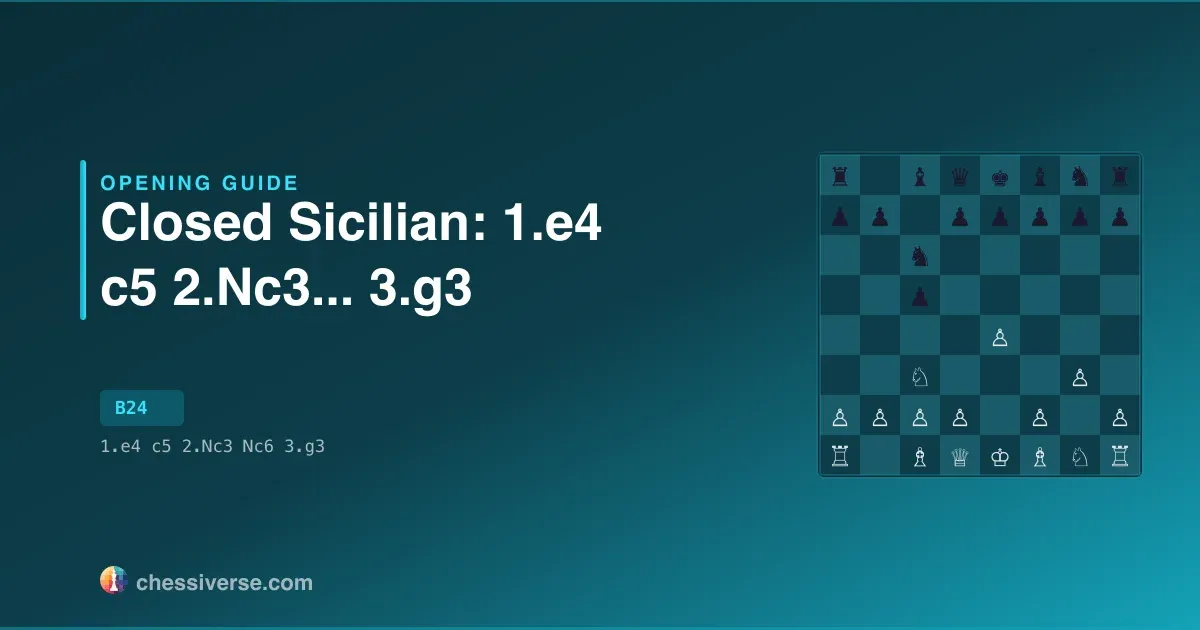
1.e4 c5 2.Nc3 Nc6 3.g3 opens the Sicilian Defense: Closed, Fianchetto Variation, ECO B24. White sidesteps the entire Open Sicilian theory dump and sets up a slow kingside fianchetto. The game becomes about plans, not memorization.
Strategic Overview
The Closed Sicilian is the principled positional answer to 1...c5 — White skips the d4 break, fianchettoes the king's bishop, and builds a King's Indian Attack style setup with Nge2, d3, Bg2, 0-0. The whole opening is structurally similar to a reversed King's Indian: White typically plays for the kingside with f4 and pawn storms, Black plays for the queenside with ...Rb8 and ...b5-b4. There's an asymmetry baked into the position — both sides know which side of the board they're attacking on, which makes for clean strategic battles rather than messy theoretical brawls. White's f4 push is the central kingside lever; played early, it can transpose into Grand Prix Attack territory with sharp attacking chances. Played late, it's part of a slow positional squeeze where White waits to see Black's setup before committing. Black's main weapon is a central break, usually ...d5 or ...e5 at the right moment, to crack open the center before White's kingside attack arrives. This is the Sicilian line for players who prefer to outplay opponents over a hundred moves rather than calculate sharp tactics — Spassky used it as a serious weapon, and at club level it sidesteps an enormous amount of preparation.
Key Ideas
When players succeed in this line, they usually do so by leaning on the following themes:
- Skip the Open Sicilian theory — The Closed Sicilian avoids the massive theoretical battleground of the Open Sicilian. White trades a chance at an objective opening edge for a position where both sides have to think for themselves.
- Opposite-flank attacks — White plays on the kingside, Black plays on the queenside. The asymmetry makes the strategic plan obvious for both sides — the battle is about who gets there first.
- f4 is the kingside lever — Pushing f4 opens lines for White's attack and can transpose into Grand Prix Attack-style positions. Timing matters: early f4 is aggressive, late f4 is part of a slower positional plan.
- Black must crack the center — Letting White attack the kingside unchallenged is dangerous. Black needs a timely ...d5 or ...e5 break to open the center, force trades, and slow the kingside assault.
History and Notable Players
It arises from the Sicilian Defense: Closed Variation. Among the most prolific White practitioners are Herbert Bastian (84 games), Ilmars Starostits (74 games), Peter Welz (64 games). Black-side regulars include Miso Cebalo (18 games), Stefan Gross (17 games), Vlastimil Hort (17 games).
Performance Across Rating Levels
Popularity and results vary sharply by rating level. At 1200 Elo, the opening shows up in 0.01% of games (45,763 samples). White scores 50%, Black 46.2%, draws 3.7%. By 1800, popularity is 0.08% and White's score is 52.7% to Black's 42.5%. At the top end (2500+ Elo), popularity is 0.20% with 8.7% draws — a clear sign of how much theory rules the line at master level.
Time Control Patterns
Look at the same opening across time controls and blitz stands out. In bullet, it appears in 0.05% of games (1,343,059); White wins 53.3%. Blitz shows 0.06% adoption across 2,223,807 games, White scoring 51.5%. In rapid, the share rises to 0.03% — 305,238 games, White 51%. White's score swings 2.3pp across formats, so time control isn't just a stylistic choice here — it shifts the actual results.
Move Diversity and Theory Depth
Move choice is far from uniform in the Sicilian Defense: Closed, Fianchetto Variation. At 1200 Elo (45,763 games), the top reply is e6, played 22% of the time. Four other moves each take at least 5% of games, and the top three moves account for 62.4% of games. Entropy: 2.67. By 2500 (27,084 games), g6 takes over as the top reply at 83.4%; only one other move still reaches 5% and the top three moves account for 92.9% of games. Entropy drops to 1.08. That entropy collapse is the signature of a line where preparation pays off: at the top, players know the best move and play it.
Historical Trends
Long-term, the trajectory of this opening is informative. Adoption peaked in 2020 at 0.07% (401,267 games). By 2025 it sits at 0.05%, 28% below the peak but still 25% above its 2013 level, so the line is up over the full period despite easing from the high.
Main Lines and Variations
The main branches off 1.e4 c5 2.Nc3 Nc6 3.g3 include:
Each branch leads to a different middlegame character — the resulting pawn structure decides what kind of game you get.
Common Mistakes
- Drifting away from main theory — At 400 Elo, the three most-played moves cover 54.9% of games, against 81.7% at 2000. The most popular deviation is e5 (played 18.2% of the time at 400, much less so up top). It looks fine but quietly hands the better-prepared side an edge.
- Neglecting development — It can feel productive to make extra pawn moves early, but falling behind in piece development is what loses most amateur games — especially in open positions where active pieces find squares fast.
- Ignoring the kingside attack — In sharp Sicilian lines, White typically castles long and pushes the h-pawn. Without your own counterplay on the queenside or in the centre, White's attack lands first.
Practice on Chessiverse
Ready to try the Sicilian Defense: Closed, Fianchetto Variation against a bot? Pick an opponent at your level and play a game.