



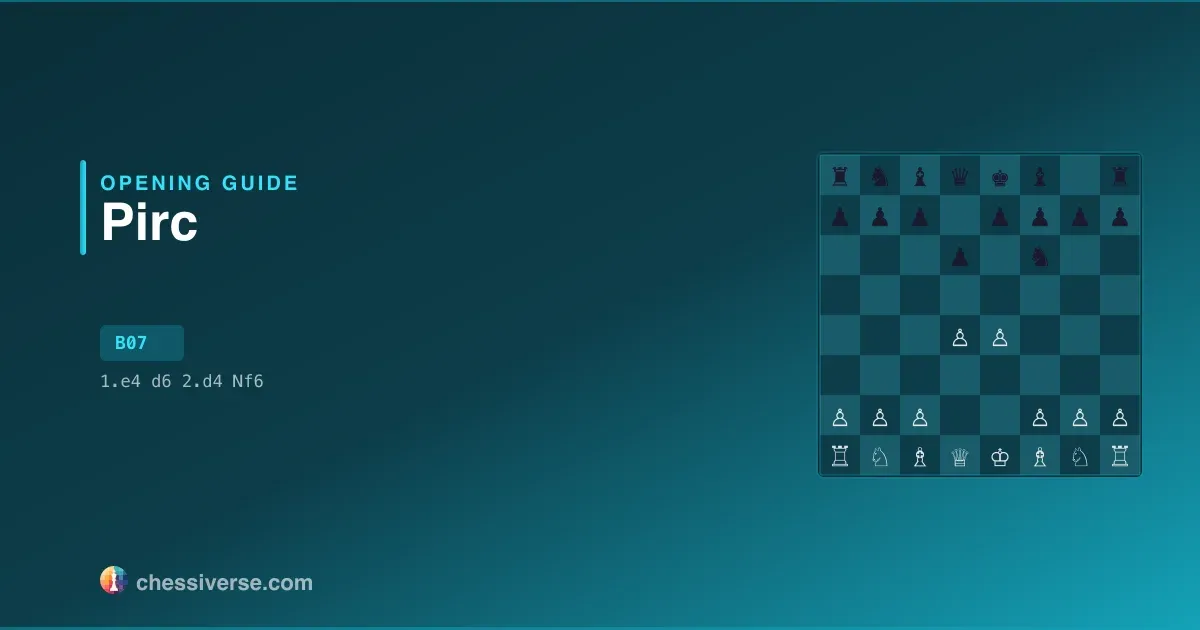
The Pirc Defense arises after 1.e4 d6 2.d4 Nf6 and falls under ECO code B07. Black develops the knight while putting pressure on e4, entering the main line of the Pirc Defense. White has multiple ways to protect the e-pawn, with 3. Nc3 being the most popular. Black typically continues with 3...g6 and 4...Bg7, fianchettoing the bishop and preparing to castle. Since Black's development is relatively slow, White has the opportunity to seize additional space, particularly on the kingside with 4. f4, the Austrian Attack (followed by Nf3), which clamps down on e5 and prevents Black's key freeing move ...e5. If Black tries 3...e5 instead, 4. Nf3 transposes into a Nimzowitsch Philidor. The Lion's Jaw, 3. f3, is another way to defend e4 while preserving the option of c4 for further expansion. After 3...g6 4. c4 Bg7 5. Nc3, the position transposes into a Samisch King's Indian. This setup also permits 3...e5, though 4. dxe5 leads to a queen exchange (4...dxe5 5. Qxd8+ Kxd8 6. Bc4 Ke8), making 4. d5 a preferable response. The quieter 3. Bd3 or 3. Nd2 are occasional alternatives that defend e4 without blocking the c-pawn. With 27.2 million Lichess games across all rating levels, it is a well-established opening choice.
- A hypermodern setup: Black lets White build a big pawn center with d4 and e4, then attacks it from the flanks rather than meeting it head-on.
- Black's dark-squared bishop goes to g7 via a kingside fianchetto, creating tension similar to a King's Indian Defense.
History and Notable Players
Among the most prolific practitioners on the White side are Michele Godena (52 games), Eduardas Rozentalis (50 games), Oleg Korneev (49 games). On the Black side, notable exponents include Josef Pribyl (211 games), Yuri Zimmerman (141 games), Mihail Marin (140 games).
Seen only occasionally in the 19th century and long dismissed as irregular, the Pirc only gained ground after World War II and was regarded as playable by the 1960s, helped by Duncan Suttles' efforts. It reached the World Championship stage in 1972, when Fischer used it against Spassky in game 17 and drew.
Named after: Slovenian grandmaster Vasja Pirc, who played it regularly from the late 1940s; in Russia it is also credited to Anatoly Ufimtsev.
Notable players: Vasja Pirc, Duncan Suttles, Jan Timman, Yasser Seirawan
Kasparov dismissed the Pirc as hardly worth using in top-category tournaments, yet his 1999 Wijk aan Zee win against Topalov's Pirc, known as Kasparov's Immortal, is called the most famous Pirc game ever.
Statistics
Based on 27.2 million Lichess games across all rating levels:
- White wins: 48.1%
- Black wins: 47.3%
- Draws: 4.7%
The statistics show a roughly balanced opening where both sides have equal chances.
Main Lines and Variations
After 1.e4 d6 2.d4 Nf6, the main continuations include:
Each of these lines leads to distinct types of positions and requires its own understanding of the resulting pawn structures and piece placements.
Common Mistakes to Avoid
- Allowing White to build an overwhelming center: Hypermodern openings allow White space in the center, but you need to strike back at the right moment. Delaying the counterattack too long can leave you without active play.
Practice on Chessiverse
The best way to learn the Pirc Defense is through practice. On Chessiverse, you can play chess against computer opponents that specialize in this opening. Our AI bots range from beginner to grandmaster level, each with unique playing styles — from aggressive attackers to solid defenders. Choose a bot that matches your rating and work your way up as you master the opening's key ideas.
Performance Across Rating Levels
The picture changes a lot as you climb the rating ladder. At 1200 Elo, the opening shows up in 0.39% of games (2,598,985 samples). White scores 48.1%, Black 47.8%, draws 4.1%. At 1800 the opening surfaces in 0.71% of games; White wins 48%, Black 47.5%, draws 4.5%. Among 2500-rated players the line appears in 1.64% of games and draws spike to 9.2%, indicating tight preparation.
Time Control Patterns
Time control matters here: blitz players reach for this opening more than others. In bullet, it appears in 0.45% of games (11,957,235); White wins 47.7%. Blitz shows 0.60% adoption across 21,481,144 games, White scoring 48%. In rapid, the share rises to 0.52% — 5,731,855 games, White 48.3%.
Move Diversity and Theory Depth
What players actually play after the opening moves depends heavily on rating. At 1200 Elo (2,598,985 games), the top reply is Nc3, played 66.6% of the time. Two other moves each take at least 5% of games, and the top three moves account for 86.4% of games. Entropy: 1.80. By 2500 (223,495 games), Nc3 dominates at 86.6% of replies; two other moves reach 5% and the top three moves account for 98.6% of games. Entropy drops to 0.78. The narrowing is significant — strong players consolidate around a small set of best moves, while amateurs scatter across many plausible-looking options.
Historical Trends
Tracking the Pirc Defense year over year shows a clear story. Adoption peaked in 2025 at 0.66% (4,898,222 games). 2025 marks the high — the opening is rising, currently at 0.66%.