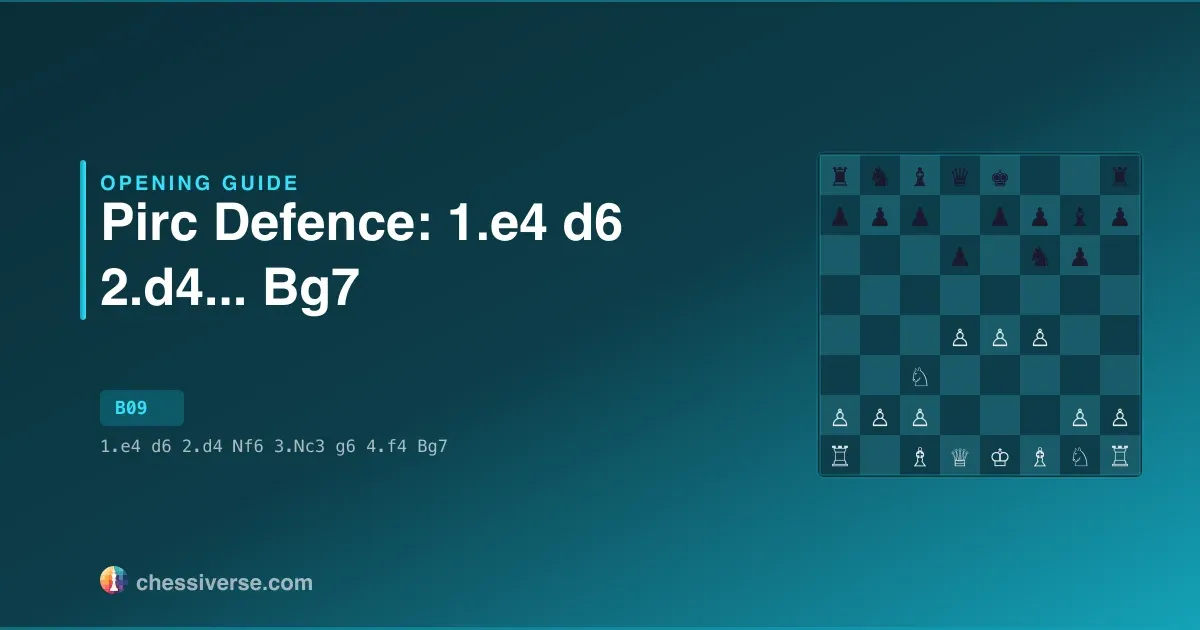
Starting from 1.e4 d6 2.d4 Nf6 3.Nc3 g6 4.f4 Bg7, players enter the Pirc Defense: Austrian Attack — ECO B09. Black completes the kingside fianchetto and squares up against the looming Austrian Attack. White's center is enormous and the e5 push is the threat everyone in the position can feel.
Strategic Overview
This is the standard Austrian Attack position with both sides committed. White has built a huge pawn front with pawns on e4, d4, and f4, and the strategic threat hanging over Black is e5 — once that pawn pushes, the g7-bishop loses its diagonal and Black's kingside structure starts looking thin. Black's whole job is to prevent or punish that advance before White can finish development. Typical Black tools are ...c5 to attack d4 and force White to commit, ...Nc6 to add pressure, ...e5 himself in some lines to lock the center, or ...Bg4 to pin the knight that would support e5. Castling kingside is standard but not automatic — sometimes Black holds back to keep flexibility against the kingside pawn storm. For White, the plan beyond e5 includes Nf3, Bd3 or Be2, 0-0, and then choosing between e5 with a structural break, or a slower kingside expansion with g4 ideas. The Austrian Attack is one of the sharpest things White can throw at the Pirc, and the games tend to be wild — fast, principled play wins, slow maneuvering tends to die a horrible death.
Key Ideas
A few ideas come up again and again in this opening:
- Stop e5 before it happens — If White gets to play e5 unchallenged, the g7-bishop is closed off and Black's whole concept collapses. Every Black setup is built around preventing or punishing this advance with timely ...c5, ...Nc6, or ...Bg4.
- The g7-bishop needs an open diagonal — Black's most important piece points down the long diagonal toward White's queenside. Keep it active and the position is fine; let it get bricked in behind a White pawn on e5 and the whole strategy is in trouble.
- ...c5 is the typical break — Attacking d4 with the c-pawn forces White to commit. Either he pushes d5, locking the center on Black's terms, or he allows ...cxd4 and the central pawn duo dissolves into something more manageable.
- Don't auto-castle kingside — With pawns on e4 and f4 looming, kingside castling can walk into a pawn storm. Black often delays castling or chooses queenside, depending on which way the game is opening up.
- White's plan is concrete — Develop pieces, prepare e5, and roll the kingside. There's no slow maneuvering for White — the whole point of the Austrian is to use the central majority before Black can challenge it.
History and Notable Players
It arises from the Pirc Defense. Among the most prolific White practitioners are Sergey Karjakin (22 games), Oleg Korneev (19 games), Ljubomir Ljubojevic (18 games). Black-side regulars include Jan Hein Donner (45 games), Volodymyr Onyshchuk (42 games), Yuri Zimmerman (36 games).
Performance Across Rating Levels
The picture changes a lot as you climb the rating ladder. Among 1200-rated players, it appears in 0.01% of games — 93,193 of them on record — with White winning 51.8% and Black 44.8%. At 1800 the opening surfaces in 0.08% of games; White wins 50.8%, Black 44.8%, draws 4.4%. At 2500, 0.18% of games go into this opening; draws sit at 9.2% — the line is well-mapped at this level. Positions also become less sharp as level rises (sharpness 0.97 → 0.91).
Time Control Patterns
Time control matters here: blitz players reach for this opening more than others. In bullet, it appears in 0.06% of games (1,463,885); White wins 52.6%. Blitz shows 0.06% adoption across 2,119,958 games, White scoring 51.3%. In rapid, the share rises to 0.03% — 338,885 games, White 51.6%.
Move Diversity and Theory Depth
Move choice is far from uniform in the Pirc Defense: Austrian Attack. At 1200 Elo (93,193 games), the top reply is Nf3, played 46.7% of the time. Two other moves each take at least 5% of games, and the top three moves account for 88.7% of games. Entropy: 1.94. By 2500 (24,506 games), Nf3 dominates at 86.2% of replies; only one other move still reaches 5% and the top three moves account for 98% of games. Entropy drops to 0.82. That entropy collapse is the signature of a line where preparation pays off: at the top, players know the best move and play it.
Historical Trends
Year-over-year data tells you whether this opening is a contemporary fixture or a fading one. Adoption peaked in 2017 at 0.058% (65,951 games). By 2025 it sits at 0.055%, 5% below the peak but still 116% above its 2013 level, so the line is up over the full period despite easing from the high.
Common Mistakes
- Drifting away from main theory — At 400 Elo, the three most-played moves cover 82.9% of games, against 93.1% at 2000. The most popular deviation is Be3 (played 5.3% of the time at 400, much less so up top). It looks fine but quietly hands the better-prepared side an edge.
- Neglecting development — It can feel productive to make extra pawn moves early, but falling behind in piece development is what loses most amateur games — especially in open positions where active pieces find squares fast.
- Letting White own the centre — Hypermodern openings concede central space on purpose, but only if you strike back in time. Delay the counter-blow and you end up squeezed.
Practice on Chessiverse
Ready to try the Pirc Defense: Austrian Attack against a bot? Pick an opponent at your level and play a game.