



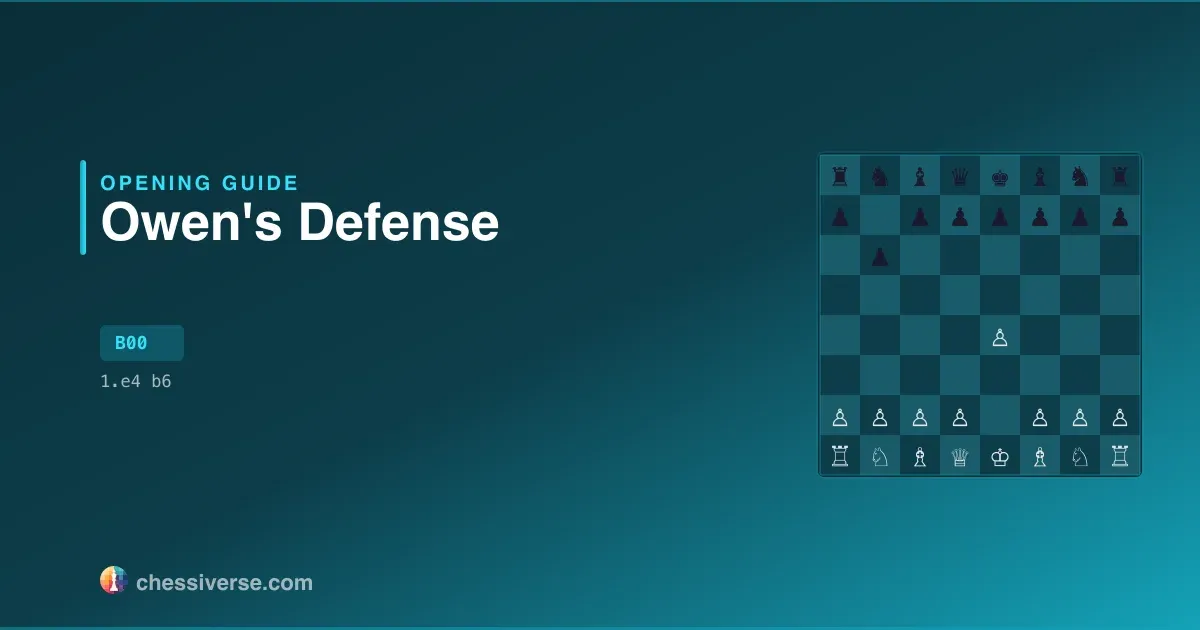
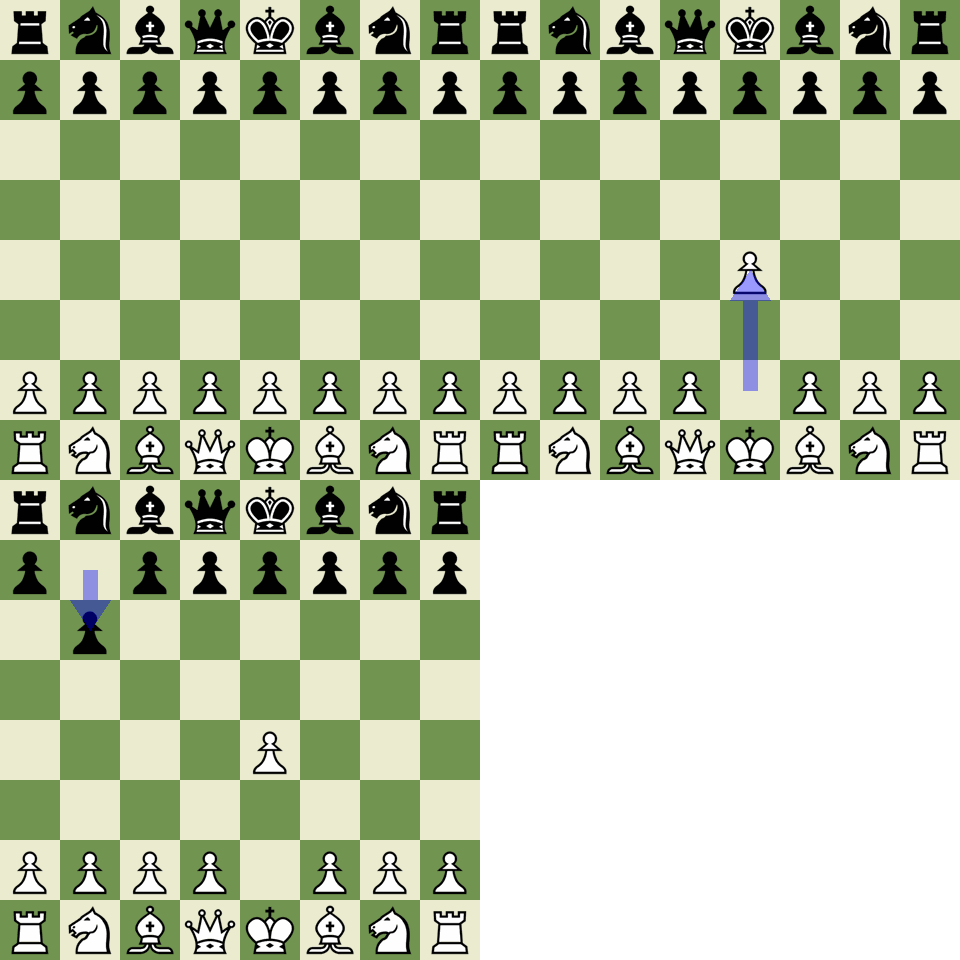
The Owen’s Defense arises after 1.e4 b6 and falls under ECO code B00. Named after the 19th-century English player John Owen, this uncommon reply to 1.e4 allows White to seize the center effortlessly with 2. d4, which is the standard and most natural response. Black’s plan is typically to fianchetto the dark-squared bishop to b7, aiming for long-diagonal pressure. Despite being rare at the top level, the Owen’s Defense retains a following among club players and offers transpositional possibilities into English Opening structures or other systems. With 50.8 million Lichess games across all rating levels, it is one of the most popular openings.
- Black fianchettoes the queen's bishop to b7 early, aiming it at White's center from a distance instead of occupying the center with pawns.
- In exchange, White gets to take over the center with pawns and enjoy a spatial advantage, which is why the line has a dubious reputation.
- Theory on it is thin, so many players use it as a surprise weapon that drags opponents into unfamiliar territory from move one.
History and Notable Players
Among the most prolific practitioners on the White side are Viswanathan Anand (1534 games), Vlastimil Jansa (1449 games), Heikki MJ Westerinen (1409 games). On the Black side, notable exponents include Viktor Korchnoi (999 games), Loek Van Wely (853 games), Vassily Ivanchuk (835 games).
Games with 1.e4 b6 appear as far back as Gioachino Greco's 17th-century writings. John Owen was the first master-strength player to use it regularly, and faced Paul Morphy with it twice in 1858. It stayed a rarity in master chess until the 1970s, when Bent Larsen and Michael Basman picked it up again.
Named after: Rev. John Owen, a 19th-century vicar and strong amateur who relied on 1.e4 b6 as his regular defense through most of his career.
Notable players: John Owen, Bent Larsen, Michael Basman, Tony Miles
In their 1858 encounters, John Owen actually beat Paul Morphy once with his pet defense, and despite its dubious reputation the line still pops up in online blitz from stars like Carlsen and Nakamura.
Statistics
Based on 50.8 million Lichess games across all rating levels:
- White wins: 50.2%
- Black wins: 45.9%
- Draws: 3.9%
The statistics show a roughly balanced opening where both sides have equal chances.
Practice on Chessiverse
The best way to learn the Owen's Defense is through practice. On Chessiverse, you can play chess against computer opponents that specialize in this opening. Our AI bots range from beginner to grandmaster level, each with unique playing styles — from aggressive attackers to solid defenders. Choose a bot that matches your rating and work your way up as you master the opening's key ideas.
Performance Across Rating Levels
The picture changes a lot as you climb the rating ladder. At 1200 Elo, the opening shows up in 1.07% of games (7,220,046 samples). White scores 49.6%, Black 46.8%, draws 3.6%. By 1800, popularity is 1.10% and White's score is 50.8% to Black's 44.9%. Among 2500-rated players the line appears in 0.23% of games and draws spike to 8.7%, indicating tight preparation.
Time Control Patterns
The Owen's Defense skews toward bullet chess. In bullet, it appears in 1.45% of games (38,493,475); White wins 49.7%. Blitz shows 1.14% adoption across 40,825,282 games, White scoring 50.1%. In rapid, the share rises to 0.90% — 9,934,851 games, White 50.4%.
Move Diversity and Theory Depth
What players actually play after the opening moves depends heavily on rating. At 1200 Elo (7,220,046 games), the top reply is d4, played 33.4% of the time. Three other moves each take at least 5% of games, and the top three moves account for 78.9% of games. Entropy: 2.48. By 2500 (31,838 games), d4 dominates at 80.3% of replies; only two other moves still reach 5% and the top three moves account for 94.2% of games. Entropy drops to 1.18. That entropy collapse is the signature of a line where preparation pays off: at the top, players know the best move and play it.
Historical Trends
Tracking the Owen's Defense year over year shows a clear story. Adoption peaked in 2014 at 1.35% (122,002 games). By 2025 it sits at 1.12%, 17% below the peak and 14% under its 2013 level, leaving the line in decline.