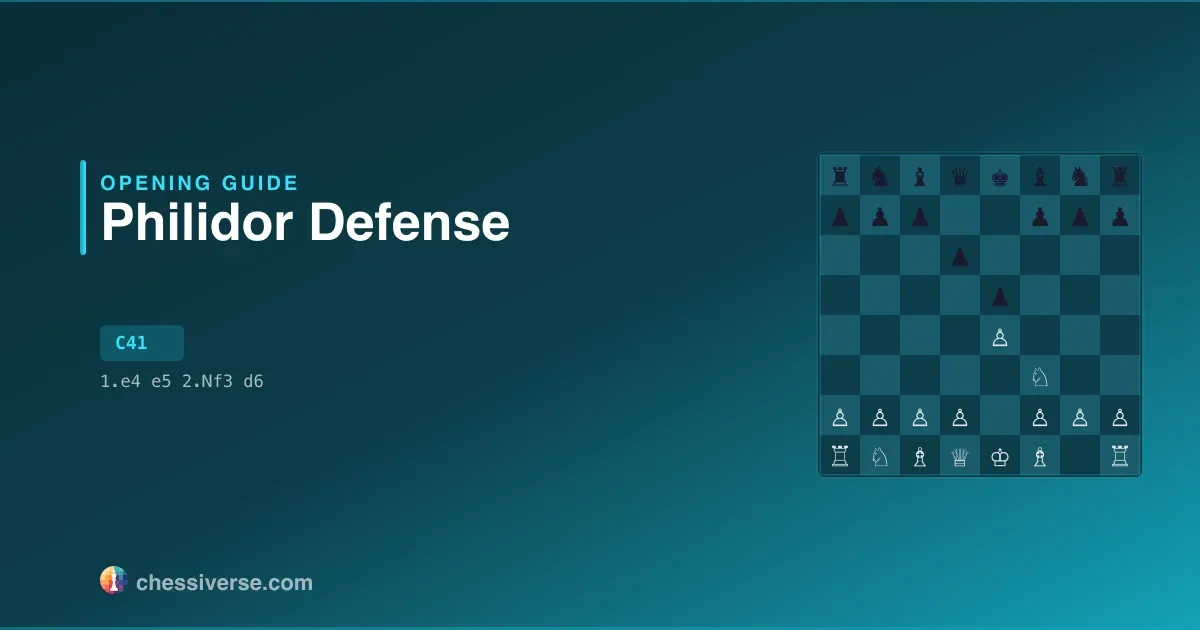
The Philidor Defense arises after 1.e4 e5 2.Nf3 d6 and falls under ECO code C41. Rather than developing a piece to defend e5, Black uses the d-pawn. While solid, this is a more passive approach than 2...Nc6, since no piece is developed and the d6 pawn will obstruct the dark-squared bishop. The main line is 3. d4, immediately threatening to open the centre with dxe5. Careless play by Black can be punished: for example, 3...Bg4?! 4. dxe5 dxe5? 5. Qxd8+ Kxd8 6. Nxe5 Be6 leaves White up material with central dominance while Black has forfeited castling rights. After 3. d4, Black's best strategies are 3...exd4, the Exchange Variation, which concedes the centre but opens the game, or 3...Nd7, the Hanham Variation, which maintains the e5 pawn and preserves tension. The most adventurous option is 3...f5?!, the Philidor Countergambit, a romantic but risky choice. With 124.4 million Lichess games across all rating levels, it is a well-established opening choice.
- Black defends the e5 pawn with a pawn instead of a piece, getting a solid but passive game where the dark-squared bishop is hemmed in by its own pawn chain.
- In the Hanham Variation Black plays ...Nd7 to keep the central tension and hold the strongpoint on e5 as long as possible.
- The Philidor Countergambit 3...f5 is a risky, romantic attempt to strike at White's center instead of defending quietly.
History and Notable Players
It arises from the Open Games (1...e5). Among the most prolific practitioners on the White side are Paul Morphy (16 games), Robert Zelcic (13 games), Vlastimil Jansa (12 games). On the Black side, notable exponents include Gavin Wall (69 games), Aarne Hermlin (56 games), Zdenek Husek (50 games).
Ruy Lopez mentioned 2...d6 in his 1561 book, but the defence is tied to Philidor, who championed it in the 18th century and even recommended the aggressive follow-up 3.d4 f5. As positional understanding grew it faded, all but disappearing from elite chess by World War I, though it has found new life in rapid, blitz and bullet chess.
Named after: Francois-Andre Danican Philidor, the 18th-century master who held 2...d6 superior to 2...Nc6, since 2...Nc6 allows the strong 3.Bb5, the Ruy Lopez.
Notable players: Francois-Andre Danican Philidor, Etienne Bacrot, Liviu-Dieter Nisipeanu
The Philidor featured in one of chess history's most famous games: the 1858 'Opera Game', in which Paul Morphy defeated the Duke of Brunswick and Count Isouard, who wielded the defence unsuccessfully.
Statistics
Based on 124.4 million Lichess games across all rating levels:
- White wins: 51.4%
- Black wins: 44.2%
- Draws: 4.4%
White holds a moderate edge statistically, though Black has good practical chances.
Practice on Chessiverse
The best way to learn the Philidor Defense is through practice. On Chessiverse, you can play chess against computer opponents that specialize in this opening. Our AI bots range from beginner to grandmaster level, each with unique playing styles — from aggressive attackers to solid defenders. Choose a bot that matches your rating and work your way up as you master the opening's key ideas.
Performance Across Rating Levels
The picture changes a lot as you climb the rating ladder. The 1200 bracket has 23,387,478 games (3.47% of all games at that level); White wins 51.1%, Black 44.7%, 4.2% are drawn. At 1800 the opening surfaces in 1.96% of games; White wins 52%, Black 43.2%, draws 4.8%. Among 2500-rated players the line appears in 0.25% of games and draws spike to 9.6%, indicating tight preparation. White's edge erodes by 4.1pp from 1200 to 2500 Elo, suggesting Black's counterplay is easier to find with experience.
Time Control Patterns
Time control matters here: rapid players reach for this opening more than others. In bullet, it appears in 1.36% of games (36,050,726); White wins 50.2%. Blitz shows 2.45% adoption across 88,022,364 games, White scoring 51.1%. In rapid, the share rises to 3.29% — 36,363,571 games, White 52%.
Move Diversity and Theory Depth
What players actually play after the opening moves depends heavily on rating. At 1200 Elo (23,387,478 games), the top reply is Bc4, played 43.3% of the time. Two other moves each take at least 5% of games, and the top three moves account for 83.8% of games. Entropy: 2.30. By 2500 (33,686 games), d4 takes over as the top reply at 71.9%; two other moves reach 5% and the top three moves account for 96.1% of games. Entropy drops to 1.34. The narrowing is significant — strong players consolidate around a small set of best moves, while amateurs scatter across many plausible-looking options.
Historical Trends
Year-over-year data tells you whether this opening is a contemporary fixture or a fading one. Adoption peaked in 2013 at 4.43% (127,547 games). By 2025 it sits at 2.51%, down 43% from that high, leaving the line in decline.