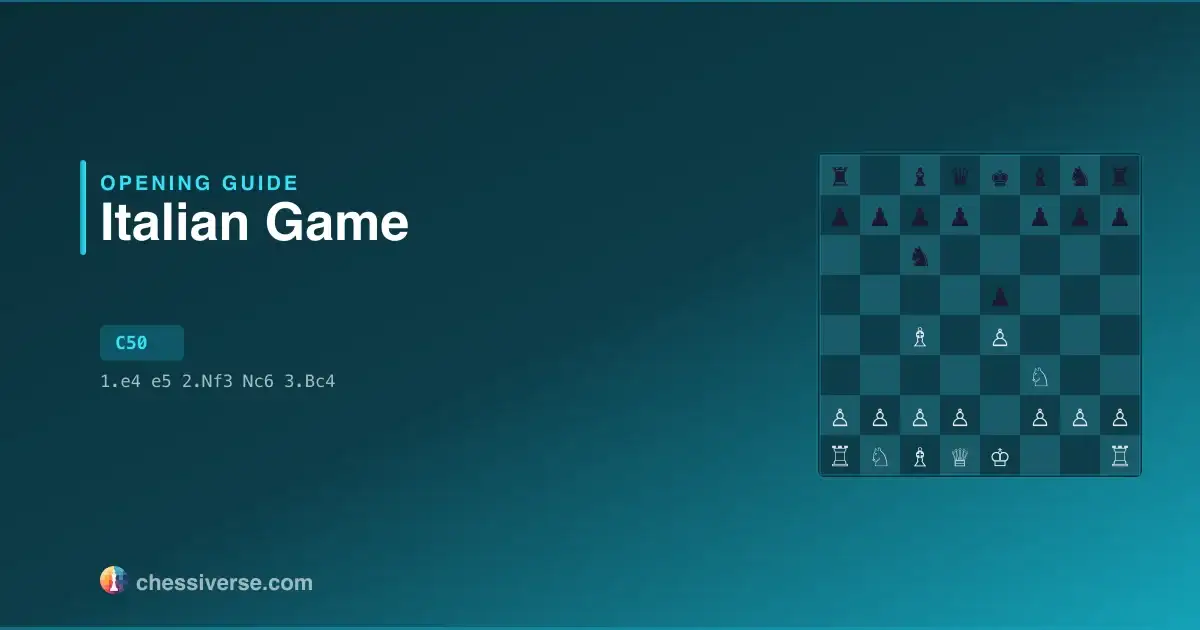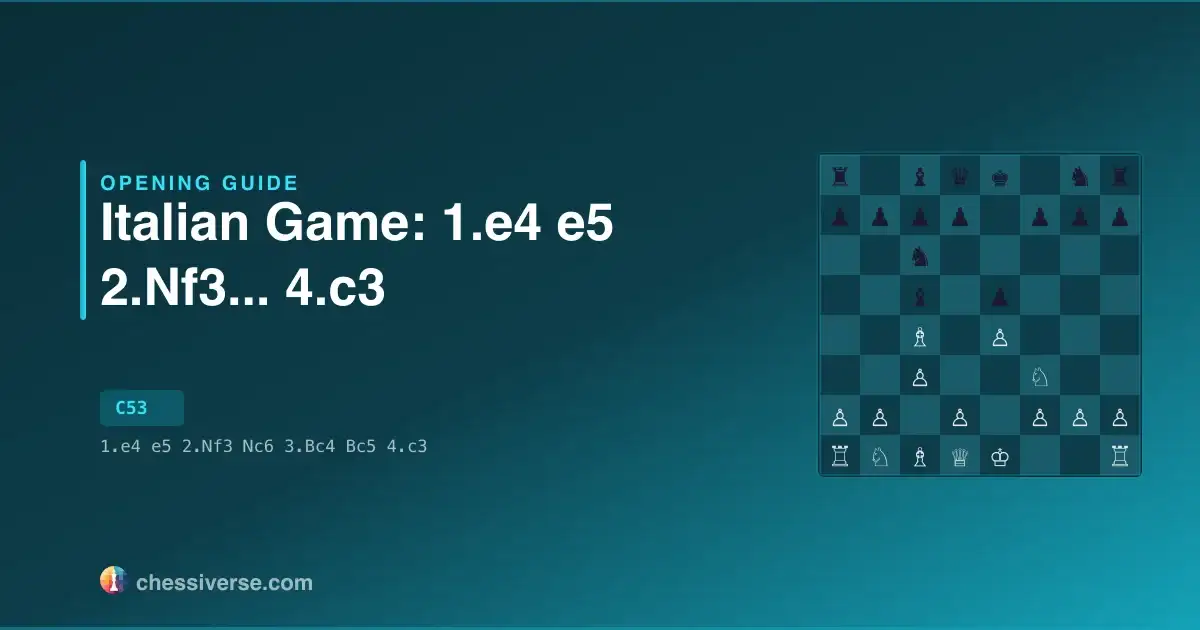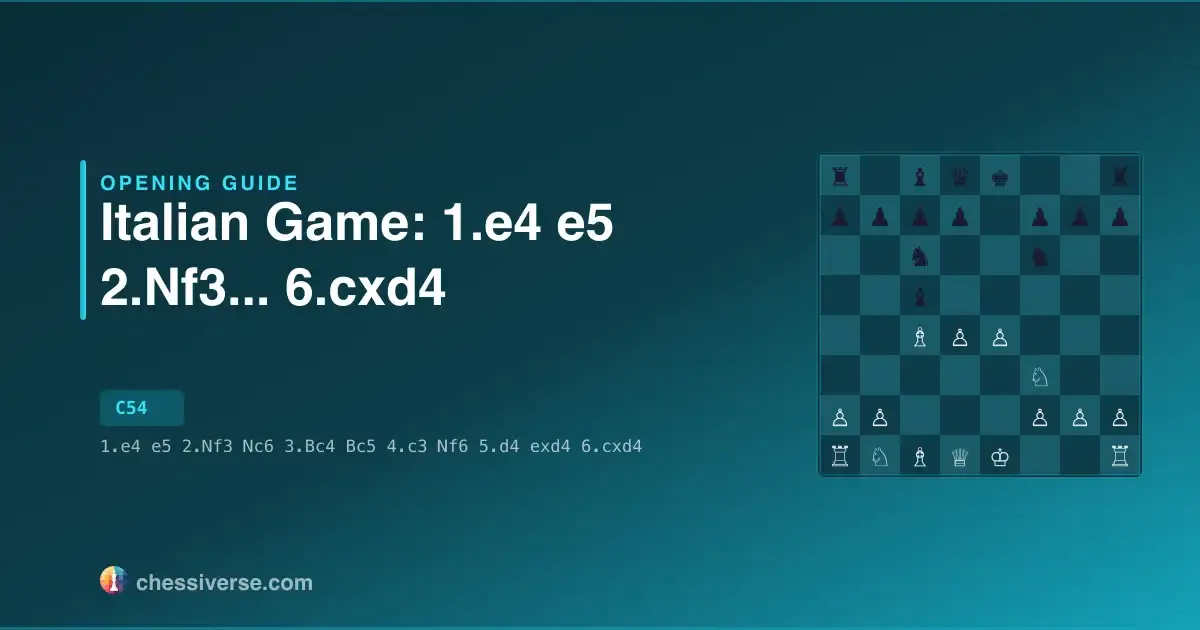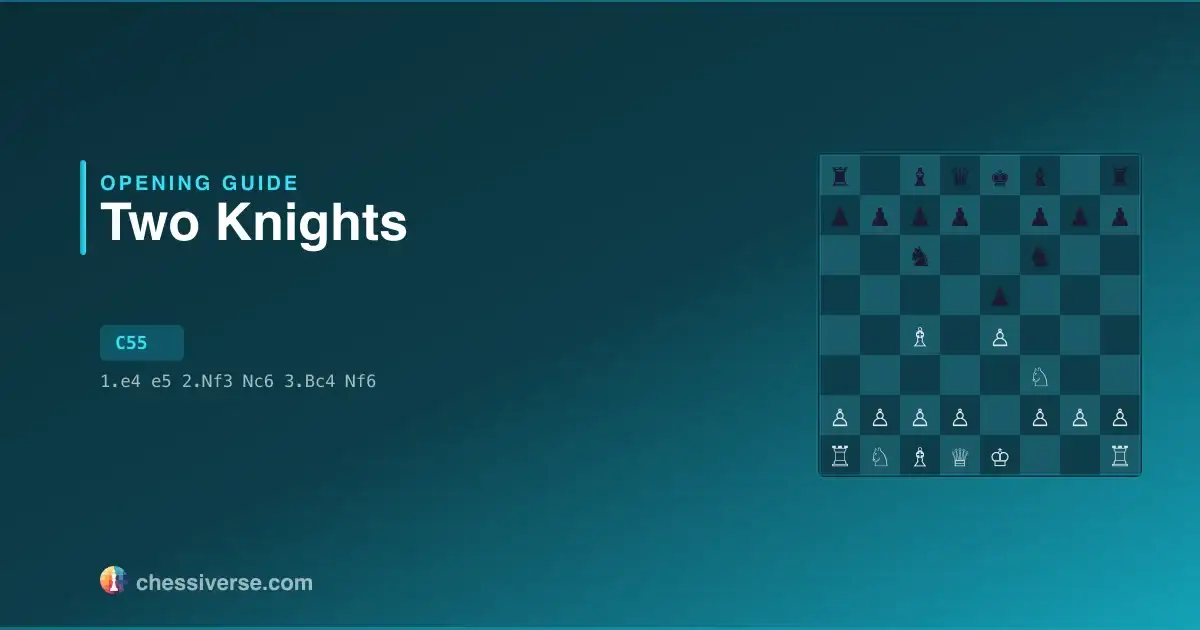




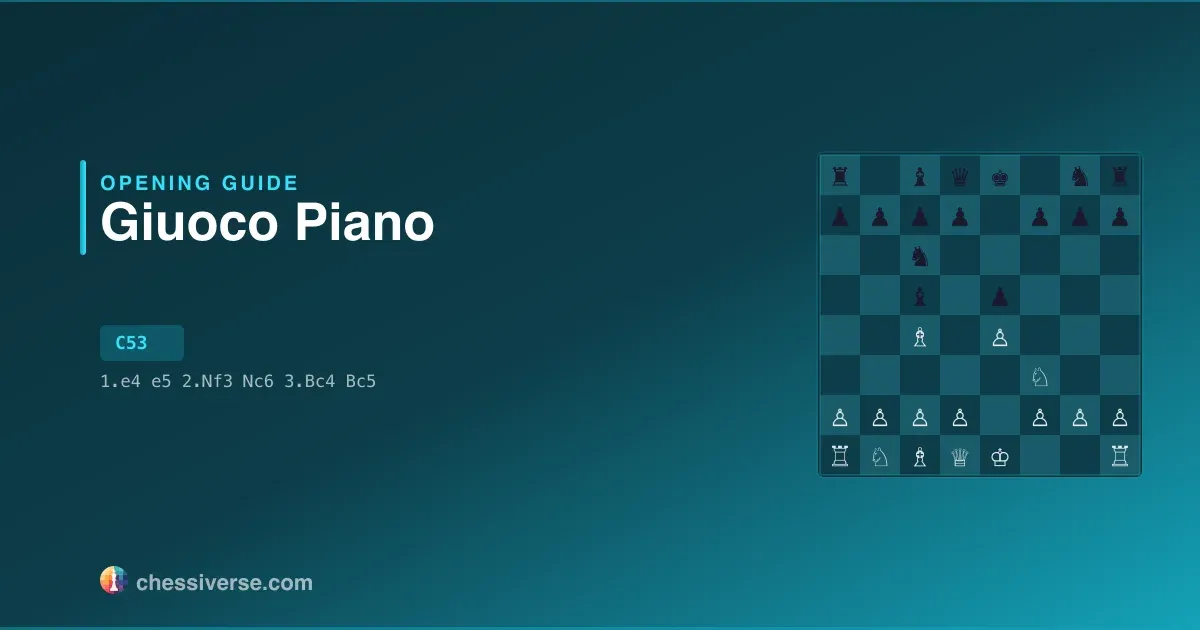
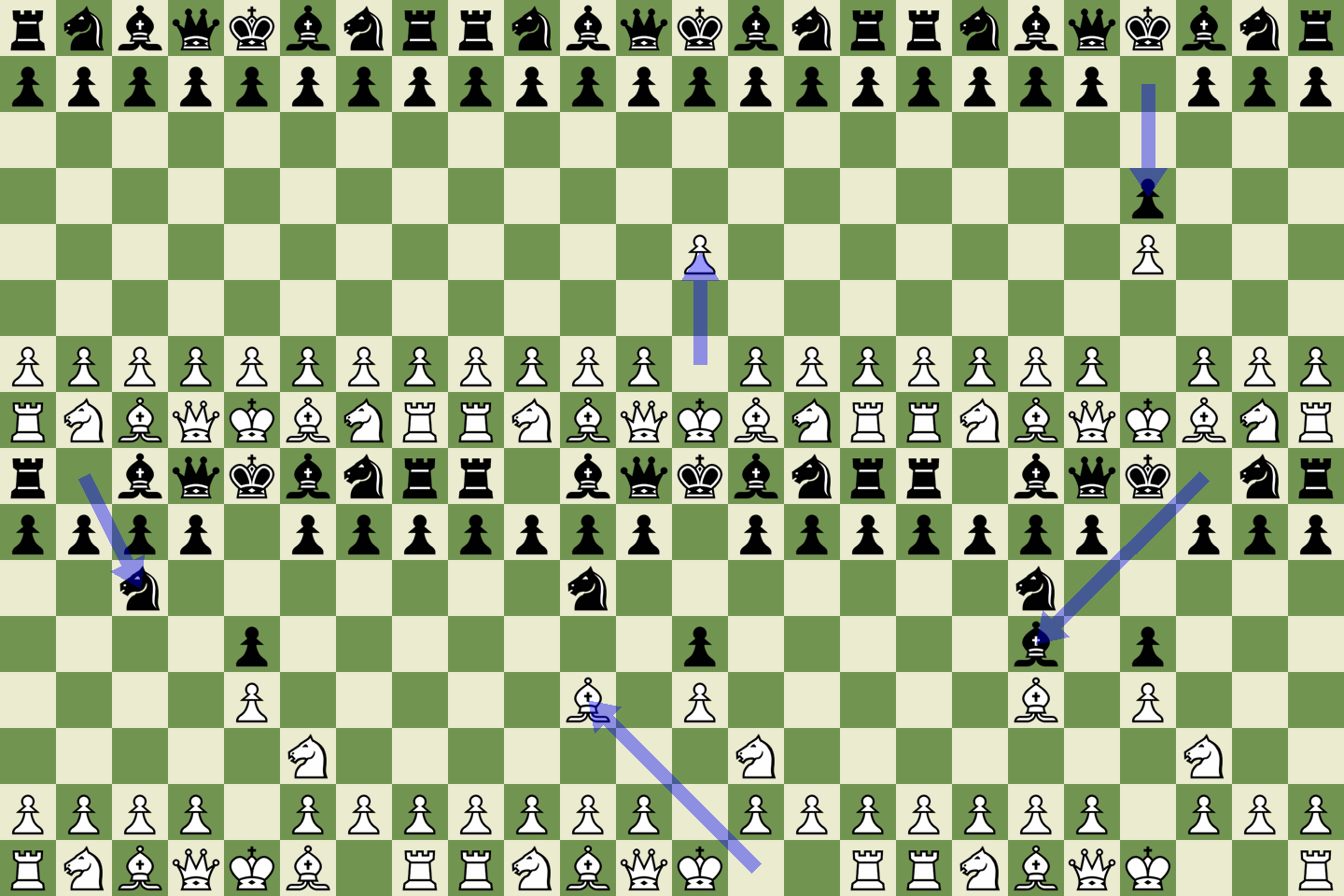
The Italian Game: Giuoco Piano arises after 1.e4 e5 2.Nf3 Nc6 3.Bc4 Bc5 and falls under ECO code C50. One of the two principal branches of the Italian Game, this line sees Black develop the kingside bishop before the knight, retaining control of the g5 square until castling is ready. In contrast to the Two Knights Defense (3...Nf6), which immediately pressures e4, the Giuoco Piano is a slower, more positional continuation, as the Italian name meaning "quiet game" suggests. White faces a strategic choice between pushing for d4 to seize the centre or settling for d3, the defining move of the even calmer Giuoco Pianissimo ("very quiet game"). Since Black currently controls d4 three times while White controls it only twice, achieving d4 and maintaining it requires preparation. The immediate 4. d4!?, known as the Italian or Rosentreter Gambit, sacrifices the pawn, which Black can capture three different ways: 4...exd4, 4...Bxd4, or 4...Nxd4. White typically seeks compensation through a rapid attack against f7, as in 4...exd4 5. c3 dxc3? 6. Bxf7+! Kxf7 7. Qd5+, but the gambit is not fully sound. With 77 million Lichess games across all rating levels, it is a well-established opening choice.
- White's classical plan is c3 followed by d4, aiming for central domination.
- The Evans Gambit (4.b4) offers a pawn for rapid development and attacking chances.
- The Giuoco Pianissimo with d3 postpones any central clash, steering the game into slow manoeuvring battles.
History and Notable Players
The earliest known analysis of this opening dates back to 16th century. It arises from the Italian Game. Among the most prolific practitioners on the White side are Maxime Vachier Lagrave (45 games), Rauf Mamedov (41 games), Victor Bologan (39 games). On the Black side, notable exponents include Aleksej Aleksandrov (56 games), Levon Aronian (35 games), Shakhriyar Mamedyarov (34 games).
One of the oldest recorded openings, it appears in Pedro Damiano's early 16th-century writings and was analysed deeply by Gioachino Greco in the early 1600s. It dominated play into the early 20th century, lost ground to the Ruy Lopez as defences improved, then made a comeback from the 1980s in the slower c3 plus d3 form.
Named after: The name is Italian for quiet game, describing the opening's calm character rather than honouring any person.
Notable players: Gioachino Greco, Anatoly Karpov
Despite meaning quiet game, it spawned the swashbuckling Evans Gambit; Anatoly Karpov trusted the quiet modern c3 plus d3 treatment in two games of his 1981 World Championship match with Korchnoi, both drawn.
Statistics
Based on 77 million Lichess games across all rating levels:
- White wins: 49.4%
- Black wins: 46.5%
- Draws: 4.1%
The statistics show a roughly balanced opening where both sides have equal chances.
Main Lines and Variations
After 1.e4 e5 2.Nf3 Nc6 3.Bc4 Bc5, the main continuations include:
Each of these lines leads to distinct types of positions and requires its own understanding of the resulting pawn structures and piece placements.
Practice on Chessiverse
The best way to learn the Italian Game: Giuoco Piano is through practice. On Chessiverse, you can play chess against computer opponents that specialize in this opening. Our AI bots range from beginner to grandmaster level, each with unique playing styles — from aggressive attackers to solid defenders. Choose a bot that matches your rating and work your way up as you master the opening's key ideas.
Performance Across Rating Levels
The picture changes a lot as you climb the rating ladder. Among 1200-rated players, it appears in 1.84% of games — 12,427,935 of them on record — with White winning 49.2% and Black 47.1%. At 1800 the opening surfaces in 1.55% of games; White wins 49.6%, Black 45.9%, draws 4.4%. At the top end (2500+ Elo), popularity is 0.80% with 9.7% draws — a clear sign of how much theory rules the line at master level.
Time Control Patterns
The Italian Game: Giuoco Piano skews toward rapid chess. In bullet, it appears in 0.85% of games (22,623,701); White wins 50.5%. Blitz shows 1.49% adoption across 53,602,977 games, White scoring 49.5%. In rapid, the share rises to 2.12% — 23,406,326 games, White 49.1%.
Move Diversity and Theory Depth
Move choice is far from uniform in the Italian Game: Giuoco Piano. At 1200 Elo (12,427,935 games), the top reply is d3, played 27.9% of the time. Four other moves each take at least 5% of games, and the top three moves account for 69.3% of games. Entropy: 2.69. By 2500 (109,512 games), c3 takes over as the top reply at 48.4%; only three other moves still reach 5% and the top three moves account for 88.3% of games. Entropy drops to 1.96. The narrowing is significant — strong players consolidate around a small set of best moves, while amateurs scatter across many plausible-looking options.
Historical Trends
Long-term, the trajectory of this opening is informative. Adoption peaked in 2021 at 1.78% (13,559,812 games). By 2025 it sits at 1.59%, 10% below the peak but still 47% above its 2013 level, so the line is up over the full period despite easing from the high.