



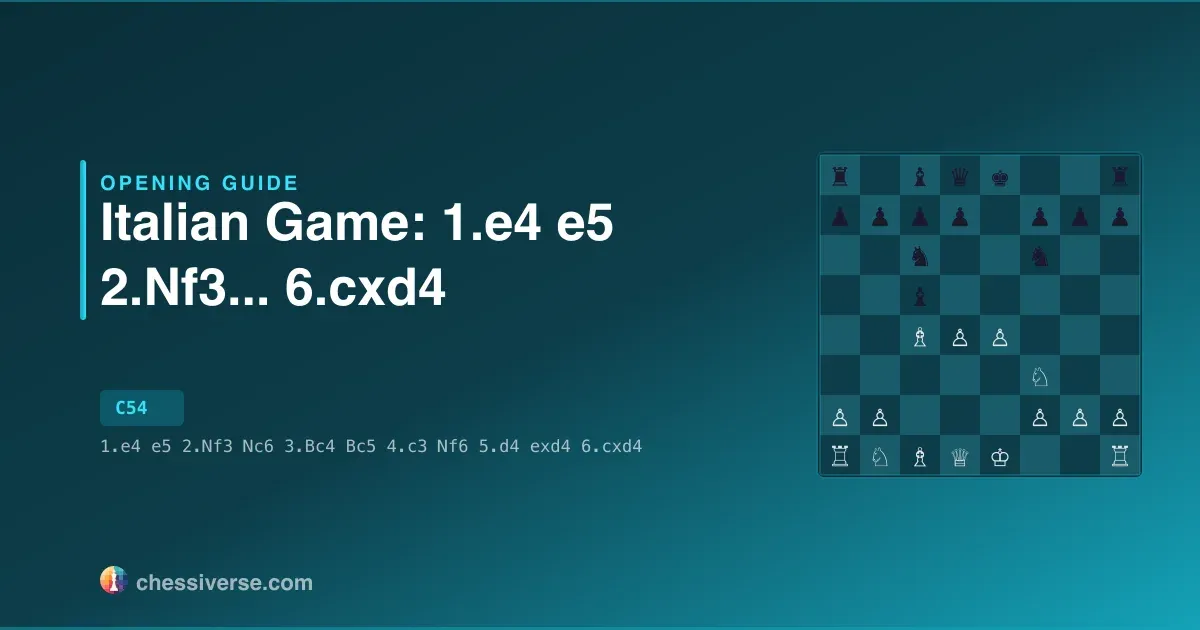
Starting from 1.e4 e5 2.Nf3 Nc6 3.Bc4 Bc5 4.c3 Nf6 5.d4 exd4 6.cxd4, players enter the Italian Game: Classical Variation, Greco Gambit, Traditional Line — ECO C54. White recaptures and lands the dream Italian centre: two pawns abreast on d4 and e4, bishops eyeing the kingside, and Black's bishop on c5 about to get kicked.
Strategic Overview
After 6.cxd4 White has achieved the classical Italian goal: two pawns side by side in the centre, active bishops, and a clear plan of pressing forward. Black's immediate concern is the bishop on c5, which is under attack from the d4 pawn and has only two reasonable squares: 6...Bb4+ or 6...Bb6. The check on b4 is the main move and the starting point for the most heavily analysed lines in the entire Italian Game. From there the game can branch into the Greco Attack with an early Nc3, where Black must navigate concrete tactical sequences and sometimes accept a piece sacrifice on f7, or into the Møller Attack with similar themes. The strategic point is constant: White has the central pawn duo and the development lead; Black has solid pieces and the half-open e-file plus the chance to exchange pieces and reach a comfortable endgame. The retreat 6...Bb6 keeps the bishop active on its best diagonal but accepts a slightly more passive position. Practically, this is one of the richest classical positions in chess. It rewards deep preparation but also responds to good general play: White wants the centre and the attack; Black wants development, accurate trades, and to neutralise the long-term initiative.
Key Ideas
The recurring motifs below distinguish a confident handler of this opening from a beginner:
- Classical Italian centre achieved — Two pawns on d4 and e4 with active bishops behind them is the structural payoff of the whole 4.c3 line. White has achieved it cleanly and now plays for development.
- 6...Bb4+ is the main response — Checking on b4 forces White to address the bishop and is the gateway to the deepest Italian theory, including the Greco and Møller Attack lines.
- 6...Bb6 is the structural alternative — Retreating the bishop keeps it active on the long diagonal without committing to a check. It is more passive but avoids the heaviest theoretical sequences.
- Centre versus development is the trade — White has the pawn centre and the lead in space; Black has solid pieces and a clear endgame plan. The middlegame is decided by who handles the central trades most accurately.
History and Notable Players
It arises from the Italian Game: Classical Variation. Among the most prolific White practitioners are Paul Saladin Leonhardt (12 games), Evgeny Sveshnikov (10 games), Julia Zikeli (9 games). Black-side regulars include Jens Strathoff (15 games), Adolf Anderssen (12 games), Aleksej Aleksandrov (12 games).
Performance Across Rating Levels
Popularity and results vary sharply by rating level. The 1200 bracket has 787,831 games (0.12% of all games at that level); White wins 53%, Black 43.4%, 3.7% are drawn. At 1800 the opening surfaces in 0.11% of games; White wins 50.9%, Black 44.3%, draws 4.9%. At the top end (2500+ Elo), popularity is 0.07% with 13.6% draws — a clear sign of how much theory rules the line at master level. White's edge erodes by 7.5pp from 1200 to 2500 Elo, suggesting Black's counterplay is easier to find with experience.
Time Control Patterns
Time control matters here: rapid players reach for this opening more than others. In bullet, it appears in 0.06% of games (1,670,113); White wins 52.9%. Blitz shows 0.10% adoption across 3,557,146 games, White scoring 51.8%. In rapid, the share rises to 0.16% — 1,722,877 games, White 52.1%.
Move Diversity and Theory Depth
What players actually play after the opening moves depends heavily on rating. At 1200 Elo (787,831 games), the top reply is Bb4+, played 63.2% of the time. Two other moves each take at least 5% of games, and the top three moves account for 93.3% of games. Entropy: 1.58. By 2500 (9,723 games), Bb4+ dominates at 99.6% of replies; no other move reaches 5% and the top three moves account for 99.9% of games. Entropy drops to 0.04. That entropy collapse is the signature of a line where preparation pays off: at the top, players know the best move and play it.
Historical Trends
Year-over-year data tells you whether this opening is a contemporary fixture or a fading one. Adoption peaked in 2021 at 0.13% (986,037 games). By 2025 it sits at 0.10%, 20% below the peak but still 30% above its 2013 level, so the line is up over the full period despite easing from the high.
Common Mistakes
- Drifting away from main theory — At 400 Elo, the three most-played moves cover 79.7% of games, against 99.5% at 2000. The most popular deviation is Bb6 (played 16.7% of the time at 400, much less so up top). It looks fine but quietly hands the better-prepared side an edge.
- Neglecting development — It can feel productive to make extra pawn moves early, but falling behind in piece development is what loses most amateur games — especially in open positions where active pieces find squares fast.
- Playing without a plan — Each Italian Game: Classical Variation, Greco Gambit, Traditional Line middlegame demands a specific approach. Decide whether the position calls for attack, manoeuvre, or simplification before reaching for a move.
Practice on Chessiverse
Ready to try the Italian Game: Classical Variation, Greco Gambit, Traditional Line against a bot? Pick an opponent at your level and play a game.