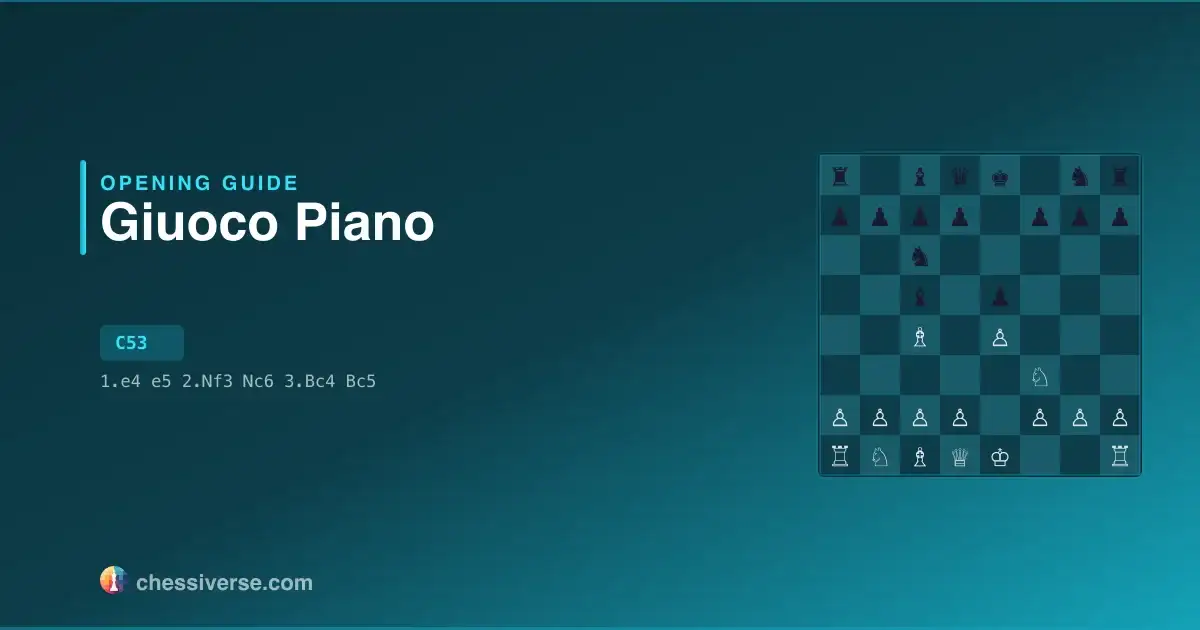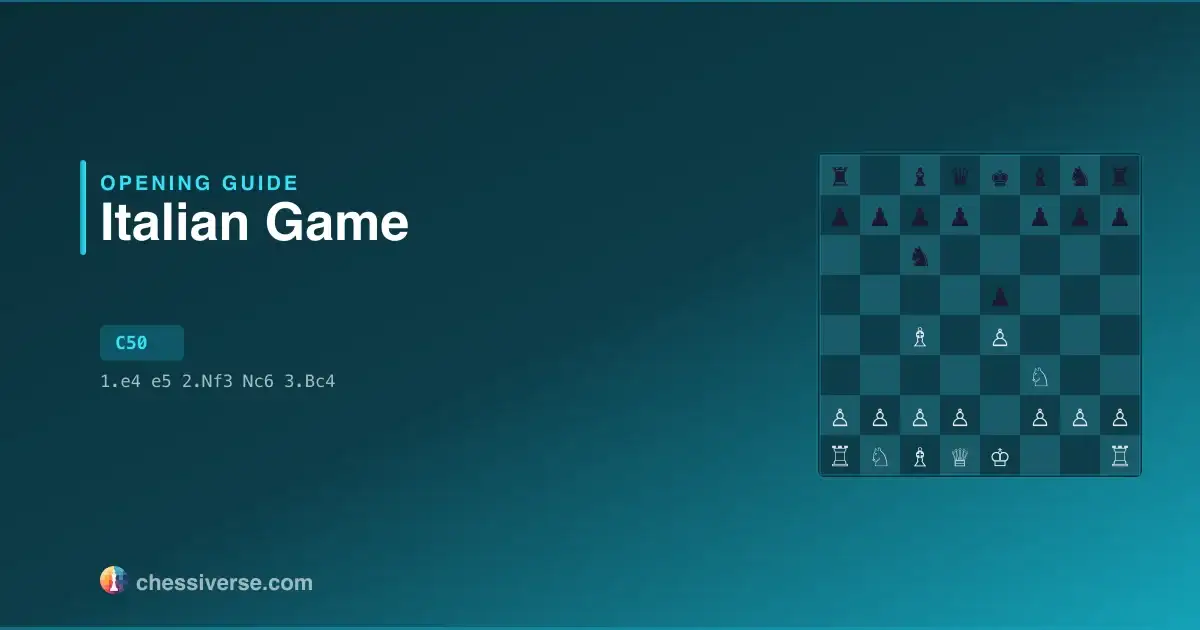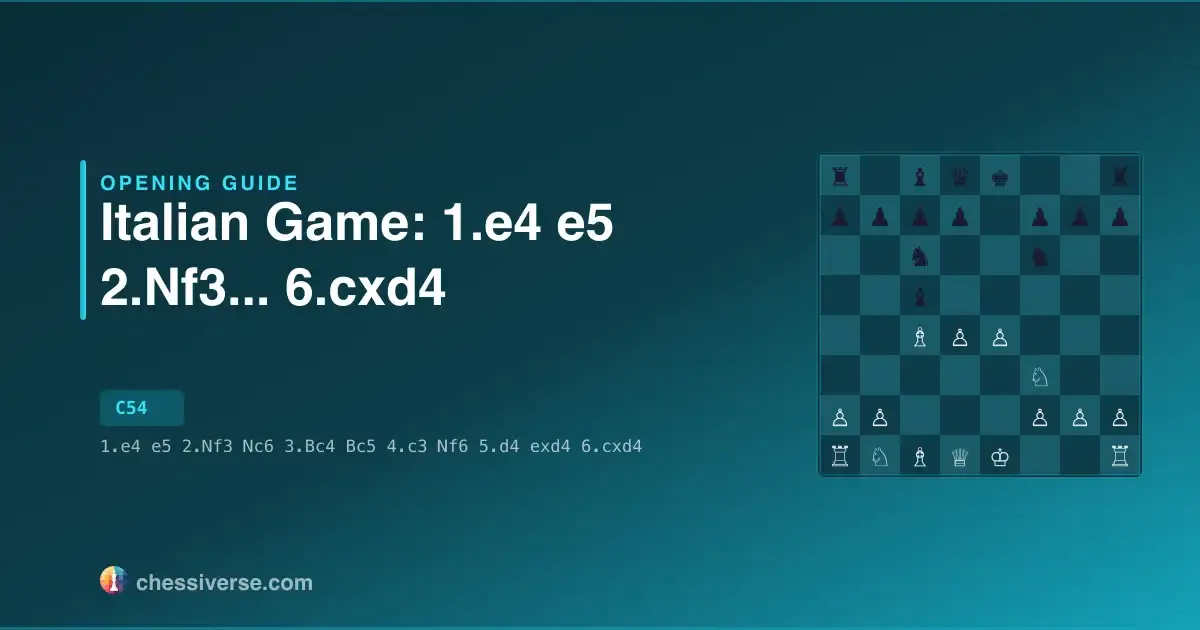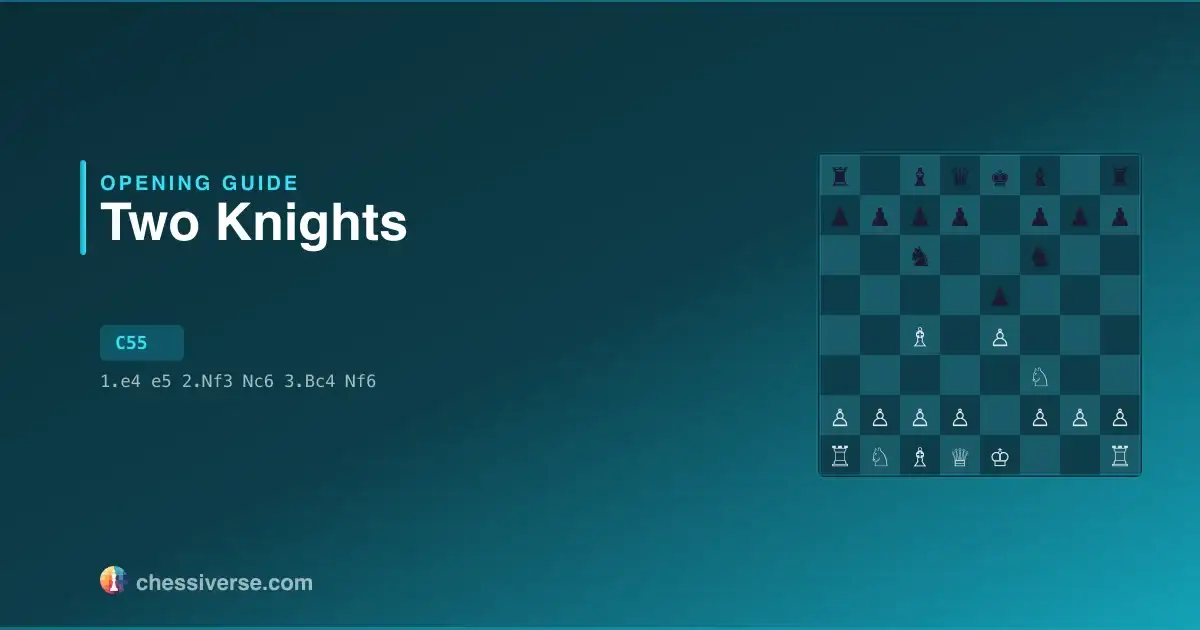




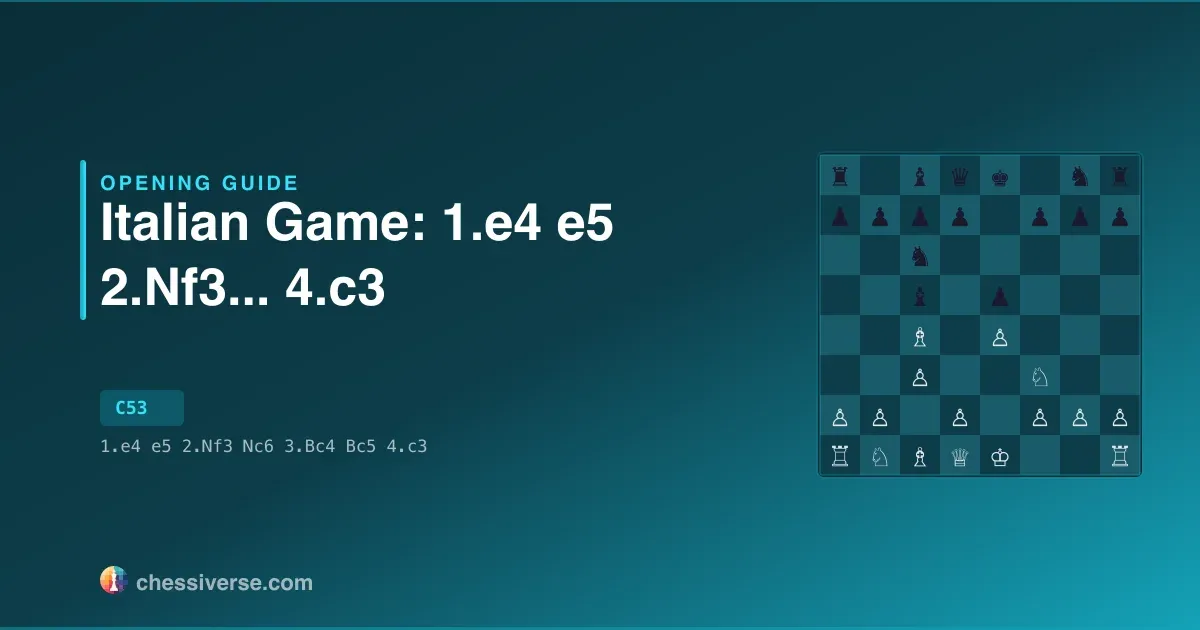
Starting from 1.e4 e5 2.Nf3 Nc6 3.Bc4 Bc5 4.c3, players enter the Italian Game: Classical Variation — ECO C53. White reinforces the central squares, kills the ...Nd4 idea, and lines up the d4 push that defines the rest of the Giuoco Piano.
Strategic Overview
4.c3 is the strategic backbone of the classical Italian Game. The pawn supports the upcoming d4 advance, which is the whole point of the structure: White wants two pawns abreast on d4 and e4 with active bishops behind them. As a bonus, c3 takes the d4 square away from Black's knight, so ideas like ...Nd4 hitting the bishop on c4 are off the table. The move also opens up a route to b3 for the queen later, intensifying pressure on f7 and lining up against the kingside. There is a structural cost. The c3 square is normally reserved for the queen's knight, and once a pawn occupies it, that knight has to find another route. Most commonly it goes Nbd2 and then to f1-g3, a slow manoeuvre that is fine if the position stays closed but awkward if Black opens it quickly. Black has multiple ways to challenge the plan. The most principled is to develop with ...Nf6 and meet d4 with ...exd4 cxd4 ...Bb4+, dragging White into Greco Attack and Møller Attack lines. Quieter players go for ...d6 followed by ...Nf6 and slow development, accepting that the centre will be contested but not opened. The Italian with 4.c3 is one of the deepest classical openings in chess, with theory running into the modern engine era and many lines still being refined.
Key Ideas
A few ideas come up again and again in this opening:
- Prepares the central d4 push — The point of c3 is to support d4 next move. White wants two pawns side by side on d4 and e4, controlling the centre and opening lines for the bishops.
- Kills ...Nd4 tactical ideas — Without c3, Black could often play ...Nd4 hitting the bishop on c4 and creating tactical mischief. The pawn move shuts that resource down completely.
- Queen's route to b3 is unlocked — A future Qb3 doubles up on f7 with the bishop on c4. This is a recurring attacking theme in the Italian, especially after Black weakens the diagonal.
- Costs the queen's knight its natural square — With a pawn on c3, the b1 knight has to take the long way out. The standard reroute through d2 and f1 to g3 is fine in closed positions but awkward if Black opens things up early.
- Deep classical theory follows — After 4.c3 the game branches into well-known structures like the Greco and Møller Attack. Theory has been refined for centuries and is still being updated by engines.
History and Notable Players
It arises from the Italian Game: Giuoco Piano. On the White side, Maxime Vachier Lagrave (45 games), Rauf Mamedov (41 games), Victor Bologan (39 games) top the database. Notable Black exponents: Aleksej Aleksandrov (56 games), Levon Aronian (35 games), Shakhriyar Mamedyarov (34 games).
Performance Across Rating Levels
How well the Italian Game: Classical Variation works depends on what level you're playing at. The 1200 bracket has 2,786,926 games (0.41% of all games at that level); White wins 52.8%, Black 43.7%, 3.5% are drawn. Move up to 1800 Elo and the share shifts to 0.53%, with White winning 50.9% versus Black's 44.6%. Among 2500-rated players the line appears in 0.39% of games and draws spike to 10%, indicating tight preparation. White's edge erodes by 5.2pp from 1200 to 2500 Elo, suggesting Black's counterplay is easier to find with experience.
Time Control Patterns
Time control matters here: rapid players reach for this opening more than others. In bullet, it appears in 0.22% of games (5,873,145); White wins 52%. Blitz shows 0.42% adoption across 15,117,563 games, White scoring 51.5%. In rapid, the share rises to 0.58% — 6,386,082 games, White 52.3%.
Move Diversity and Theory Depth
What players actually play after the opening moves depends heavily on rating. At 1200 Elo (2,786,926 games), the top reply is Nf6, played 58.4% of the time. Two other moves each take at least 5% of games, and the top three moves account for 89.6% of games. Entropy: 1.85. By 2500 (52,921 games), Nf6 dominates at 93.2% of replies; no other move reaches 5% and the top three moves account for 97.8% of games. Entropy drops to 0.49. The narrowing is significant — strong players consolidate around a small set of best moves, while amateurs scatter across many plausible-looking options.
Historical Trends
Year-over-year data tells you whether this opening is a contemporary fixture or a fading one. Adoption peaked in 2021 at 0.50% (3,818,595 games). By 2025 it sits at 0.45%, 9% below the peak but still 54% above its 2013 level, so the line is up over the full period despite easing from the high.
Main Lines and Variations
From the position after 1.e4 e5 2.Nf3 Nc6 3.Bc4 Bc5 4.c3, the recognised continuations are:
Each branch leads to a different middlegame character — the resulting pawn structure decides what kind of game you get.
Common Mistakes
- Neglecting development — Extra pawn moves in the opening are tempting, especially when you "know the moves". Developing a piece each turn is the simple correction.
- Playing without a plan — Each Italian Game: Classical Variation middlegame demands a specific approach. Decide whether the position calls for attack, manoeuvre, or simplification before reaching for a move.
Practice on Chessiverse
Ready to try the Italian Game: Classical Variation against a bot? Pick an opponent at your level and play a game.