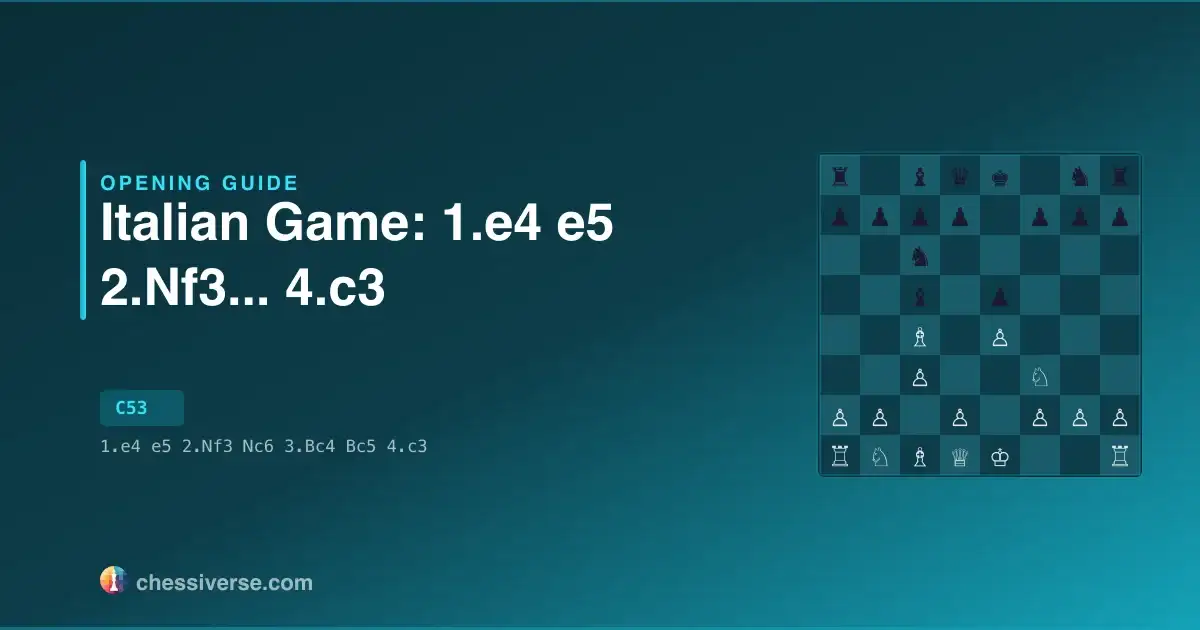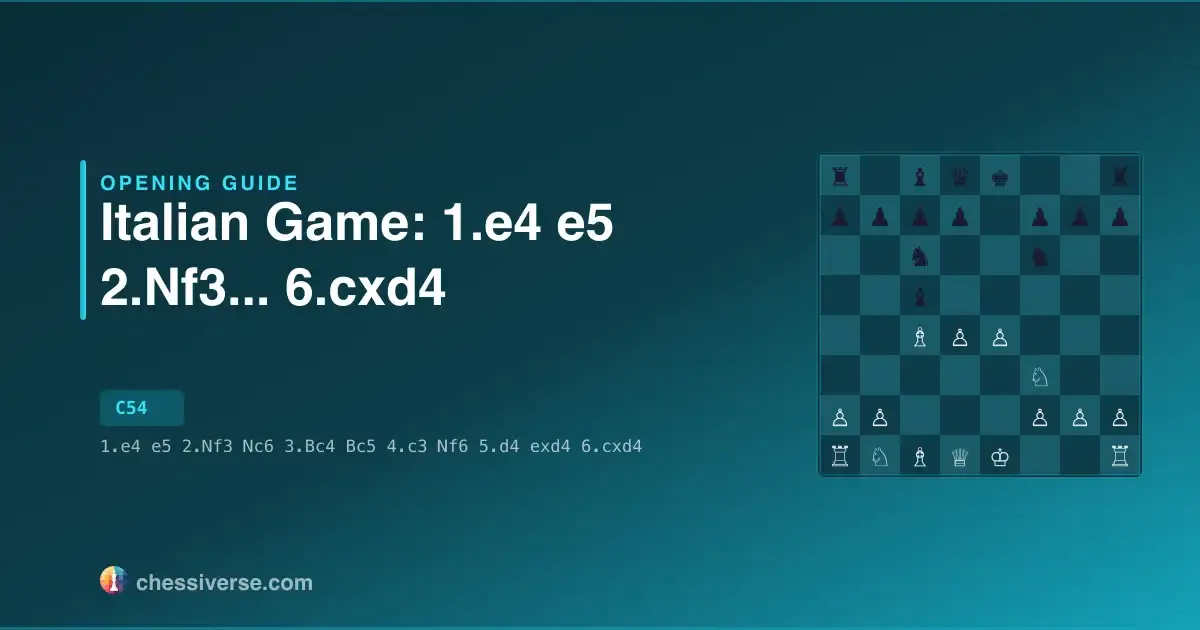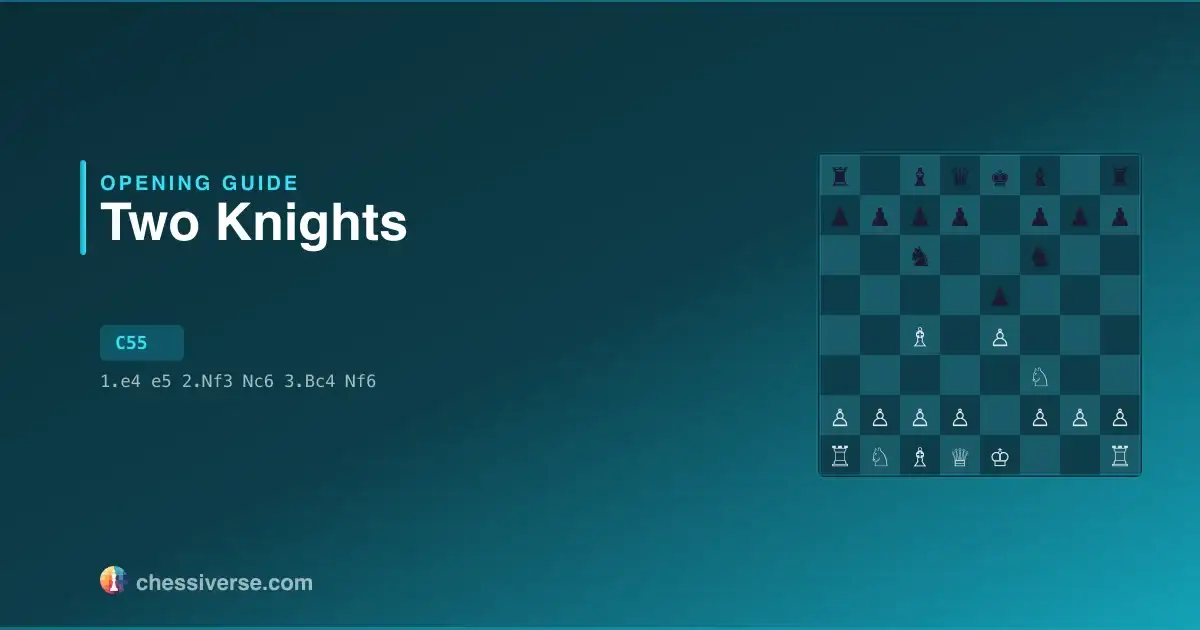


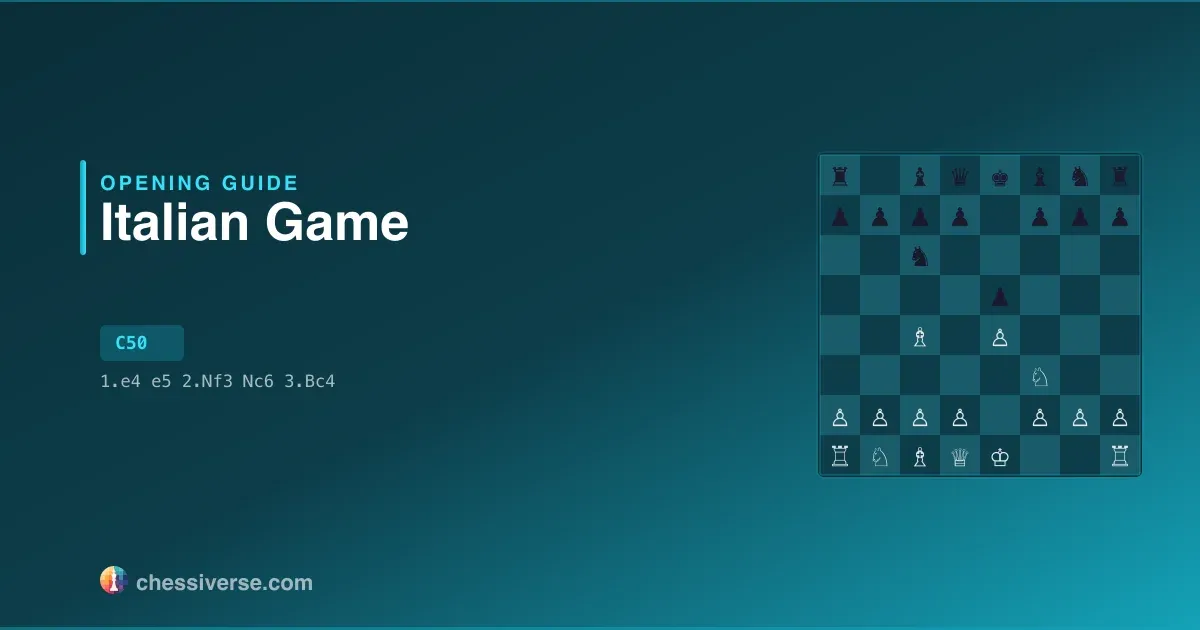
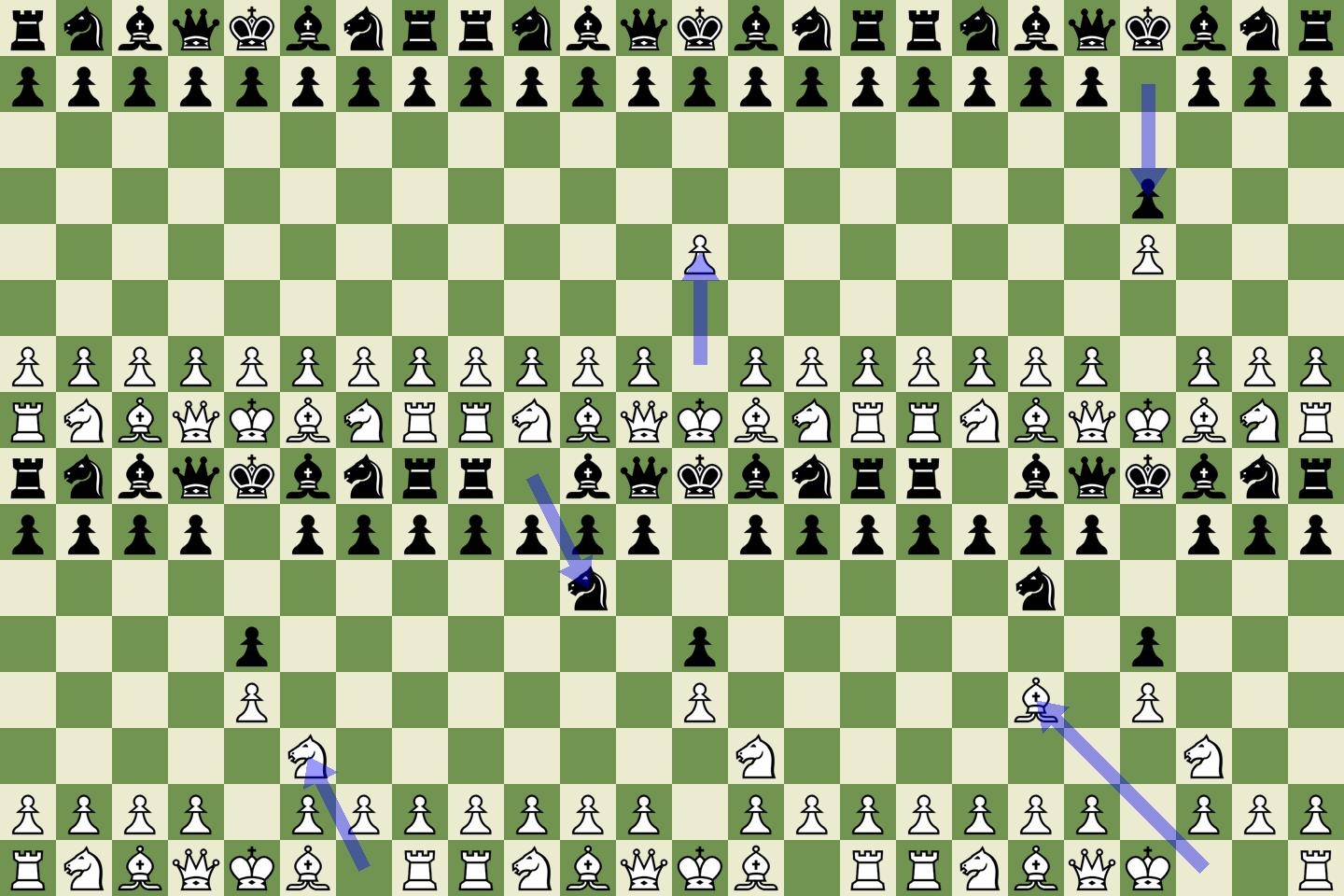
The Italian Game arises after 1.e4 e5 2.Nf3 Nc6 3.Bc4 and falls under ECO code C50. White places the bishop on an active square controlling the key d5 point and bearing down on f7, the weakest pawn in Black's position. With both kingside minor pieces developed, White is already prepared to castle and can look ahead to plans involving a quick strike at f7 or building a large centre with c3 and d4. Since there is no immediate threat, Black has some latitude in choosing a response, with the two main options being 3...Nf6 (the Two Knights Defense) or 3...Bc5 (the Giuoco Piano), a decision that hinges on whether Black wants to maintain or release control of the g5 square. The Two Knights Defense develops a piece while putting pressure on e4. Defending with 4. Nc3 runs into the centre fork trick (4...Nxe4 5. Nxe4 d5 6. Bd3 dxe4 7. Bxe4), so White more often plays 4. d3, which can transpose into the Giuoco Pianissimo, or the sharp 4. Ng5, targeting f7 and potentially leading to the aggressive Fried Liver sacrifice. The Two Knights Defense is known for producing tactical, sharp positions. With 233 million Lichess games across all rating levels, it is a well-established opening choice.
- White puts the bishop on the active c4 square, where it aims at f7, a pawn guarded only by Black's king.
- The Giuoco Pianissimo holds the d-pawn back with d3, leading to a slower game — these lines are also known as the Slow Italian.
- Gambit options like the Evans Gambit give up a pawn for rapid development and attacking chances.
History and Notable Players
The earliest known analysis of this opening dates back to 15th or 16th century. It arises from the Open Games (1...e5). Among the most prolific practitioners on the White side are Victor Bologan (109 games), Vladislav Nevednichy (106 games), Adolf Anderssen (100 games). On the Black side, notable exponents include Aleksej Aleksandrov (92 games), Levon Aronian (87 games), William Steinitz (85 games).
Among the oldest openings on record, it appears in the Göttingen manuscript and was analysed by Greco around 1620. It was a mainstay of 19th-century attacking chess before losing ground to the Ruy Lopez in the 1880s, then returned to top-level play through the Giuoco Pianissimo lines, from the late 20th century onwards.
Notable players: Gioachino Greco, Paul Morphy, Rudolf Spielmann, Anatoly Karpov
The Evergreen Game, Adolf Anderssen's spectacular win over Jean Dufresne probably played in 1852, is perhaps the most famous Evans Gambit game — a gambit arising within the Italian Game.
Statistics
Based on 233 million Lichess games across all rating levels:
- White wins: 50.7%
- Black wins: 45.3%
- Draws: 4%
White holds a moderate edge statistically, though Black has good practical chances.
Main Lines and Variations
After 1.e4 e5 2.Nf3 Nc6 3.Bc4, the main continuations include:
Each of these lines leads to distinct types of positions and requires its own understanding of the resulting pawn structures and piece placements.
Practice on Chessiverse
The best way to learn the Italian Game is through practice. On Chessiverse, you can play chess against computer opponents that specialize in this opening. Our AI bots range from beginner to grandmaster level, each with unique playing styles — from aggressive attackers to solid defenders. Choose a bot that matches your rating and work your way up as you master the opening's key ideas.
Performance Across Rating Levels
Popularity and results vary sharply by rating level. Among 1200-rated players, it appears in 6.65% of games — 44,839,642 of them on record — with White winning 51.2% and Black 45.2%. Move up to 1800 Elo and the share shifts to 3.81%, with White winning 50% versus Black's 45.6%. At the top end (2500+ Elo), popularity is 1.74% with 9.2% draws — a clear sign of how much theory rules the line at master level. White's edge erodes by 4.1pp from 1200 to 2500 Elo, suggesting Black's counterplay is easier to find with experience.
Time Control Patterns
The Italian Game skews toward rapid chess. In bullet, it appears in 2.48% of games (65,893,025); White wins 50.7%. Blitz shows 4.45% adoption across 159,944,295 games, White scoring 50.6%. In rapid, the share rises to 6.60% — 73,056,596 games, White 51%.
Move Diversity and Theory Depth
Move choice is far from uniform in the Italian Game. At 1200 Elo (44,839,642 games), the top reply is Nf6, played 32.9% of the time. Four other moves each take at least 5% of games, and the top three moves account for 79.6% of games. Entropy: 2.50. By 2500 (237,902 games), Nf6 is still the top reply, at 47.8%; only one other move still reaches 5% and the top three moves account for 96.1% of games. Entropy drops to 1.42. The narrowing is significant — strong players consolidate around a small set of best moves, while amateurs scatter across many plausible-looking options.
Historical Trends
Tracking the Italian Game year over year shows a clear story. Adoption peaked in 2023 at 5.20% (41,229,705 games). By 2025 it sits at 4.95%, 5% below the peak but still 26% above its 2013 level, so the line is up over the full period despite easing from the high.