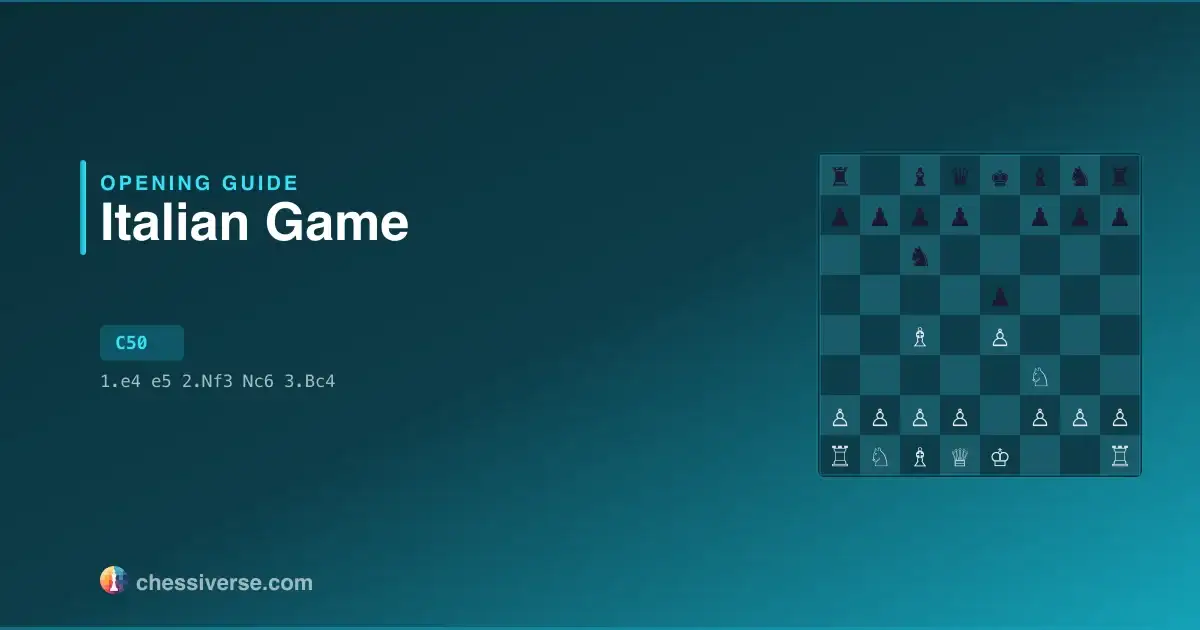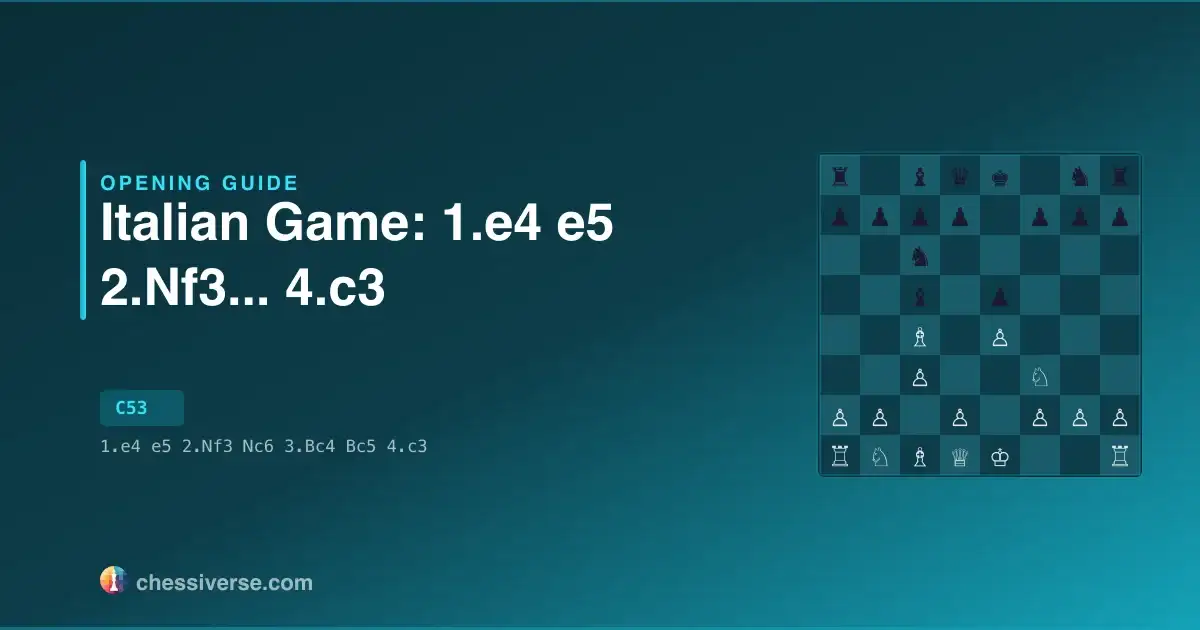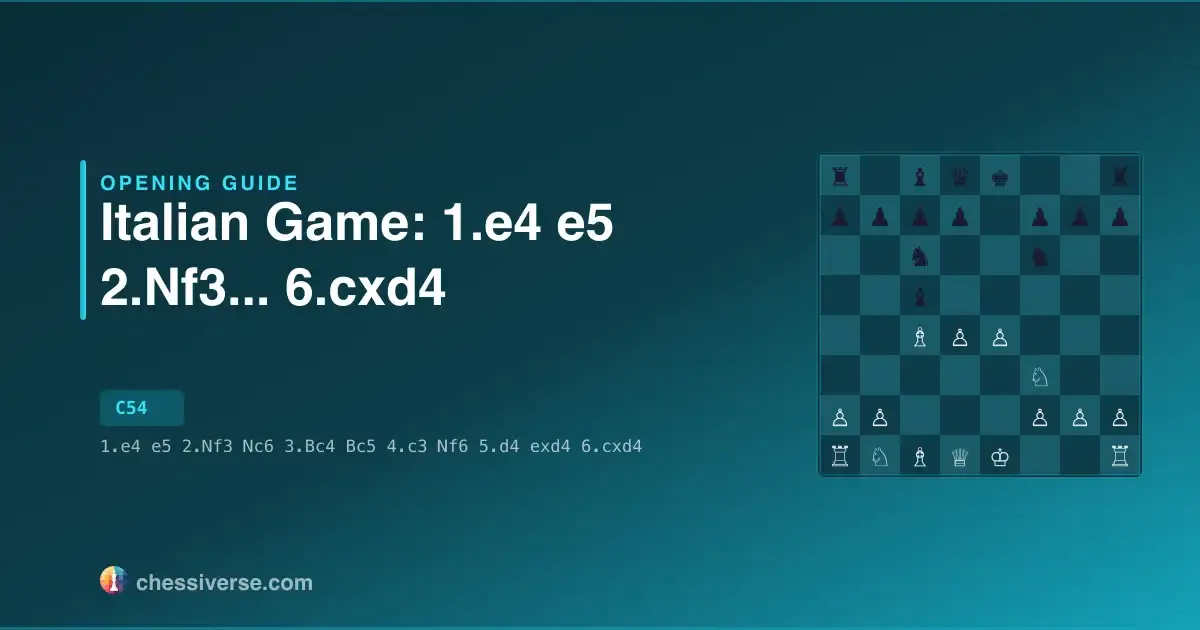




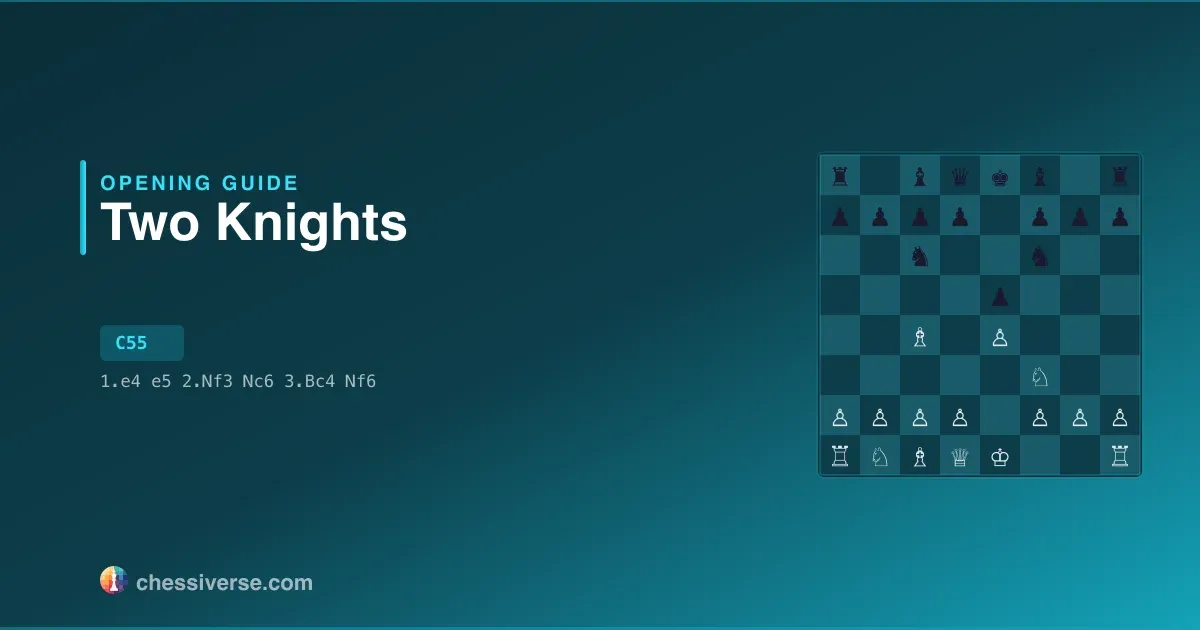
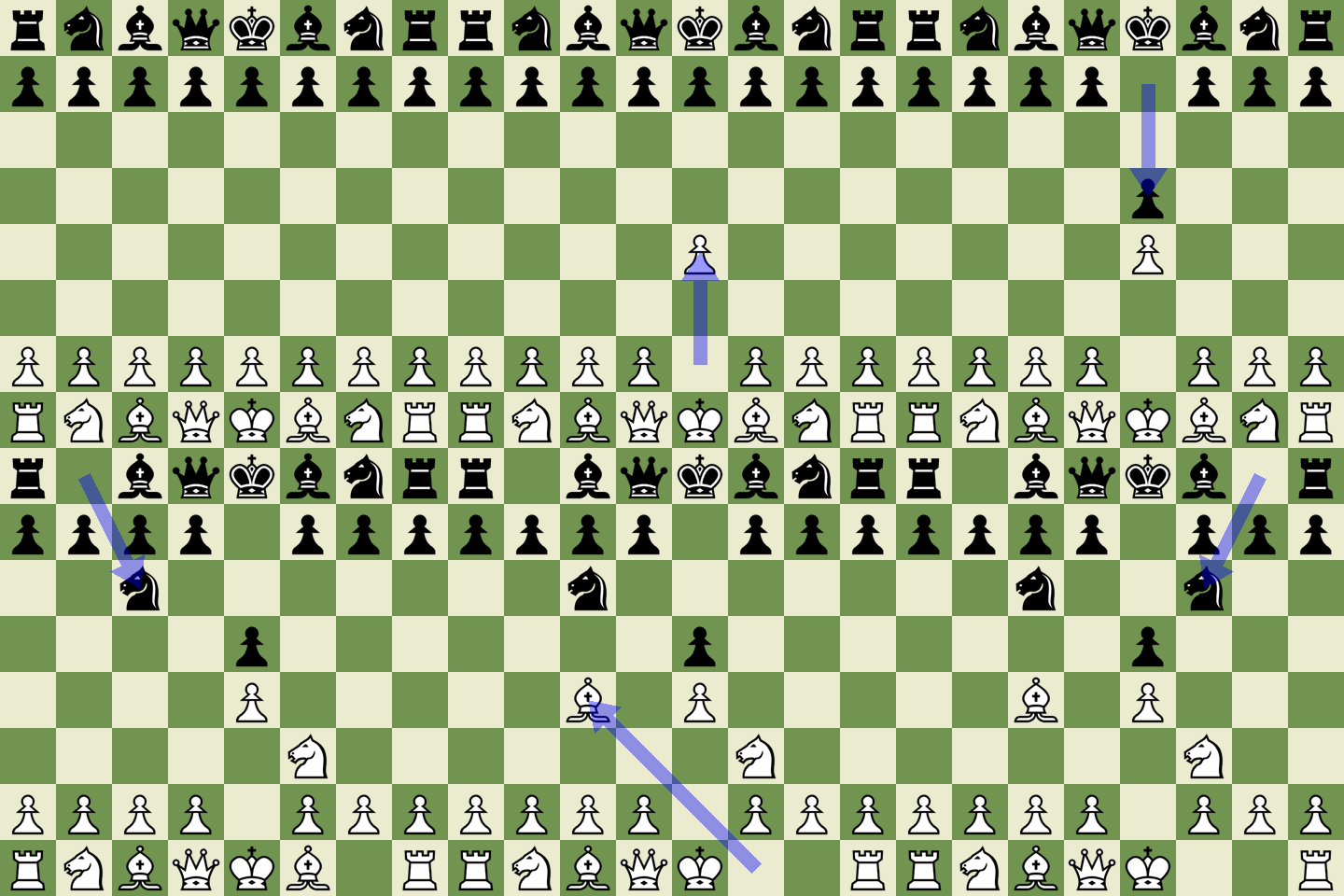
The Italian Game: Two Knights Defense arises after 1.e4 e5 2.Nf3 Nc6 3.Bc4 Nf6 and falls under ECO code C55. Black develops the knight while putting immediate pressure on the e4 pawn, moving one step closer to castling. Although this appears to be the most natural move in the Italian, it does come with the drawback of blocking the queen's access to the d8-h4 diagonal. White can respond in several ways: defend the e-pawn (typically with 4. d3), launch an aggressive attack on f7 with 4. Ng5, or sacrifice the pawn to open the centre for a rapid assault. Since e4 is under attack, defending it is the most straightforward option. The most common choice is 4. d3, which protects the pawn and opens the c1-h6 diagonal for the dark-squared bishop, a setup known as the Modern Bishop's Opening. After 4...Bc5 the game transposes into the Giuoco Pianissimo, while 4...Be7 leads to quieter, Ruy Lopez-style development. With 82.1 million Lichess games across all rating levels, it is a well-established opening choice.
- Against 4.Ng5, Black gives up a pawn with 4...d5 and 5...Na5 to grab a big lead in development and lasting initiative
- Play is sharp and tactical from move four - Black counterattacks instead of defending quietly
- The wild Traxler Counterattack 4...Bc5 simply ignores the threat to f7 and invites chaos
History and Notable Players
It arises from the Italian Game. Among the most prolific practitioners on the White side are Vladislav Nevednichy (56 games), Sergey Kudrin (44 games), Victor Bologan (42 games). On the Black side, notable exponents include Mark L Hebden (58 games), Jonny Hector (42 games), Vladimir P Malaniuk (42 games).
First recorded by Giulio Cesare Polerio around 1580, the opening was worked out in depth in the 19th century by Mikhail Chigorin, who showed Black gets real compensation for the pawn in the main line. Alexander Morozevich and Nigel Short led a revival of the sharp 4.Ng5 lines in the 1990s.
Named after: David Bronstein argued the word 'defense' misses the opening's true character and proposed 'Chigorin Counterattack' as a better name.
Notable players: Mikhail Chigorin, Mikhail Tal, Boris Spassky, Paul Keres
Siegbert Tarrasch famously sneered at 4.Ng5 as 'a duffer's move'; Classical-school players objected that it shifted one piece a second time and attacked before White had finished developing.
Statistics
Based on 82.1 million Lichess games across all rating levels:
- White wins: 51.5%
- Black wins: 44.7%
- Draws: 3.8%
White holds a moderate edge statistically, though Black has good practical chances.
Main Lines and Variations
After 1.e4 e5 2.Nf3 Nc6 3.Bc4 Nf6, the main continuations include:
Each of these lines leads to distinct types of positions and requires its own understanding of the resulting pawn structures and piece placements.
Practice on Chessiverse
The best way to learn the Italian Game: Two Knights Defense is through practice. On Chessiverse, you can play chess against computer opponents that specialize in this opening. Our AI bots range from beginner to grandmaster level, each with unique playing styles — from aggressive attackers to solid defenders. Choose a bot that matches your rating and work your way up as you master the opening's key ideas.
Performance Across Rating Levels
How well the Italian Game: Two Knights Defense works depends on what level you're playing at. The 1200 bracket has 16,031,427 games (2.38% of all games at that level); White wins 52.8%, Black 43.8%, 3.4% are drawn. At 1800 the opening surfaces in 1.29% of games; White wins 49.3%, Black 46.4%, draws 4.2%. Among 2500-rated players the line appears in 0.84% of games and draws spike to 8.7%, indicating tight preparation. White's edge erodes by 5.6pp from 1200 to 2500 Elo, suggesting Black's counterplay is easier to find with experience.
Time Control Patterns
Time control matters here: rapid players reach for this opening more than others. In bullet, it appears in 1.04% of games (27,560,468); White wins 51.4%. Blitz shows 1.58% adoption across 56,700,074 games, White scoring 51.3%. In rapid, the share rises to 2.29% — 25,367,879 games, White 51.9%.
Move Diversity and Theory Depth
Move choice is far from uniform in the Italian Game: Two Knights Defense. At 1200 Elo (16,031,427 games), the top reply is Ng5, played 36% of the time. Four other moves each take at least 5% of games, and the top three moves account for 83% of games. Entropy: 2.29. By 2500 (114,345 games), d3 takes over as the top reply at 64.3%; only two other moves still reach 5% and the top three moves account for 93.5% of games. Entropy drops to 1.52. The narrowing is significant — strong players consolidate around a small set of best moves, while amateurs scatter across many plausible-looking options.
Historical Trends
Long-term, the trajectory of this opening is informative. Adoption peaked in 2023 at 1.81% (14,399,725 games). By 2025 it sits at 1.77%, 2% below the peak but still 44% above its 2013 level, so the line is up over the full period despite easing from the high.