

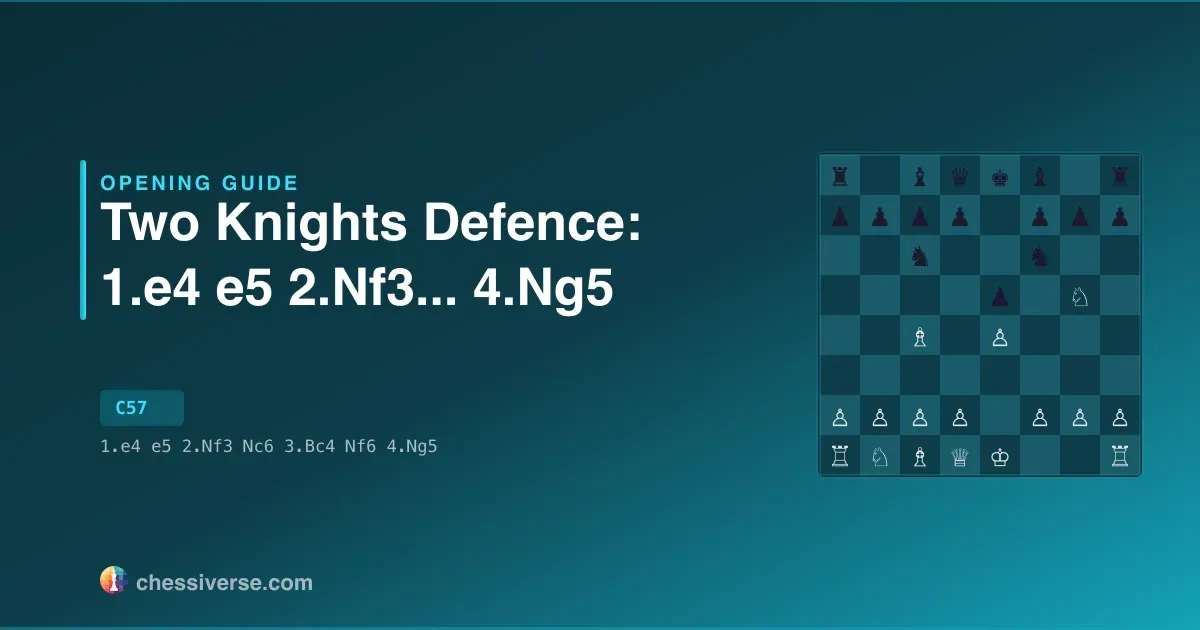
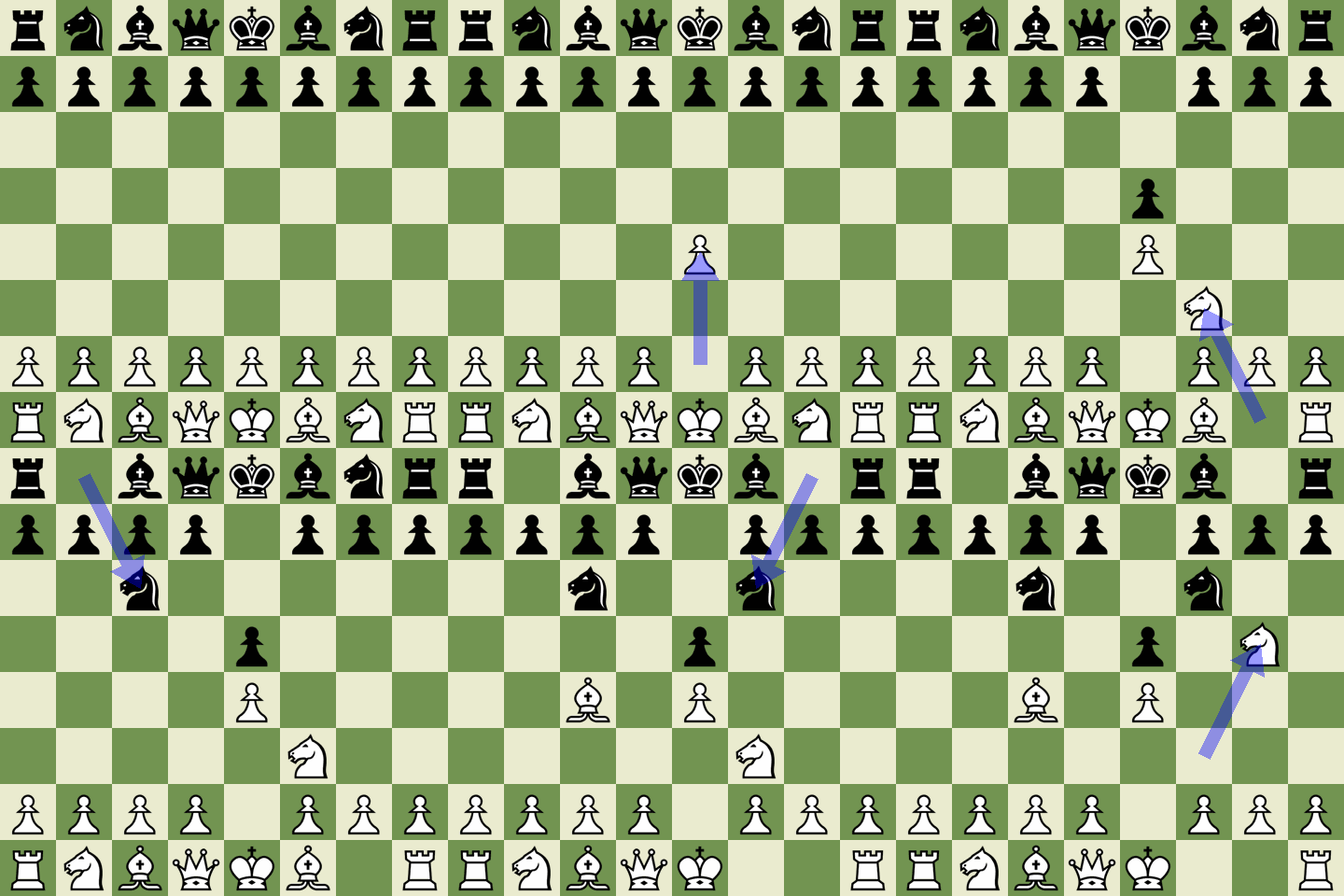
Starting from 1.e4 e5 2.Nf3 Nc6 3.Bc4 Nf6 4.Ng5, players enter the Italian Game: Two Knights Defense, Knight Attack — ECO C57. Four moves in and White's already lunging at f7 with a developed piece. It violates every opening rule you ever learned, and Black still has to know exactly what to do or the game is over by move 10.
Strategic Overview
Ng5 is the loud option in the Two Knights. The bishop on c4 and the knight on g5 both stare at f7, Black hasn't castled, and the immediate question is whether the threat is real. With best play it isn't, but "best play" here is a forced theoretical sequence that punishes any sloppy reaction. The natural-looking 4...h6?? simply loses material to 5.Nxf7, and 4...Nxe4? falls to 5.Bxf7+!. The principled answer is 4...d5, hitting the bishop and refusing to defend f7 passively. After 5.exd5 Black is a pawn down for the moment but the bishop on c4 is loose and Black's pieces want to attack it. From here the lines split sharply: the modern main line keeps Black sound with active piece play, while ...Nxd5?! invites White straight into the Fried Liver and Lolli sacrifices. The whole variation is a stress test of opening principles versus concrete tactics, and at club level it scores well precisely because most defenders haven't memorised the exact path through.
Key Ideas
A few ideas come up again and again in this opening:
- f7 is the only target that matters — Every White piece is pointed at f7 and Black's king is still in the centre. Any move that doesn't address that square gets refuted by a forced sequence, which is why 4...h6 and 4...Nxe4 both lose on the spot.
- 4...d5 is the principled break — Instead of defending f7, Black counter-strikes the centre and hits the c4-bishop. White wins a pawn with 5.exd5 but the bishop becomes the new target and Black gets the initiative in return.
- 5...Na5 hits the bishop and forces a long sequence — The Polerio is the modern main line. After 6.Bb5+ c6 7.dxc6 bxc6 8.Bd3 Black is a pawn down but has the bishop pair, open lines, and active development. Engines call it equal.
- 5...Nxd5?! walks into the Fried Liver — Recapturing with the knight looks natural and is the most popular reply in club play. It hands White 6.Nxf7 (the Fried Liver) or 6.d4 (the Lolli), both crushing if Black doesn't know the defence.
- Traxler 4...Bc5 is bluff over substance — The counter-sacrifice is glorious to play and objectively dubious. White declines with 5.Bxf7+ and pockets a clean pawn; only 5.Nxf7? falls into Black's prep.
History and Notable Players
It arises from the Italian Game: Two Knights Defense. Among the most prolific White practitioners are Enrico Paoli (34 games), Hagen Poetsch (17 games), Nigel D Short (13 games). Black-side regulars include Jiri Jirka (13 games), Arthur Bernard Bisguier (12 games), Alexander G Beliavsky (12 games).
Performance Across Rating Levels
How well the Italian Game: Two Knights Defense, Knight Attack works depends on what level you're playing at. Among 1200-rated players, it appears in 0.85% of games — 5,757,078 of them on record — with White winning 55.6% and Black 41.5%. By 1800, popularity is 0.36% and White's score is 49.4% to Black's 47%. Among 2500-rated players the line appears in 0.18% of games and draws spike to 7.2%, indicating tight preparation. White's edge erodes by 6.1pp from 1200 to 2500 Elo, suggesting Black's counterplay is easier to find with experience.
Time Control Patterns
Time control matters here: rapid players reach for this opening more than others. In bullet, it appears in 0.32% of games (8,604,186); White wins 52.6%. Blitz shows 0.50% adoption across 17,825,679 games, White scoring 53.2%. In rapid, the share rises to 0.81% — 8,937,476 games, White 54.5%.
Move Diversity and Theory Depth
Move choice is far from uniform in the Italian Game: Two Knights Defense, Knight Attack. At 1200 Elo (5,757,078 games), the top reply is d5, played 74.6% of the time. One other move takes at least 5% of games, and the top three moves account for 90.5% of games. Entropy: 1.43. By 2500 (24,131 games), d5 dominates at 93.4% of replies; one other move reaches 5% and the top three moves account for 99.6% of games. Entropy drops to 0.42. That entropy collapse is the signature of a line where preparation pays off: at the top, players know the best move and play it.
Historical Trends
Tracking the Italian Game: Two Knights Defense, Knight Attack year over year shows a clear story. Adoption peaked in 2021 at 0.61% (4,673,302 games). By 2025 it sits at 0.53%, 13% below the peak but still 15% above its 2013 level, so the line is up over the full period despite easing from the high.
Main Lines and Variations
After 1.e4 e5 2.Nf3 Nc6 3.Bc4 Nf6 4.Ng5, the established follow-ups are:
Each branch leads to a different middlegame character — the resulting pawn structure decides what kind of game you get.
Common Mistakes
- Drifting away from main theory — At 400 Elo, the three most-played moves cover 77% of games, against 99.3% at 2000. The most popular deviation is Qe7 (played 13.7% of the time at 400, much less so up top). It looks fine but quietly hands the better-prepared side an edge.
- Neglecting development — It can feel productive to make extra pawn moves early, but falling behind in piece development is what loses most amateur games — especially in open positions where active pieces find squares fast.
- Playing without a plan — Each Italian Game: Two Knights Defense, Knight Attack middlegame demands a specific approach. Decide whether the position calls for attack, manoeuvre, or simplification before reaching for a move.
Practice on Chessiverse
Ready to try the Italian Game: Two Knights Defense, Knight Attack against a bot? Pick an opponent at your level and play a game.