



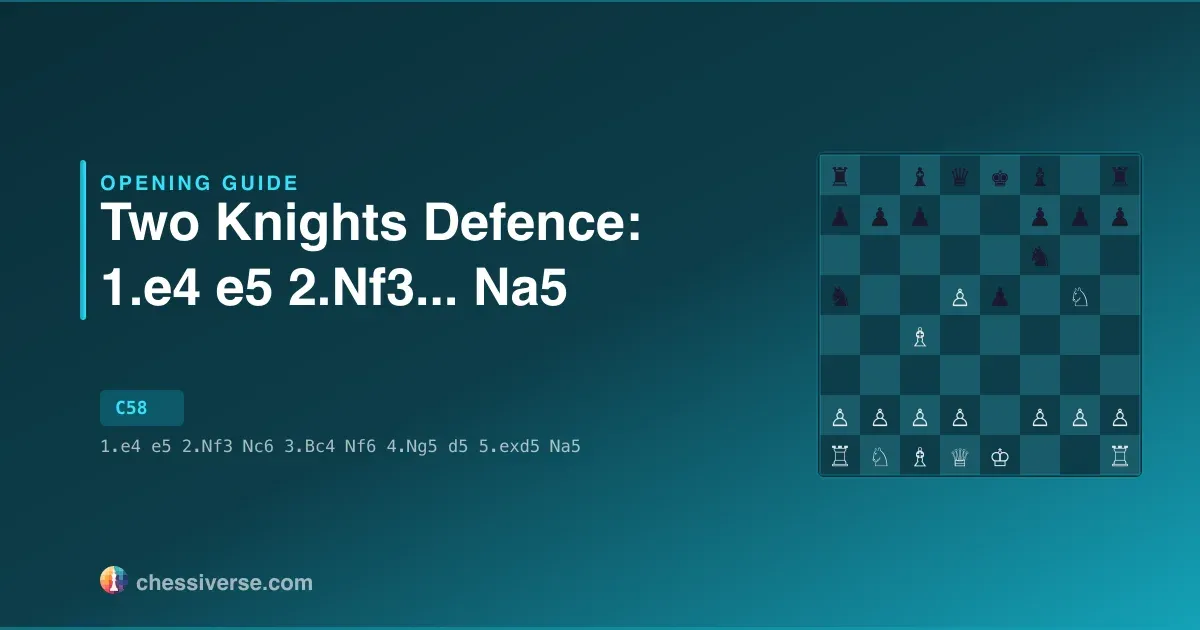
Starting from 1.e4 e5 2.Nf3 Nc6 3.Bc4 Nf6 4.Ng5 d5 5.exd5 Na5, players enter the Italian Game: Two Knights Defense, Polerio Defense — ECO C58. The knight goes to the rim, the bishop is forced to retreat, and Black is happy to be a pawn down. This is the Polerio, the modern main line for surviving Ng5 and getting active play in return.
Strategic Overview
5...Na5 is Black's most respected answer to the Ng5 attack. Instead of meekly recapturing on d5 and inviting the Fried Liver, Black ignores the pawn, hits the c4-bishop, and forces White to make a concrete decision about where it goes. The bishop usually drops back to b5 with check, and after a long forcing sequence Black ends up with the bishop pair, open queenside files, and very active piece play in exchange for the gambited pawn. White's structure is fine but the development lead is gone and the king on e1 isn't where it wants to be. The middlegame plays itself around Black's lead in mobilisation and the weakness of White's queenside light squares. Anyone playing the Two Knights with Black needs to know this line cold, because it's the difference between equality with chances and being a sad pawn down for nothing. Theory is deep but the moves make sense: chase the bishop, get the pieces out, and pile pressure on White's king before they consolidate the extra pawn.
Key Ideas
When players succeed in this line, they usually do so by leaning on the following themes:
- The knight attacks the bishop, not the centre — 5...Na5 looks anti-positional because the knight heads to the edge, but its job is to harass the c4-bishop and disrupt White's coordination. The pawn deficit is temporary compensation; the development lead is the point.
- Black plays for activity, not material — Black is comfortable staying a pawn down for several moves while finishing development. White's extra pawn on d5 is hard to defend long-term, and Black's bishop pair plus open lines usually balance the material.
- White's king is the long-term weakness — After the bishop dance, White often has to delay castling and resort to awkward moves like Bd3. Black's pressure on the e-file and the diagonal toward h1 keeps the initiative alive even when the position looks calm.
History and Notable Players
It arises from the Italian Game: Two Knights Defense, Knight Attack. Among the most prolific White practitioners are Enrico Paoli (22 games), Hagen Poetsch (16 games), Nigel D Short (12 games). Black-side regulars include Mikhail Chigorin (11 games), Arthur Bernard Bisguier (10 games), Alexander G Beliavsky (10 games).
Performance Across Rating Levels
Popularity and results vary sharply by rating level. At 1200 Elo, the opening shows up in 0.15% of games (1,034,431 samples). White scores 45.5%, Black 51.4%, draws 3.1%. By 1800, popularity is 0.17% and White's score is 47.8% to Black's 48.3%. Among 2500-rated players the line appears in 0.13% of games and draws spike to 7.3%, indicating tight preparation. White's score improves by 3.8pp from the 1200 bracket to the 2500 bracket — the line rewards preparation.
Time Control Patterns
Time control matters here: rapid players reach for this opening more than others. In bullet, it appears in 0.11% of games (2,867,729); White wins 48%. Blitz shows 0.15% adoption across 5,490,179 games, White scoring 47.4%. In rapid, the share rises to 0.18% — 2,012,001 games, White 45%. White's score swings 3.0pp across formats, so time control isn't just a stylistic choice here — it shifts the actual results.
Move Diversity and Theory Depth
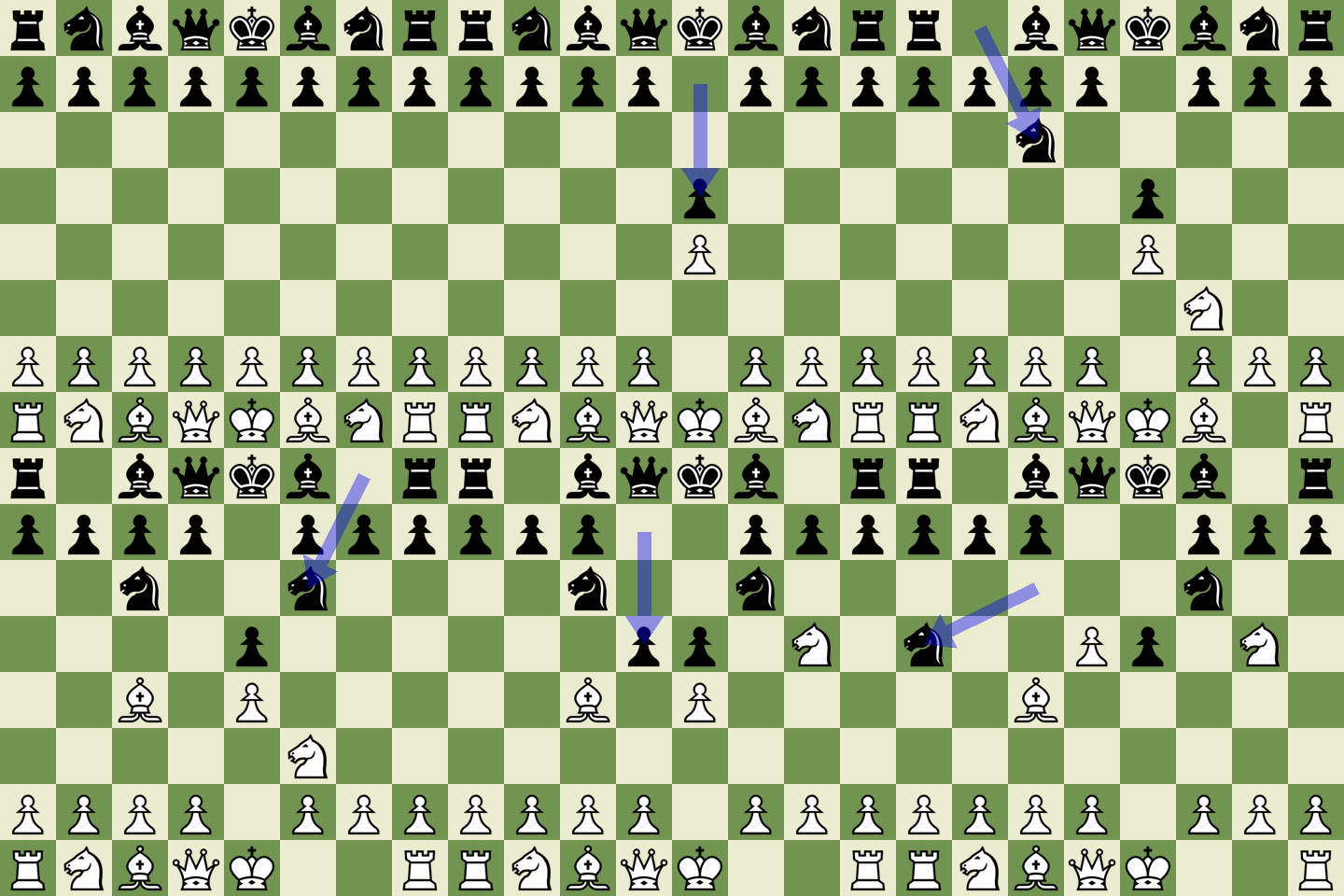
Looking at move selection shows how forcing — or not — the position really is. At 1200 Elo (1,034,431 games), the top reply is Bb5+, played 59.5% of the time. Three other moves each take at least 5% of games, and the top three moves account for 78.8% of games. Entropy: 2.12. By 2500 (18,400 games), Bb5+ dominates at 89.5% of replies; only one other move still reaches 5% and the top three moves account for 99.6% of games. Entropy drops to 0.54. That entropy collapse is the signature of a line where preparation pays off: at the top, players know the best move and play it.
Historical Trends
Year-over-year data tells you whether this opening is a contemporary fixture or a fading one. Adoption peaked in 2017 at 0.18% (200,307 games). By 2025 it sits at 0.15%, 13% below the peak but still 26% above its 2013 level, so the line is up over the full period despite easing from the high.
Main Lines and Variations
The main branches off 1.e4 e5 2.Nf3 Nc6 3.Bc4 Nf6 4.Ng5 d5 5.exd5 Na5 include:
Each branch leads to a different middlegame character — the resulting pawn structure decides what kind of game you get.
Common Mistakes
- Drifting away from main theory — At 400 Elo, the three most-played moves cover 69.1% of games, against 98.1% at 2000. The most popular deviation is Bb3 (played 11.5% of the time at 400, much less so up top). It looks fine but quietly hands the better-prepared side an edge.
- Neglecting development — It can feel productive to make extra pawn moves early, but falling behind in piece development is what loses most amateur games — especially in open positions where active pieces find squares fast.
- Playing without a plan — Each Italian Game: Two Knights Defense, Polerio Defense middlegame demands a specific approach. Decide whether the position calls for attack, manoeuvre, or simplification before reaching for a move.
Practice on Chessiverse
Ready to try the Italian Game: Two Knights Defense, Polerio Defense against a bot? Pick an opponent at your level and play a game.