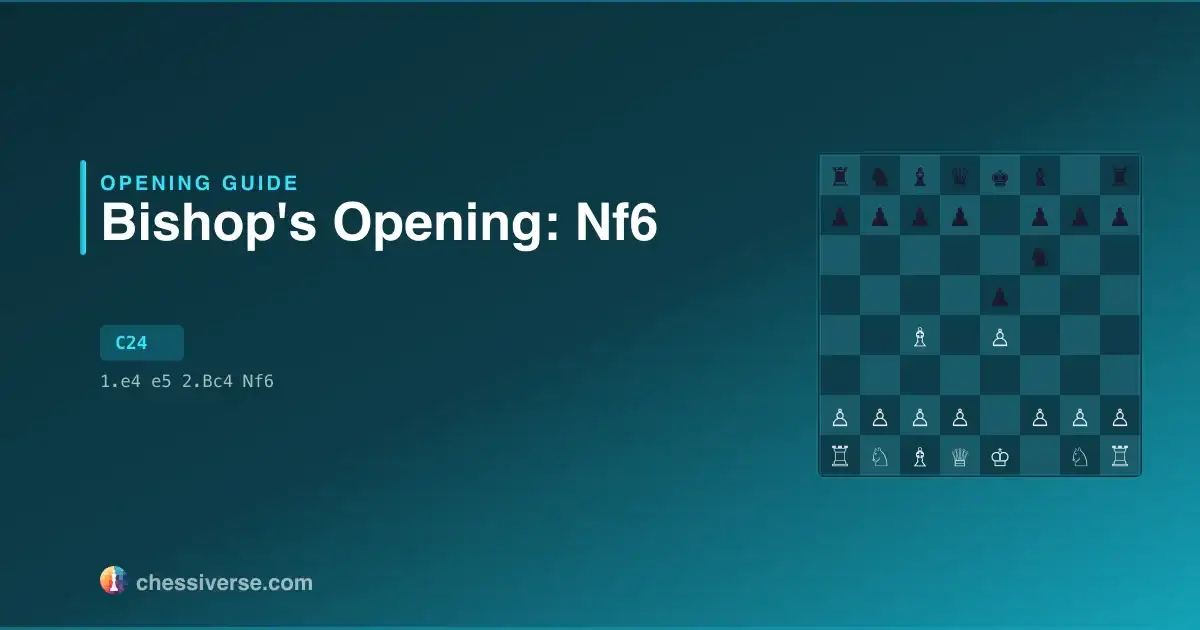


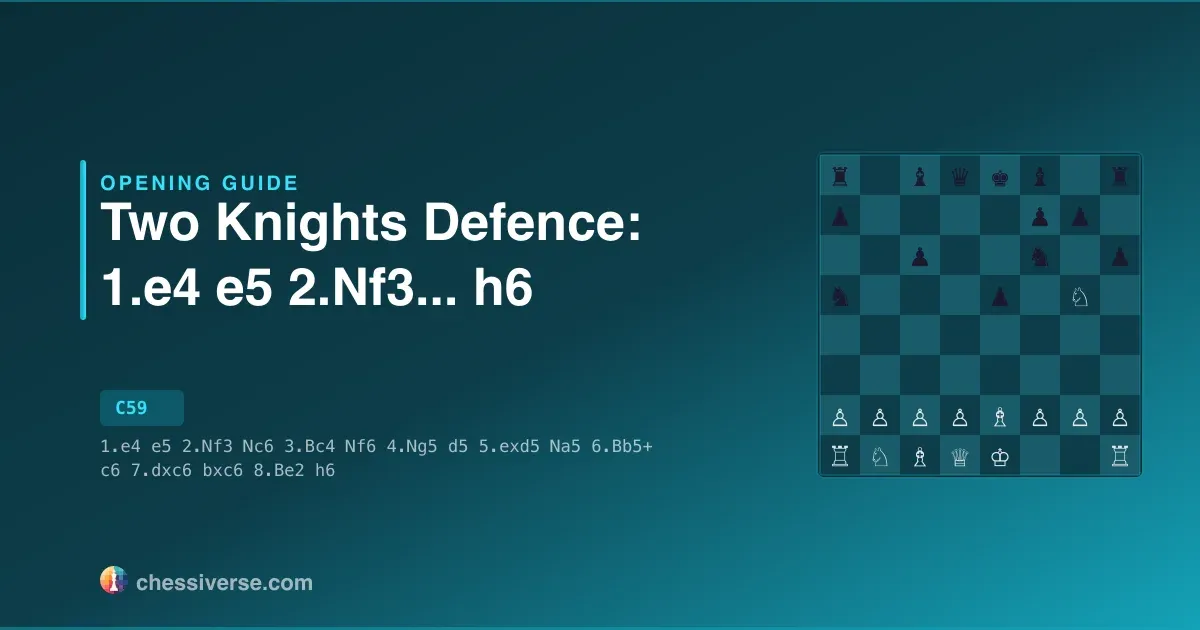
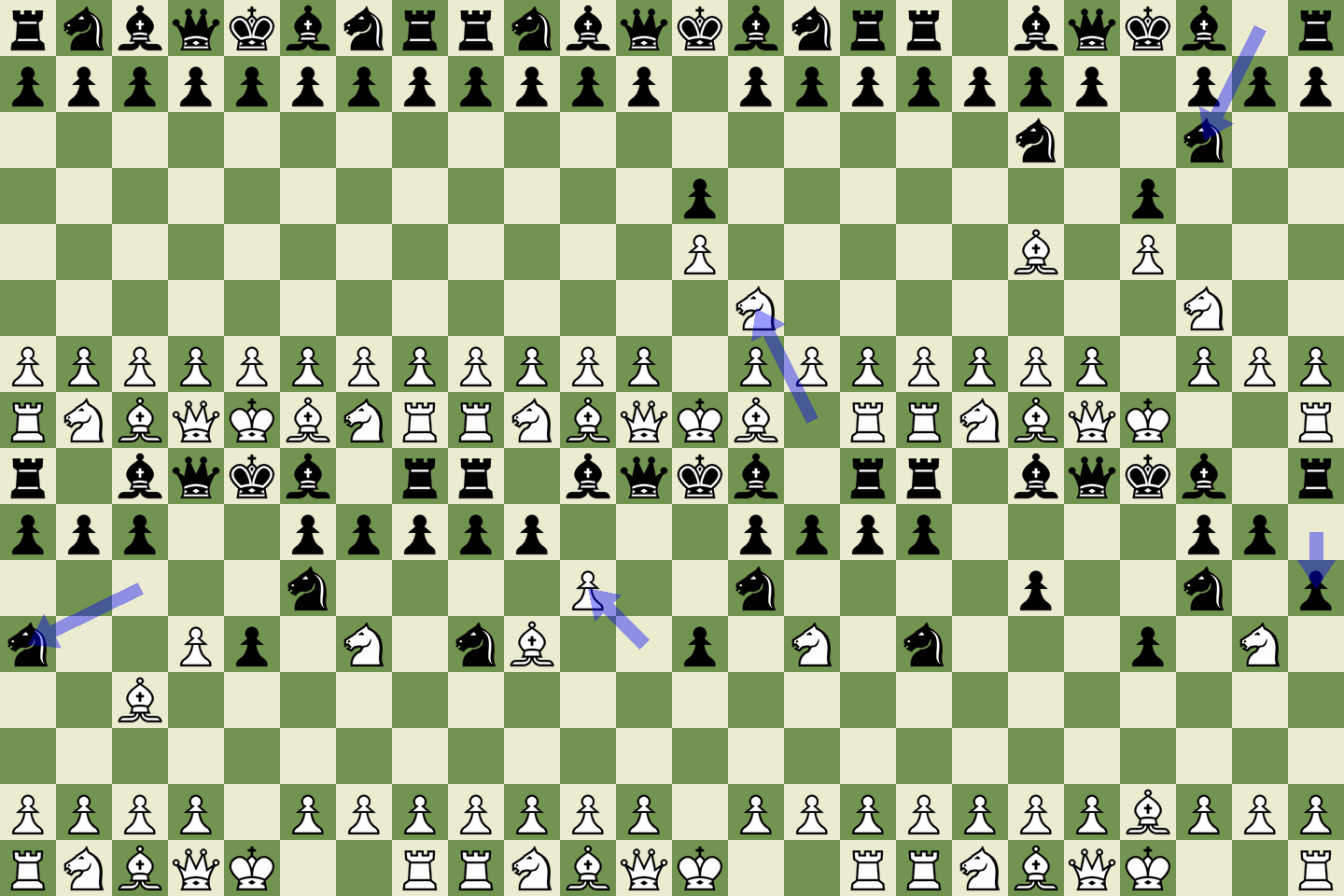
The Italian Game: Two Knights Defense, Polerio Defense, Suhle Defense begins with 1.e4 e5 2.Nf3 Nc6 3.Bc4 Nf6 4.Ng5 d5 5.exd5 Na5 6.Bb5+ c6 7.dxc6 bxc6 8.Be2 h6 (ECO C59). Across rating levels it shows up in 528,087 recorded games — enough data to map exactly where it succeeds and where it stalls.
History and Notable Players
It arises from the Italian Game: Two Knights Defense, Polerio Defense. On the White side, Boris Taborov (7 games), Graham D Lee (7 games), Georgy Timoshenko (7 games) top the database. Notable Black exponents: Efim Geller (8 games), Yuri Kruppa (7 games), Mikhail Chigorin (6 games).
Performance Across Rating Levels
How well the Italian Game: Two Knights Defense, Polerio Defense, Suhle Defense works depends on what level you're playing at. Among 1200-rated players, it appears in 0.00% of games — 20,126 of them on record — with White winning 42.6% and Black 53.9%. At 1800 the opening surfaces in 0.02% of games; White wins 45.7%, Black 50.2%, draws 4.1%. At 2500, 0.01% of games go into this opening; draws sit at 7.8% — the line is well-mapped at this level. White's score improves by 4.1pp from the 1200 bracket to the 2500 bracket — the line rewards preparation.
Time Control Patterns
Look at the same opening across time controls and blitz stands out. In bullet, it appears in 0.01% of games (193,429); White wins 48.3%. Blitz shows 0.01% adoption across 406,947 games, White scoring 45.8%. In rapid, the share rises to 0.01% — 121,140 games, White 42.5%. White's score swings 5.8pp across formats, so time control isn't just a stylistic choice here — it shifts the actual results.
Move Diversity and Theory Depth
What players actually play after the opening moves depends heavily on rating. At 1200 Elo (20,126 games), the top reply is Nf3, played 87.9% of the time. One other move takes at least 5% of games, and the top three moves account for 97.7% of games. Entropy: 0.74. By 2500 (1,579 games), Nh3 takes over as the top reply at 54.6%; one other move reaches 5% and the top three moves account for 99.9% of games. Entropy rises to 1.01.
Historical Trends
Year-over-year data tells you whether this opening is a contemporary fixture or a fading one. Adoption peaked in 2015 at 0.02% (4,624 games). By 2025 it sits at 0.01%, 57% below the peak and 24% under its 2013 level, leaving the line in decline.
Common Mistakes
- Neglecting development — Extra pawn moves in the opening are tempting, especially when you "know the moves". Developing a piece each turn is the simple correction.
- Playing without a plan — Each Italian Game: Two Knights Defense, Polerio Defense, Suhle Defense middlegame demands a specific approach. Decide whether the position calls for attack, manoeuvre, or simplification before reaching for a move.
Practice on Chessiverse
Ready to try the Italian Game: Two Knights Defense, Polerio Defense, Suhle Defense against a bot? Pick an opponent at your level and play a game.