King's Pawn Game: Hungarian Defense

-14%
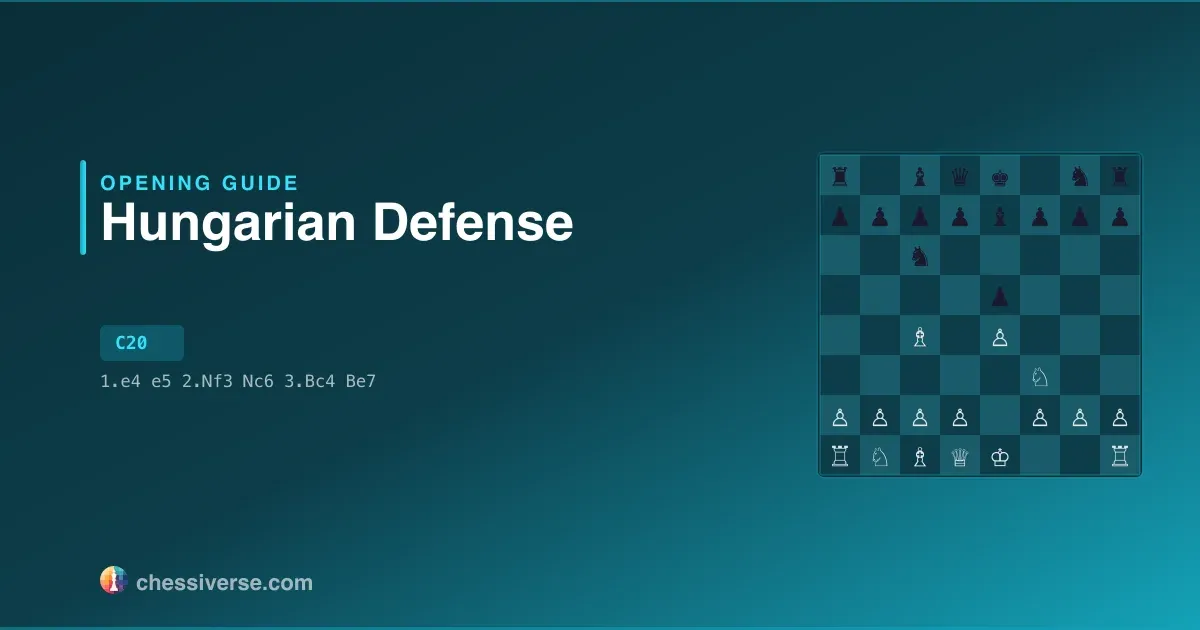
C201.e4 e5 2.Nf3 Nc6 3.Bc4 Be7
Updated Mar 27, 2026
Play this opening as...
TL;DR

The Hungarian Defence answers 3.Bc4 with the modest 3...Be7, ducking out of the Two Knights, Italian Game, and Evans Gambit theory. Black accepts a quiet, slightly cramped position with the plan of d6, Nf6, and slow development. A reliable equalising weapon against the Italian.

Reviewed by

IM John Bartholomew
IM John BartholomewCo-Founder & Chess Educator

International Master and chess educator. Co-founded Chessable and joined Chessiverse as co-founder. Best known for his "Climbing the Rating Ladder" YouTube series and structured opening courses.

King's Pawn Game: Hungarian Defense: A Complete Guide
King's Pawn Game: Hungarian Defense - Opening Moves
Summary

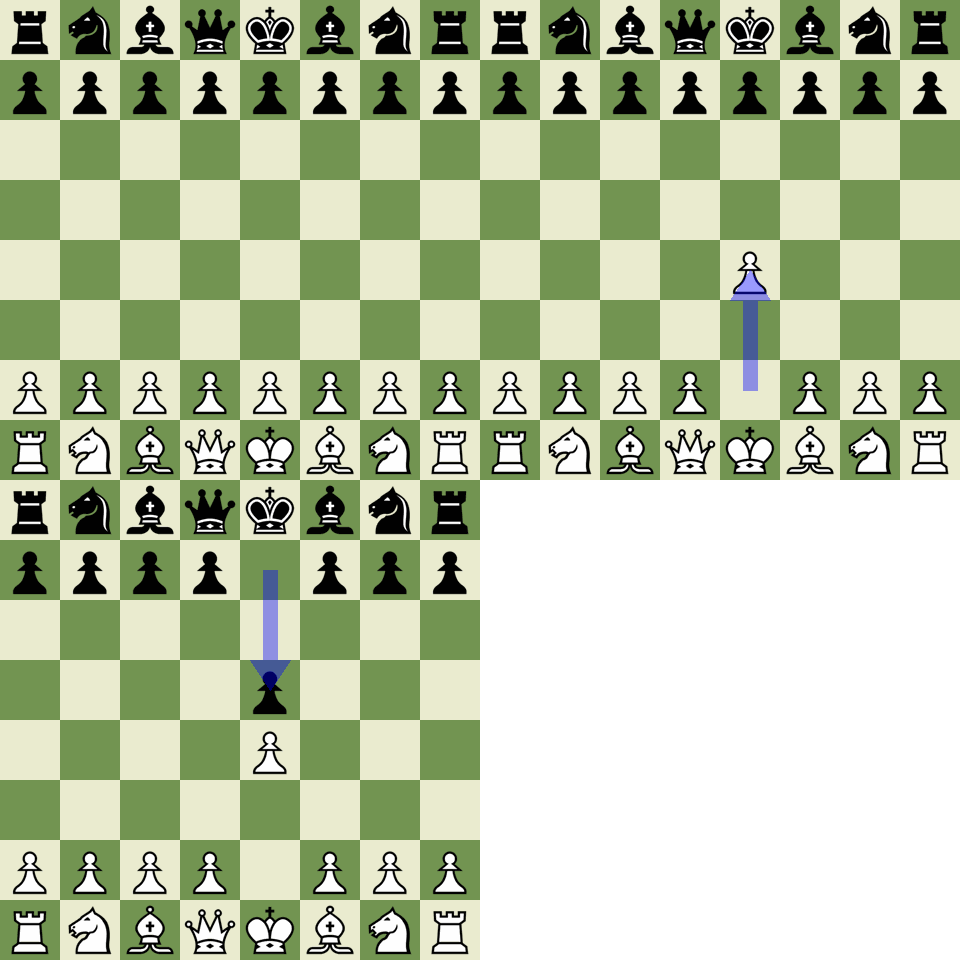
The King's Pawn Game: Hungarian Defense arises after 1.e4 e5 and falls under ECO code C20. The reply 1...e5 defines the Open Game (also called the Double King's Pawn), and it remains Black's most classical answer to 1.e4. By matching White's central pawn, Black secures an equal foothold in the center and opens lines for piece development. Importantly, 1...e5 is one of the few responses that directly prevents White from easily achieving d4. The drawback, however, is that symmetry favors the player with the move — so the longer the position stays mirrored, the more White benefits from having the initiative. Although 1...e5 experienced a slight dip in popularity during the 20th century, it remains common at all levels. Because the e5 pawn is undefended, White can develop in ways that threaten to capture it, keeping the initiative by forcing Black to respond defensively. White may also choose a quieter path that develops without immediately pressuring e5. With 1314.2 million Lichess games across all rating levels, it is one of the most popular openings.

History and Notable Players

The earliest known analysis of this opening dates back to 18th century. It arises from the Italian Game. Among the most prolific practitioners on the White side are Viswanathan Anand (627 games), Sergey Karjakin (439 games), Alexei Shirov (429 games). On the Black side, notable exponents include Ivan Sokolov (531 games), Levon Aronian (499 games), Aleksej Aleksandrov (471 games).

Statistics

Based on 7.7 million Lichess games across all rating levels:

  • White wins: 48.1%
  • Black wins: 47.2%
  • Draws: 4.6%

The statistics show a roughly balanced opening where both sides have equal chances.

Practice on Chessiverse

The best way to learn the King's Pawn Game: Hungarian Defense is through practice. On Chessiverse, you can play chess against computer opponents that specialize in this opening. Our AI bots range from beginner to grandmaster level, each with unique playing styles — from aggressive attackers to solid defenders. Choose a bot that matches your rating and work your way up as you master the opening's key ideas.

Performance Across Rating Levels

Popularity and results vary sharply by rating level. The 1200 bracket has 680,936 games (0.10% of all games at that level); White wins 47.3%, Black 49%, 3.7% are drawn. Move up to 1800 Elo and the share shifts to 0.24%, with White winning 48.7% versus Black's 46.3%. At the top end (2500+ Elo), popularity is 0.04% with 11% draws — a clear sign of how much theory rules the line at master level. White's score improves by 3.6pp from the 1200 bracket to the 2500 bracket — the line rewards preparation.

Time Control Patterns

Look at the same opening across time controls and rapid stands out. In bullet, it appears in 16.12% of games (428,583,498); White wins 51.2%. Blitz shows 25.61% adoption across 920,743,069 games, White scoring 50.9%. In rapid, the share rises to 35.56% — 393,441,672 games, White 51%.

Move Diversity and Theory Depth

What players actually play after the opening moves depends heavily on rating. At 1200 Elo, the top reply is Nf3, played 63.3% of the time. There are 4 other moves seeing meaningful share, and 81% of games stick to established theory. Entropy: 1.98. By 2500, Nf3 dominates at 83.3% of replies; only 2 viable alternatives remain and 93.7% of moves are theory. Entropy drops to 1.00. The narrowing is significant — strong players consolidate around a small set of best moves, while amateurs scatter across many plausible-looking options.

Long-term, the trajectory of this opening is informative. Adoption peaked in 2013 at 31.65% (912,193 games). By 2025 it sits at 27.26% — a 14% shift overall, leaving the line in decline.

Quick Facts

Main Line1.e4 e5 2.Nf3 Nc6 3.Bc4 Be7
FENr1bqk1nr/ppppbppp/2n5/4p3/2B1P3/5N2/PPPP1PPP/RNBQK2R w KQkq - 4 4
ECO CodeC50
DifficultyIntermediate
Parent OpeningItalian Game
First Analyzed18th century
Named AfterParis Chess Club vs. City of Budapest, 1843<ref name=Paris–Budapest />
Style

Unorthodox openings deviate from classical principles to surprise opponents and lead the game into unfamiliar territory. They can be highly effective when the opponent is unprepared.

7,692,163games on Lichess
48.1%
4.6%
47.2%
White wins Draws Black wins

Top Players

As White
As Black

Data from Lichess opening explorer (blitz & rapid)

Most Popular At1800
SharpnessSharp

Popularity by Rating

Percentage of all games at each rating bracket that feature this opening.

Data from Lichess opening explorer (blitz & rapid games)

Theory Adherence by Rating

How often players choose the single most popular move at this position. Higher = more predictable play.

White to move after the opening line

Popularity Over Time

Share of all Lichess blitz + rapid games featuring this opening, by year.

Top Moves by Rating

White to move after the opening line

RatingMost Popular2nd3rd
400Nf352.8%Bc411.9%Qh510.7%
1000Nf360.2%Bc410.6%d47%
1200Nf363.3%Bc411.4%d46.4%
1400Nf363.7%Bc412.2%d45.8%
1600Nf363.3%Bc411.7%f48.5%
1800Nf364.2%f410.6%Bc49.5%
2000Nf368.4%f49.7%d46.8%
2200Nf375.4%Nc37.7%f46.3%
2500Nf383.3%Nc37.4%f43.1%

Popularity by Time Control

Bullet
16.1%428.6M
Blitz
25.6%920.7M
Rapid
35.6%393.4M
2% more decisive in bullet
Raw data tables (Lichess blitz + rapid)
King's Pawn Game: Hungarian Defense: popularity and win rates by player rating
Rating (Elo)Share %GamesWhite win %Black win %Draw %Sharpness
4000.0360,56248.248.23.60.964
10000.06237,83147.149.33.50.965
12000.10680,93647.349.03.70.963
14000.161,450,82147.348.73.90.961
16000.222,177,87448.047.64.40.956
18000.242,001,76548.746.35.00.950
20000.20887,66548.945.16.00.940
22000.11189,22649.642.97.50.925
25000.045,48350.938.111.00.890
King's Pawn Game: Hungarian Defense: move-choice theory adherence by rating
Rating (Elo)Top moveTop move %Viable movesTheory %Entropy
400Nf352.8575.32.347
1000Nf360.2577.72.110
1200Nf363.3481.01.981
1400Nf363.7581.61.929
1600Nf363.3583.41.902
1800Nf364.2584.31.826
2000Nf368.4584.81.657
2200Nf375.4489.41.366
2500Nf383.3293.71.005
King's Pawn Game: Hungarian Defense: popularity over time
YearShare %GamesWhite win %Black win %Draw %
201331.65912,19353.143.63.3
201427.952,522,63652.743.63.7
201526.705,927,91052.344.03.7
201627.9317,218,64552.044.13.8
201727.8131,749,57851.544.54.0
201827.1850,832,16551.344.74.0
201927.1477,810,81851.244.84.0
202027.63158,503,22051.144.54.4
202128.67218,889,12451.044.84.2
202228.20208,489,84950.945.04.1
202328.81228,565,29550.745.04.2
202427.78207,405,21850.745.14.2
202527.26202,130,33150.845.14.1
King's Pawn Game: Hungarian Defense: popularity by time control
FormatShare %GamesWhite win %Black win %Draw %Sharpness
bullet16.12428,583,49851.246.12.60.974
blitz25.61920,743,06950.945.04.10.959
rapid35.56393,441,67251.044.64.40.956
King's Pawn Game: Hungarian Defense: top candidate moves by rating bracket
Rating (Elo)1st move1st %2nd move2nd %3rd move3rd %
400Nf352.8Bc411.9Qh510.7
1000Nf360.2Bc410.6d47.0
1200Nf363.3Bc411.4d46.4
1400Nf363.7Bc412.2d45.8
1600Nf363.3Bc411.7f48.5
1800Nf364.2f410.6Bc49.5
2000Nf368.4f49.7d46.8
2200Nf375.4Nc37.7f46.3
2500Nf383.3Nc37.4f43.1
King's Pawn Game: Hungarian Defense: top practitioners by side
SidePlayerGames
WhiteViswanathan Anand627
WhiteSergey Karjakin439
WhiteAlexei Shirov429
BlackIvan Sokolov531
BlackLevon Aronian499
BlackAleksej Aleksandrov471
Play this opening as...

Training Recommendations

Targeted drills using our bots' unique playstyles to sharpen your skills in this opening.

Opening Foundations in the King's Pawn Game

beginner

Defensive Guardian Hiro Bonsai likes to trade pieces and grind out long endings, while emma Castlewright plays sharply — an aggressive Savage who lives for complications. Use this matchup to build a feel for the opening before drilling theory.

Cementing the Basics in the King's Pawn Game

novice

Pavel Endgame is a defensive Observer who is hard to crack in complicated positions, while bez Bez, an attacking Savage, relishes deep complications. Good fit if the basic ideas are clear but the middlegame still surprises you.

Stepping Up in the King's Pawn Game

intermediate

Coins, a defensive Observer, lets you tangle yourself in your own complications, while whisk Wood is an aggressive Hunter who likes to cut play toward simpler positions. Practice at the intermediate level to handle sharper positions.

Proving Your Preparation in the King's Pawn Game

skilled

Filê Rei is a defensive Guardian who steers play toward clean simpler endings, while check Mateo, an attacking Hunter, applies pressure then trades into clean endings. A real opponent once preparation has gone past memorisation.

No-Quarter Sparring in the King's Pawn Game

advanced

Steve Repairman, a defensive Observer, lets you tangle yourself in your own complications, while bogo Ryhm is an aggressive Hunter who likes to cut play toward simpler positions. The right pairing once you are ready for opponents that exploit every drift.

Frequently Asked Questions

What is the King's Pawn Game: Hungarian Defense?

The King's Pawn Game: Hungarian Defense begins with 1.e4 e5 and is classified under ECO code C20. 1...e5 is the Open game (or the Double King's Pawn game).

Is the King's Pawn Game: Hungarian Defense good for beginners?

The King's Pawn Game: Hungarian Defense can be played at any level. Beginners should focus on understanding the key strategic ideas rather than memorizing long theoretical lines. Our AI bots at various rating levels provide a great way to practice the opening concepts.

What are the win rates for the King's Pawn Game: Hungarian Defense?

Across 7.7 million Lichess games, White wins 48.1% of the time, Black wins 47.2%, and 4.6% are drawn. Notable master practitioners on the White side include Viswanathan Anand and Sergey Karjakin. On the Black side, Ivan Sokolov and Levon Aronian are among the most frequent practitioners.

Reviewed by

IM John Bartholomew
IM John BartholomewCo-Founder & Chess Educator

International Master and chess educator. Co-founded Chessable and joined Chessiverse as co-founder. Best known for his "Climbing the Rating Ladder" YouTube series and structured opening courses.

Practice This Opening on Chessiverse

Play against 1000+ AI bots with unique personalities and opening repertoires. From beginner-friendly to grandmaster-level opponents, find the perfect sparring partner for any opening.

Play Now

Not sure which opening fits you? Take the free chess personality test — your style determines which openings will work with you.

Back to Articles